California declares state of emergency in Orange County


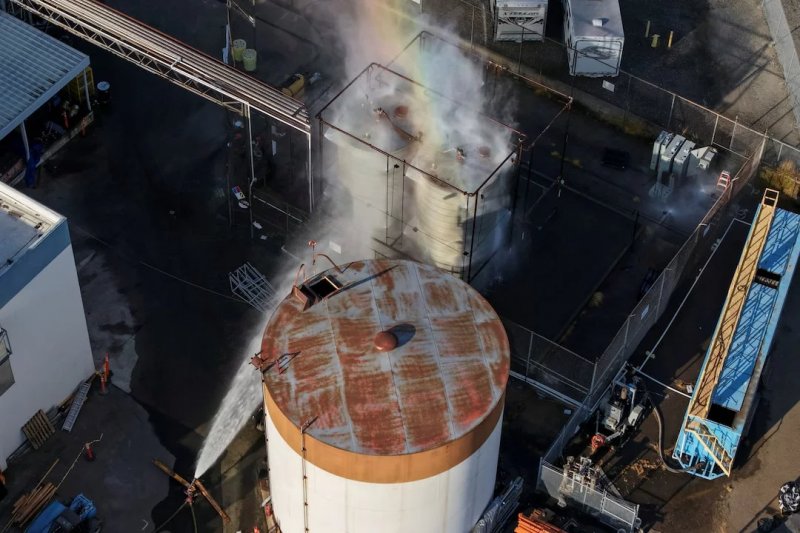
California Governor Gavin Newsom has declared a state of emergency in Orange County as emergency crews raced to cool down a tank containing volatile industrial chemicals at an aerospace manufacturing facility in Garden Grove following an initial leak, News.Az reports, citing Xinhua.
"The safety of Orange County residents is the top priority," Newsom said in a statement, adding that California was deploying all available resources to support responders and affected communities.
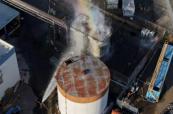
The emergency order allows the state to mobilize additional resources and accelerate coordination among local, state and federal agencies responding to the crisis at the GKN Aerospace plant in Garden Grove, where a tank holding methyl methacrylate (MMA), a highly flammable industrial chemical used in aerospace manufacturing, has remained at an unstable temperature for days.
RECOMMENDED STORIES
- 3.5-magnitude quake hits near Truckee, California
- Thousands evacuated in Southern California over exploding tank threat
- Chemical leak at aerospace facility triggers evacuations in Garden Grove, California - VIDEO
- Meta settles first US case over school costs tied to youth mental health, court filing shows
The situation has grown more urgent as temperatures inside the compromised tank have continued to rise, reaching about 90 degrees Fahrenheit (32.22 degrees Celsius) on Saturday from 77 degrees (25 degrees Celsius) a day earlier.
If it gets too hot, pressure inside the vessel could rise enough to compromise structural integrity, authorities have warned in public briefings. A catastrophic failure could trigger a large spill or an explosion powerful enough to affect surrounding industrial tanks, releasing thousands of gallons of hazardous chemicals.
Both outcomes carry risks of toxic exposure, environmental contamination and secondary fires involving nearby industrial materials. Officials have repeatedly said an explosion remains an unacceptable outcome and that response strategies are focused on preventing one.
"We are working nationally with experts all across the country trying to find the third solution," Orange County Supervisor Janet Nguyen told the Los Angeles Times on Saturday. "Maybe, if possible, the third solution could be to contain the liquid and freeze or maybe turn it into a solid, we don't know."
Emergency crews have used remotely operated hoses, facility sprinkler systems and continuous water application in attempts to lower temperatures without placing firefighters directly in danger.
The original leak began after an overheated storage tank started venting chemical vapors through a pressure-relief system. Conditions initially appeared to stabilize, but later worsened, prompting expanded evacuation orders affecting portions of Southern California.
Containment efforts have broadened beyond cooling. Responders erected sandbag and earth barriers to prevent runoff from entering storm drains, rivers or coastal waters if the tank fails. Hazardous-material specialists from across the country have reportedly been consulted as local agencies search for ways to safely transfer or neutralize the chemical load.
Government air monitoring teams have continued testing around evacuation zones. Officials said they had not identified widespread dangerous concentrations of airborne contaminants outside restricted areas, though they emphasized that changing conditions inside the tank mean risks remain unpredictable.
Health authorities have warned that exposure to concentrated MMA vapors can irritate the eyes and respiratory system and may cause dizziness, nausea or breathing difficulty.
Despite evacuation orders, some residents have declined to leave. Authorities estimated that a portion of affected households remained inside evacuation zones even as officials warned that the tank's condition could deteriorate rapidly. Emergency shelters remain open for displaced residents.
No injuries had been reported as of Saturday, according to company and government statements. GKN Aerospace said community and worker safety remained its priority while engineers and emergency responders continue efforts to prevent what officials fear could become one of Southern California's most serious industrial chemical disasters in years.
Around 50,000 residents in portions of six Southern California cities are still under evacuation orders by Saturday afternoon due to the emergency.
By Nijat Babayev


Similar news