3I/ATLAS shows rare anti-tail as it nears Earth


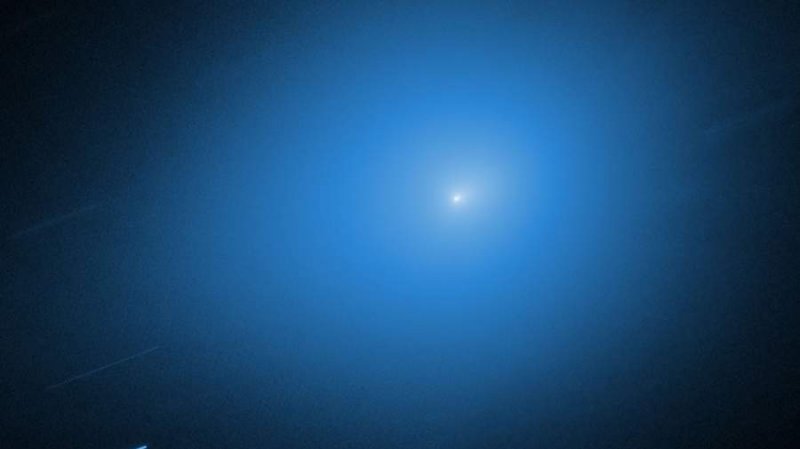
As of December 14, the comet object 3I/ATLAS is approximately 270.5 million kilometers from Earth.
Light from the object takes 15 minutes to reach us, so its images are slightly delayed, News.Az reports, citing foreign media.
On December 19, 2025, 3I/ATLAS will make its closest approach to Earth, at a perigee distance of 269.9097 (+/-0.0060) million kilometers.
The latest image, captured by Teerasak Thaluang on December 13, 2025, at 21:30:26 UTC using a 0.26-meter telescope in Rayong, Thailand, shows a clear anti-tail. This unusual feature, pointing toward the Sun, is uncommon for comets.
While anti-tails have been observed in solar system comets as a temporary perspective effect when Earth crosses the comet’s orbital plane, this explanation does not apply to 3I/ATLAS. Its anti-tail was visible in the first Hubble Space Telescope image taken on July 21, 2025, when the object was approaching the Sun from a geocentric distance of 2.98 AU. The feature remained evident in the second Hubble image taken on November 30, 2025, at 1.91 AU from Earth, as well as in thousands of images captured between these dates.
The persistent anti-tail continues to make 3I/ATLAS a rare and intriguing object as it approaches Earth.
The anti-tail of 3I/ATLAS is therefore not a perspective effect. It is a real physical jet, with a glow extending from 3I/ATLAS towards the Sun. Its nature is a mystery because gas and micrometer-dust particles are expected to be pushed away from the Sun by solar radiation pressure and the solar wind, creating the appearance of a tail — as routinely seen in solar-system comets. There was no mention of this mystery at the NASA press conference about 3I/ATLAS on November 19, 2025 (accessible here).
To explain the physics of the anti-tail of 3I/ATLAS, I have written three scientific papers. The first two of these peer-reviewed papers, co-authored with Eric Keto (accessible here and here), associate the anti-tail with scattering of sunlight by fragments of ice shed from the sun-facing side of 3I/ATLAS. These tiny ice particles evaporate before they get pushed back significantly by the solar radiation pressure and so they never appear as a conventional cometary tail. The third (single-authored) paper, published on December 8, 2025 here, associates the anti-tail with a swarm of objects that lag behind 3I/ATLAS because of its non-gravitational acceleration away from the Sun (as reported by JPL Horizons here). Analysis of the latest Hubble image could potentially favor one of these explanations.


Similar news