Interstellar comet 3I/ATLAS emits first radio signal during solar system passage


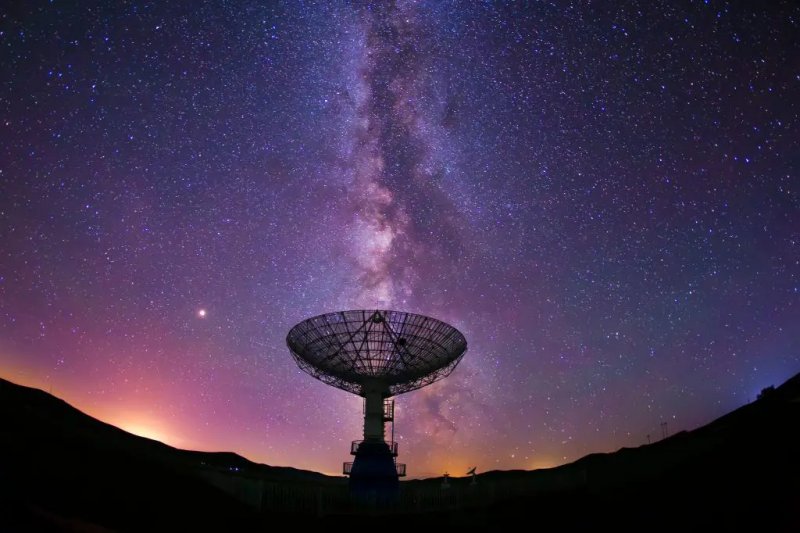
Astronomers have recorded the first-ever radio signal from the interstellar comet 3I/ATLAS as it passed the halfway point of its journey through the solar system.
While some might speculate about alien origins, scientists confirm the signal is entirely natural, News.Az reports, citing Live Science.
3I/ATLAS, the third-known interstellar object (ISO) to enter our solar system, was first observed in early July traveling at over 130,000 mph (210,000 km/h), with earlier observations traced back to May. Researchers believe it is a comet, possibly the oldest ever observed, likely ejected from a distant star system in the Milky Way up to 7 billion years ago.
A small group of scientists, including Harvard astrophysicist Avi Loeb, have suggested without evidence that 3I/ATLAS might be an alien spacecraft. Experts warn that such claims, similar to those made about the first ISO ‘Oumuamua, can mislead the public and detract from the genuine scientific study of interstellar objects.
So, when astronomers at South Africa's MeerKAT radio telescope recently announced that they had detected the first radio emissions from 3I/ATLAS, proponents of Loeb's theory were probably expecting to find evidence of some covert alien transmission, especially as it coincided with the comet's closest approach to the sun, or perihelion, which occurred on Oct. 29.
But the signals did not have a technological origin. Instead, they are the result of specific wavelength absorption related to the presence of hydroxyl radicals, or OH molecules, in the comet's coma.
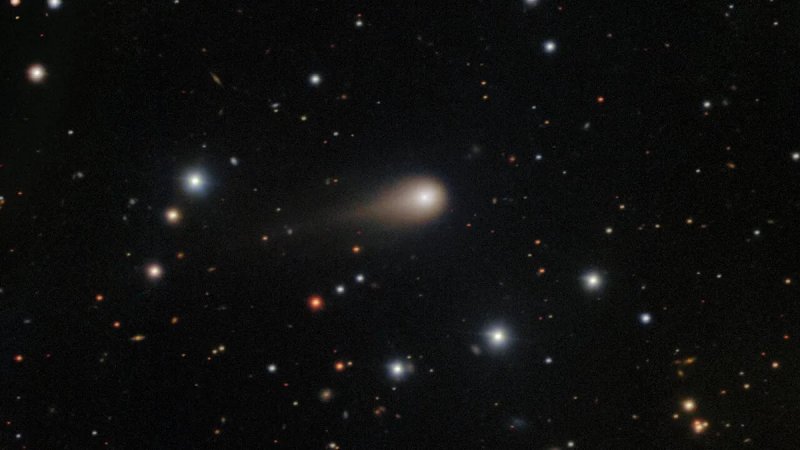 3I/ATLAS has displayed multiple classic signs of cometary activity, including a striking tail that emerged in the build up to its perihelion. (Image credit: International Gemini Observatory)
These radicals are formed by the breakdown of water molecules as they are ejected from the comet via a natural process known as outgassing, which is a clear sign of cometary activity, according to a 2016 study.
This is not the first time that astronomers have seen evidence of water coming from 3I/ATLAS: In early October, NASA researchers spotted water spewing from the comet "like a fire hose" on full blast. But the latest findings show that this water is being broken down by solar radiation —as you would expect during perihelion.
Loeb acknowledged the detection of the hydroxyl radicals in the latest 3I/ATLAS update on his personal blog, which now has over 100,000 subscribers. However, he did not state whether this was a sign of classic cometary activity or not.
The new radio signals were first detected on Oct. 24, shortly after 3I/ATLAS briefly disappeared behind the sun during perihelion. The comet's solar flyby was also notable for an unexpected brightening event and a temporary color change. And after reappearing earlier this month, the comet then appeared to have lost its tail, although this turned out not to be true.
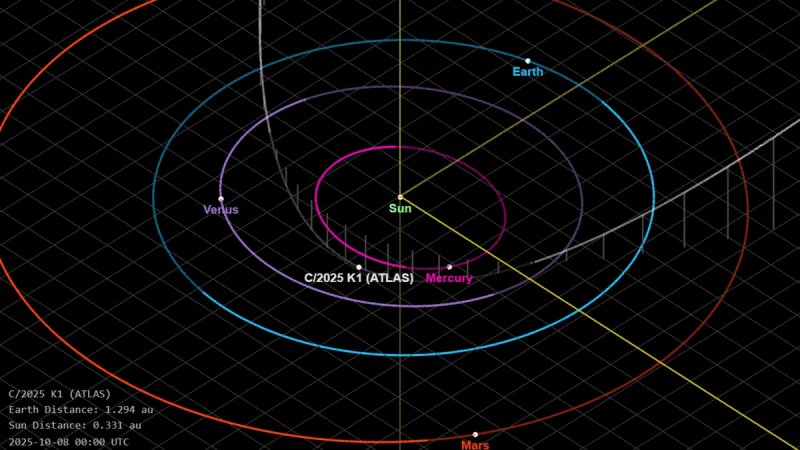 A newly discovered comet, dubbed C/2025 V1 (Borisov), was wrongly linked with 3I/ATLAS, despite having nothing to do with the ISO. It made it reached its closest point to Earth on Tuesday (Nov. 11). (Image credit: NASA/JPL)
The comet has previously displayed several other anomalous characteristics that have added fuel to the fires of alien conspiracy theorists, including a highly irradiated surface, an overabundance of carbon dioxide and a puzzling anti-tail. However, all of these traits have been properly explained by the astronomical community, which is almost unanimously convinced that 3I/ATLAS is a natural object.
A separate yet connected alien theory was also squashed this week when astronomers detected an "almost interstellar object" that reached its closest point to Earth on Tuesday (Nov. 11). Rumors suggested that it could have been a probe deployed by 3I/ATLAS during perihelion, but this was quickly trashed, with even Loeb admitting the claim was unlikely. Instead, the newly discovered object, dubbed C/2025 V1 (Borisov) is a typical solar system comet.
Other reports, which cited Loeb's calculations on 3I/ATLAS's non-gravitational acceleration, also suggested that the comet may have exploded due to its supposedly excessive loss of mass. However, recent observations have proved that this is not the case either.


Similar news