Map reveals growing military presence of NATO and Russia in the Arctic


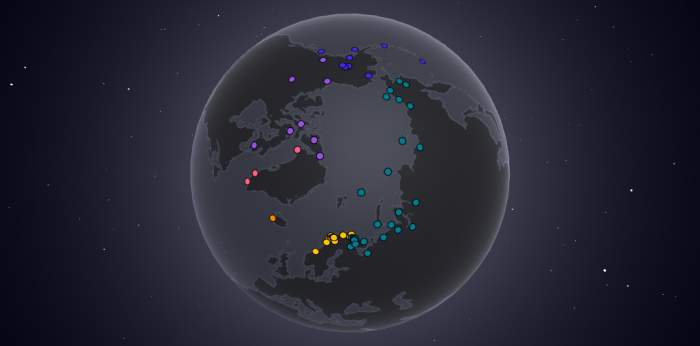
As NATO and Russia expand their influence in the Arctic, the locations of major military bases highlight the growing geopolitical and military competition in the region.
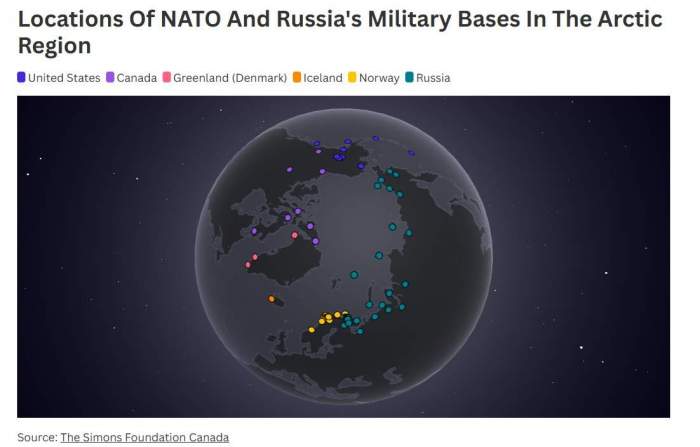
Newsweek's map shows the locations of military bases in the Arctic region, News.Az reports.
The Arctic, once a politically neutral area of the globe, is largely now seen as a geopolitical and military frontier.
Since the start of the Russia-Ukraine war, international peace in the Arctic has been put on hold and now even countries outside of the Arctic Circle, like China, have been showing more interest in the region.
As Arctic ice melts, alternative shipping routes are opening up, which is believed to be behind President Donald Trump's desire to buy Greenland from Denmark.
Based on a report by The Simons Foundation Canada, an association in Vancouver that provides information on nuclear disarmament, international law and security, Russia has 32 "continuously attended military sites" in the Arctic region as of 2024.
Per the report, three sites of the sites, those situated in Franz Josef Land, Kotelny Island, and Wrangel Island are capable of housing up to 150 ground troops each.
Norway has 15 "continuously attended military sites," while the U.S. has 10, Canada eight, Denmark three (situated on Greenland) and Iceland one.
While NATO therefore has five more such sites in total than Russia, Russia has the largest Arctic population of any of the states bordering the Arctic Ocean, The Simons Foundation Canada wrote.
After Russia's invasion on Ukraine in February 2022, international relations in the Arctic were made significantly uncertain, given that Russia was the country that chaired the Arctic Council at the time, Statista reported.
Per the outlet, all Arctic Council member except Russia boycotted the council's meetings, and it only met again in 2023 to establish Norway as its next chair.
More than half the Arctic's coastline is Russian territory and in the last six years Russia has built more than 475 military bases along its northern border, according to The Economist.
Four Arctic experts that spoke to Reuters in 2022 said at the time that it would take the West at least 10 years to catch up with Russia's military in the region.
More recently, China has been expanding it's influence in the Arctic, in what is believed to be a move to challenge American power.
China's move to boost its presence in the polar region could also be part of the country's aim to become a "polar great power," which was something President Xi Jinping mentioned during a speech in November 2014, according to the Australian Policy Institute.


Similar news