UK defense chief says NATO deterrence strategy is ‘working’


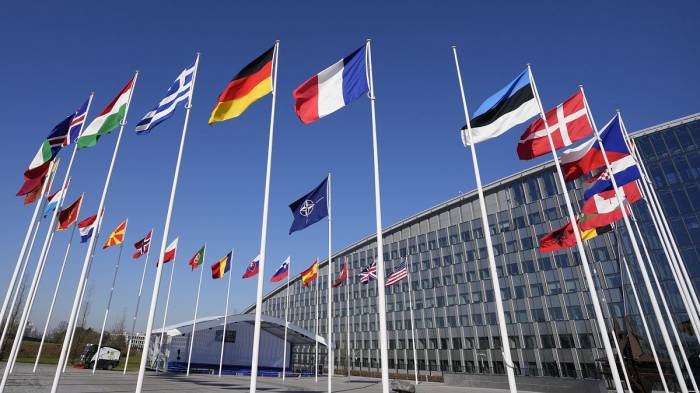
Photo: AP
UK Chief of the Defense Staff, Admiral Sir Antony David Radakin, has stated that the likelihood of Russia attacking Britain or other NATO allies remains low, highlighting that the alliance's deterrence strategy is working.
“Russia knows the response would be overwhelming, whether conventional or nuclear. The strategy of deterrence by NATO works and is working. But it has to be kept strong and strengthened against a more dangerous Russia,” Radakin said during an annual lecture at the Royal United Services Institute (RUSI), the world’s oldest and the UK’s leading defense and security think tank, News.Az reports, citing foreign media.Describing the deployment of North Korean soldiers to the Ukrainian border on the Russian side as “this year’s most extraordinary development,” he said the cooperation between Russia and North Korea could lead to increased trade in technology and expertise between Moscow and Pyongyang.
Radakin said the UK is not facing “an existential threat like Ukraine or Israel.”
“We are protected by our maritime geography and the strength in depth of an Alliance with a landmass stretching from the fringes of the Arctic to the Eurasian steppe.”
He noted that “the security outlook is more contested, more ambiguous and more dangerous than we have known in our careers,” adding “nowhere is this more apparent than in the nuclear domain.”
“The first nuclear age – the Cold War – was defined by two opposing blocs governed by the risk of uncontrollable escalation and the logic of deterrence. The second nuclear age was governed by disarmament efforts and counter-proliferation.
“But we are at the dawn of a third nuclear age which is altogether more complex. It is defined by multiple and concurrent dilemmas, proliferating nuclear and disruptive technologies, and the almost total absence of the security architectures that went before,” he added.
“Nuclear non-proliferation has been one of the great successes of international security since the end of the Second World War but is now being challenged. It has been successful because of states that took their international responsibilities seriously, and those, like Britain and the United States, who were willing to extend their nuclear umbrella to allies and partners and guarantee their security. This must continue,” Radakin said.
He pointed to the steps taken by Iran, North Korea, Russia and China in the nuclear field as global threats.
He also underscored the importance of defense reform, saying the UK is still “too slow, too cautious, too risk adverse.”


Similar news