Armenia between the EU and EAEU: duplicity or political strategy? – INTERVIEW


Photo: Shutterstock
By Asif Aydinly
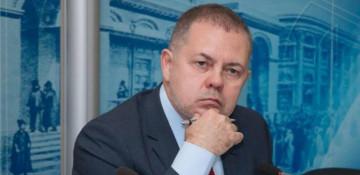
News.Az interview with Deputy Director General of the Russian information and analytical agency “Vestnik Kavkaza,” Andrey Petrov.
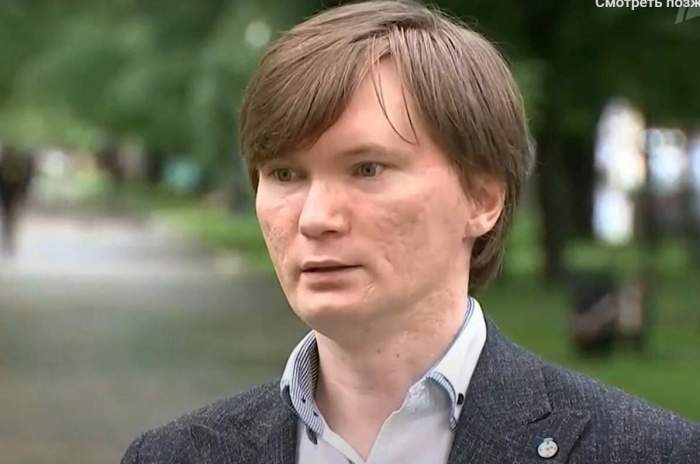
Deputy Director General of the Russian information and analytical agency “Vestnik Kavkaza,” Andrey Petrov.
- The Armenian government has officially approved a draft law initiating the country’s accession process to the European Union, which will be submitted to parliament for consideration. Should the parliament approve it, a referendum on joining the EU will be held in Armenia. How do you assess this step by the Armenian authorities, given that the country is a member of the EAEU and the CSTO?
- I believe that approving the draft law on starting the process of Armenia’s accession to the European Union is a logical new step in Armenia’s policy of double-dealing—trying to extract the maximum possible benefits from both Russia and the West. In pursuing this policy, Nikol Pashinyan’s team follows the rule of preserving as many of Armenia’s existing advantages as possible, while adding as many new benefits as they can from other directions.
In this regard, I do not think that Armenia will jeopardize its membership in the Eurasian Economic Union for the distant prospect of joining the EU in 20–30 years. Membership in the EAEU brings Yerevan direct and tangible daily benefits in real time.
As we know, in 2023 alone, trade turnover between Russia and Armenia reached 7.5 billion US dollars, whereas in 2021 it was only 2.6 billion. By the end of 2024, this figure had doubled again, and it is expected to reach 14 billion dollars once all the statistics are finalized.
Meanwhile, Armenia’s trade with the European Union is significantly lower—by more than an order of magnitude. Naturally, no “rosy dreams” of relocating Armenia to the EU will make Nikol Pashinyan abandon the ongoing economic cooperation with Russia that continues to yield such consistent benefits. Even if he were tempted, I believe his team would restrain him from doing so.
Therefore, when it comes to EU integration, Yerevan will act in a way that does not undermine its membership in the EAEU. We can anticipate that, after some time, the Armenian parliament will pass this draft law, a referendum will be held, and it is even possible that Armenian citizens may vote in favor of EU integration.
However, I see the chances of such a vote succeeding at about fifty-fifty, because Armenians are well aware of Georgia’s example: although Georgia appeared to integrate into the EU, it later faced aggressive pressure, threats, and sanctions from European institutions. Politicians will push their objectives, but the people might look at that situation and decide that this kind of EU is not what they want. On the other hand, they might think, “Perhaps we Armenians will manage it better than the Georgians did.”
After that, the Armenian government would adopt a roadmap for EU integration. First, they would need to obtain candidate status, for which even Georgia fought for a long time. Then it would take many years of meeting EU requirements to qualify as a candidate. Some of these requirements will prove unworkable for Armenia, because they would necessitate transitioning from post-Soviet economic, legal, and even military standards to EU standards. Armenia simply will not be able to do this without ceasing to meet EAEU standards—and consequently being unable to continue its participation in the EAEU.
Those particular requirements will remain unachievable. Throughout this process, Nikol Pashinyan will keep emphasizing to European politicians that Armenia is ready for all kinds of Western integration and will demand the maximum it can get in return.
I think Armenia’s genuine “maximum plan” for EU integration at this time is probably gaining visa-free travel for Armenian citizens—much as Georgia did. It is unlikely that Armenia expects its products to sell well in European markets, because it does not produce anything unique that the EU needs and cannot already supply on its own or procure from elsewhere. Existing Armenian exports to the EU will not fundamentally change because of any new arrangement.
- Armenian Prime Minister Nikol Pashinyan posted his proposals for achieving peace with Azerbaijan on social media, noting that the peace agreement is 90% ready. What do you think lies behind this step?
- It is extremely important that Pashinyan’s standard statements—of which he makes plenty every week—are followed by real diplomatic steps to finalize the text of the peace agreement. In response to President Ilham Aliyev’s recent press conference, Pashinyan essentially echoed part of Azerbaijan’s demands, claiming them as his own proposals, when in fact they were originally initiated by Azerbaijan.
It’s good that he supports them, but it is equally important that he carry them out in practice, rather than just leave them on paper. It is also fundamentally important that Armenia not only agrees to the principle of no territorial claims, but that it also fulfills its obligations to open communications in the manner specified in international documents—and that it unequivocally removes territorial claims to Karabakh from its constitution.
Currently, the biggest sticking point is that Nikol Pashinyan says he agrees to the initiatives put forward by Ilham Aliyev but avoids tackling the root cause of the conflict, which is still enshrined in the Armenian constitution. Without removing that root—where it is written in black and white about “the aspiration to reunite Karabakh with Armenia”—there can be no real progress in the peace process. Baku knows perfectly well that Pashinyan’s words mean nothing if another Armenian government comes to power and claims that the constitution carries more weight than any international documents. Such a new administration might then attempt to reignite a war. Naturally, Baku wants to prevent this scenario.
A peace treaty should definitively establish normal relations between the two countries. On the one hand, it is good that Pashinyan supports Azerbaijan’s peace initiatives; on the other hand, one hopes for real, concrete steps toward peace—steps that Azerbaijan deems essential.
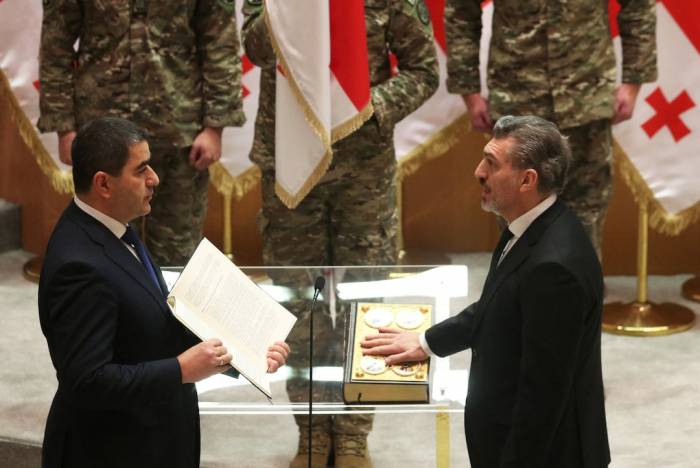
Mikheil Kavelashvili, elected by lawmakers as Georgia's new President, takes the oath during his swearing-in ceremony at the parliament in Tbilisi, Georgia on December 29, 2024. Photo: Reuters
- How do you assess the current domestic political situation in Georgia?
- In Georgia, following the election of the new President Mikheil Kavelashvili and Salome Zurabishvili’s peaceful step back from attempts to remain in the presidential residence, the situation has fully stabilized. There are still nightly protest actions, but they are small and non-violent—nothing like what we saw a month and a half ago.
This stabilization is primarily due, in my opinion, to a change in tactics by the EU officials who support the Georgian opposition. They realized that they could not simply topple the current Georgian government, nor provoke an excessive security crackdown that might trigger wider public outrage. Hence, it is no longer worthwhile for them to spend money on backing provocations and protests.
I believe Europe is reviewing its approach to dealing with the ruling Georgian Dream party. On one hand, pressure will certainly continue; in the near future, the European Parliament is expected to adopt a new resolution calling explicitly on Georgian Dream to join the fight against Russia. Georgia, of course, will reject this resolution, as it has all previous ones. On the other hand, there will likely be more systematic attempts to normalize relations with Georgia, given that bringing down the current leadership before the next election cycle has proven impossible. The EU needs to work with whoever is in power or risk losing Georgia entirely.
After all, every previous political attack on the Georgian government was motivated by the EU’s desire to keep Georgia within Europe’s sphere of influence on its own terms. That goal hasn’t changed—maintaining Georgia in Europe’s orbit remains essential. If a “hardline” approach fails to remove Georgian Dream and reinstall supporters of former President Mikheil Saakashvili, then the EU must engage with the existing authorities. Therefore, I think everything will remain relatively stable in Georgia in 2025.
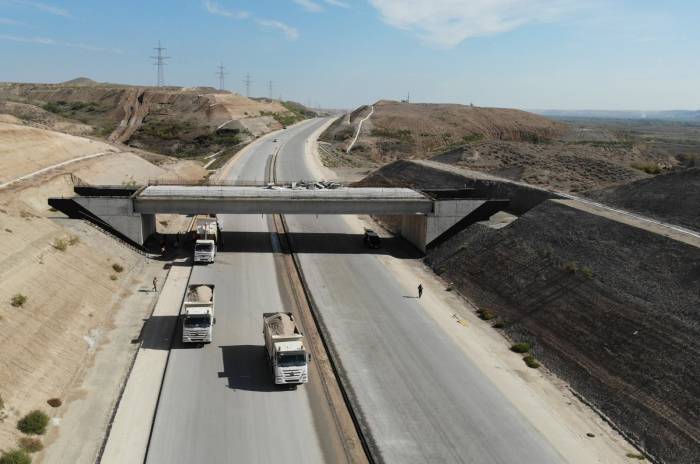
Aerial view of ongoing works on a section of Zangezur Corridor, Azerbaijan, Jan. 9, 2024. Photo: Anadolu Agency
- In his latest interview with local TV channels, Azerbaijani President Ilham Aliyev stated that the Zangezur Corridor must and will be opened. How would you comment on this?
- President Ilham Aliyev’s statement about the inevitability of opening the Zangezur Corridor has two dimensions.
First, there must be a route from the Zangilan region to Nakhchivan via Iranian territory. Recently, Secretary of the Supreme National Security Council of Iran, Ali Akbar Ahmadian, visited Baku, and it appears that the parties discussed organizing transportation between Nakhchivan and the Zangilan region through Iranian territory.
As far as I know, bridges and roads are already under construction in the Zangilan region. The remaining task is to negotiate the construction of a railway line passing through Iran. Most likely, Azerbaijan will handle that construction, because Iran is not in a position to bring its railway equipment to that specific region, while Azerbaijan can do so. All of this needs to be formally agreed upon, and I am 100% sure it will be implemented.
Despite the recurring challenges in Iran-Azerbaijan relations, I believe this project will move forward because it benefits not only Baku but also Tehran, by bolstering Iran’s economic and logistical participation in the South Caucasus. That was one of Tehran’s main goals after the end of the Karabakh war.
The second aspect of Ilham Aliyev’s statement is that Armenia will not be able to open any communication routes with Azerbaijan in any form if it does not complete its own section of the Zangezur Corridor and put it into operation. Aliyev is emphasizing that Armenia has an obligation—enshrined in the trilateral statement of November 10, 2020, which Armenia signed along with Azerbaijan and Russia—to open this section.
That agreement has not been rescinded. Armenia, regardless of what Nikol Pashinyan or any other Armenian officials say, is still obligated to open that route. If it fails to do so, then there will be no communications between Armenia and Azerbaijan whatsoever. Baku will simply utilize the Iranian route to access Nakhchivan, and Armenia will remain isolated as before.
If Armenia does not open communications with Azerbaijan, it also will not be able to open communications with Turkiye. In other words, Ilham Aliyev is warning Yerevan that if Armenia does not fulfill its obligations, no one will unilaterally uphold theirs either.
There will be no room for any goodwill gestures toward Armenia if that country itself shows no goodwill and does not do what it is obliged—and could easily—do for its neighbors.


Similar news