The war that will change the world




Editor's note: Moses Becker is a special commentator on political issues for News.Az, a PhD in political science and an expert on interethnic and interreligious relations. The article expresses the personal opinion of the author and may not coincide with the view of News.Az.
At 3 a.m. on June 13, 2025, just days before the sixth round of negotiations on Iran’s nuclear program scheduled for June 15 in Oman, the Israeli Air Force launched a massive bombing campaign targeting the Islamic Republic’s uranium enrichment facilities. According to IAEA Director General Rafael Grossi, Tehran had reached the threshold required to produce weapons-grade plutonium sufficient for nine nuclear bombs. This development triggered a long-anticipated strike against Iran, whose leadership has repeatedly threatened to annihilate the State of Israel. A striking symbol of this hostility is a large clock in the center of Tehran counting down the lifespan of the “Zionist entity.” Since the Islamic Revolution, the destruction of the Jewish state has been a foundational pillar of the Ayatollahs’ regime.
Israel had been preparing for this operation for many years. The planning intensified significantly after Donald Trump was elected the 47th President of the United States in 2024. The nuclear talks had stalled from the outset, as it became clear that Iran’s leadership would not abandon its missile and nuclear ambitions—doing so would threaten the very foundation of the regime. Israeli intelligence agencies conducted extensive work to identify nuclear sites, build a network of informants inside Iran, and disseminate disinformation.

Source: BBC
In the days leading up to the strike, misleading signals were sent: it was announced that Prime Minister Benjamin Netanyahu was flying to the U.S. to attend his son’s wedding, and the Knesset suddenly introduced a vote of no confidence in the government—suggesting a possible change of leadership. Clearly, the American president was aware of the impending attack. Analysts believe that the statements made by U.S. and Israeli leaders were more likely part of a smokescreen to confuse Tehran rather than evidence of disagreement between Jerusalem and Washington.
On the night of the strike, 200 Israeli fighter jets carried out a preemptive attack on Iranian territory. According to the IDF, more than 100 targets related to Iran’s nuclear program were hit. The operation also eliminated several high-ranking Iranian military officials, including IRGC commander Hossein Salami and Chief of Staff Mohammad Bagheri, as well as six top nuclear scientists. Iran confirmed that its uranium enrichment facility in Natanz had been damaged. The IAEA reported that the nuclear sites in Fordow and Isfahan remained intact, although two explosions were later heard near Fordow.
In retaliation, Iran is expected to target U.S. assets in the Middle East. However, given the current circumstances, Tehran is unlikely to spread its forces thin and provoke a direct U.S. intervention. Only Washington possesses the bombers and specialized bunker-busting munitions capable of destroying Iran’s deepest nuclear facilities—particularly the Fordow plant. Given its limited military capabilities, Tehran will likely avoid provoking neighboring countries, most of which are under the protection of U.S. forces.
Source: Reuters
There is, of course, the risk that Iran might attempt to block the Strait of Hormuz, thereby disrupting oil shipments to Europe. But such a move would likely prompt NATO countries, led by the U.S., to use force to defend freedom of navigation. A modest increase in oil prices is already being observed, fueling inflation—a deeply unwelcome development for European economies. It is no coincidence that the UK and France have expressed readiness to support Israel should the conflict escalate.
Given the above, the situation for Iran’s leadership is now critical—especially in light of its declining domestic legitimacy. Should hostilities continue, the collapse of the Ayatollahs’ regime and the rise of new leaders willing to negotiate with the West becomes a real possibility. On social media, Iranians are increasingly referencing Reza Cyrus Pahlavi, heir to the Iranian throne, and enthusiastically sharing images from the wedding of his daughter, Princess Iman.
Recently, Israeli Prime Minister Benjamin Netanyahu addressed “the proud people of Iran,” recalling the long-standing history between Jews and Persians. He declared that Israel’s attack was “clearing the path to freedom” from “an evil and despotic regime.” The potential fall of the Iranian government could be welcomed by many regional actors—especially Lebanon, Syria, the UAE, Bahrain, and others. The disappearance of the Islamic regime would profoundly transform not only the Middle East but the entire global geopolitical landscape.
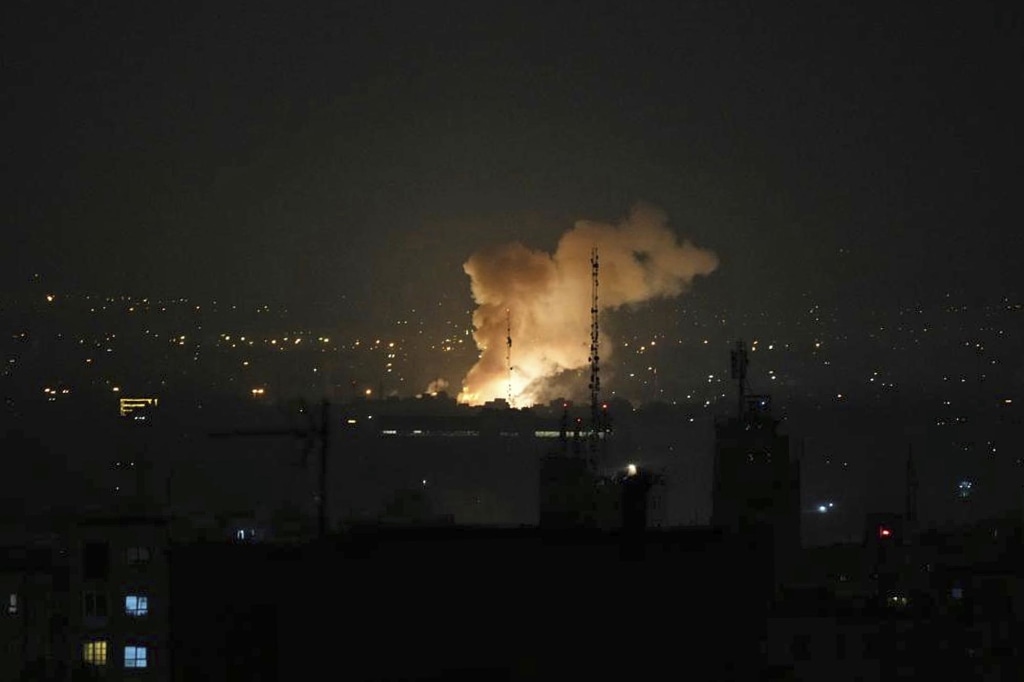
Meanwhile, the war continues. Both sides are trading blows, resulting in casualties among both Iranians and Israelis. In the third wave of strikes, Iranian missiles hit Tel Aviv, Ashdod, and Bat Yam. A total of 61 buildings were damaged—six beyond repair and slated for demolition. According to the IDF, Israel responded with attacks on military targets inside Iran. The Israeli Air Force also bombed the Shahran oil depot in the north and a fuel base in southern Tehran, both of which were engulfed in massive fires.
Local sources report that Israeli forces struck the homes of IRGC commanders in Tehran’s Mehlati neighborhood. Additional strikes targeted Tehran’s suburbs of Chitgar and Sadr, where the sounds of jets and bomb explosions were heard. Tehran’s air defenses engaged in repelling a large drone attack, according to Clash Report. Iranian media also reported a powerful explosion in Karaj, hitting IRGC camps—possibly killing two IRGC commanders.

Source: NDTV
According to Al Jazeera, the supreme leader of Iran, Ayatollah Ali Khamenei, may have been the primary target of the current operation. Meanwhile, Tasnim News claims that Israel’s strikes on Tehran were aimed at the headquarters of Iran’s Ministry of Defense, with one of the buildings sustaining minor damage.
The airstrikes also ruptured Tehran’s sewage and water systems, flooding parts of the city. The Israeli Air Force reportedly damaged the Ministry of Justice building and other infrastructure sites. According to The Washington Post, Syria, Jordan, and Iraq closed their airspace following Iran’s missile attacks on Haifa. Lebanon canceled flights after Iranian projectiles were spotted over Beirut. The same applies to Israeli civilian aviation—many citizens are currently unable to return home.
Axios reports that Israel may have requested U.S. military involvement to destroy Iran’s nuclear program, although the accuracy of this claim remains unconfirmed. It is important to note, however, that ahead of the conflict, the United States had supplied Israel with a significant quantity of weapons and munitions. As such, Israel has the resources to bring down the Ayatollahs’ regime and reshape the region in favor of peace, cooperation, and prosperity.
(If you possess specialized knowledge and wish to contribute, please reach out to us at opinions@news.az).


Similar news