France needs Armenia as an anti-Russian platform, not an equal partner


Editor’s note: Zaur Nurmamedov is a journalist and a graduate of the Faculty of Political Science at the Academy of Public Administration under the President of the Republic of Azerbaijan (1993–1999). He previously served as first deputy editor-in-chief of the Vesti.Az news portal (2009–2023). The views expressed in this article are his own and do not necessarily reflect the position of News.Az.
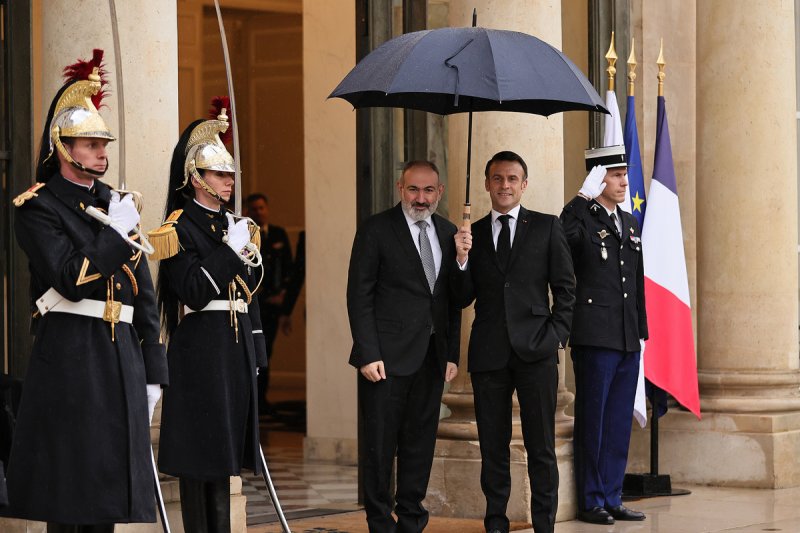
French President Emmanuel Macron’s state visit to Armenia from 3 to 5 May was presented in Yerevan as a major political moment — perhaps even the beginning of a “new era” in Armenia’s relationship with Europe. The timing was certainly symbolic. Armenia had become the venue for high-profile international events, hosting both the European Political Community summit and the first Armenia–EU summit. Against this backdrop, Macron’s arrival was carefully staged as a demonstration of European attention, French support, and Armenia’s supposed geopolitical transformation.
But behind the ceremonies, warm words, and public gestures, the visit raised a more serious question: what exactly did France bring to Armenia beyond political theatre?
RECOMMENDED STORIES
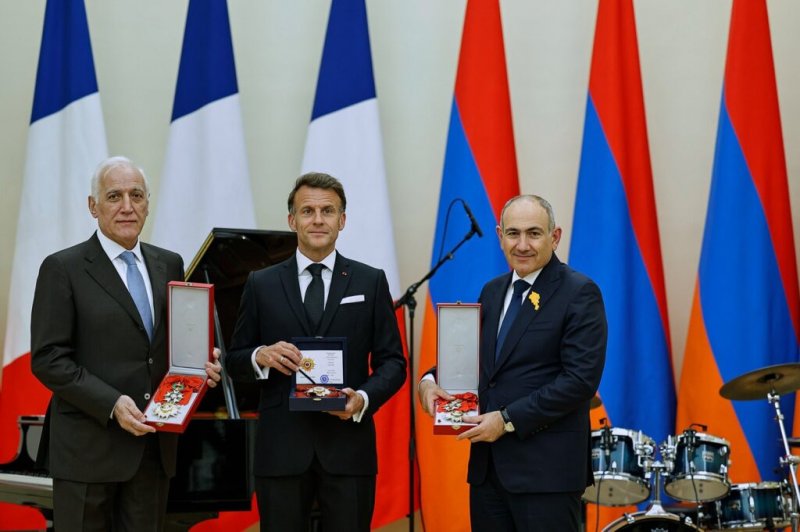
During the trip, Macron visited Yerevan and Gyumri, held meetings with Armenia’s leadership, walked through the capital, sang Charles Aznavour’s songs, received an order, and was warmly welcomed by the public. The atmosphere was almost triumphal. In Armenia, the French president appeared far more comfortable than he often does at home, where his policies continue to face strong criticism from large sections of French society. In Yerevan, by contrast, Macron was greeted with open arms and treated almost as a saviour figure.
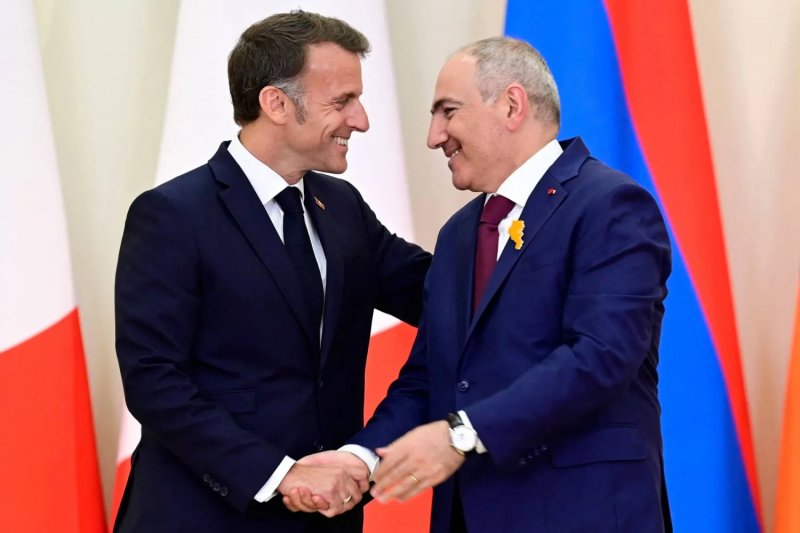
It was in this emotional setting that Macron spoke of a “new era” in Armenia’s relations with Europe. He also declared that Armenia had consciously chosen a European path “from Iceland to the Caucasus.” The phrase sounded impressive, but it also revealed the core problem of the visit: there were many grand statements, but very few concrete answers.
Macron’s remarks at the EPC summit were particularly revealing. “Eight years ago, many saw Armenia as a country heavily dependent on Russia, whose security was entirely in Russian hands,” he said. In doing so, the French president effectively acknowledged what Azerbaijani President Ilham Aliyev had long argued: that Armenia had for years functioned as Russia’s outpost in the South Caucasus.
However, Macron did not stop there. He stated that France had always considered, and would continue to consider, it its duty to stand by Armenia, guided by the “principle of justice.” This raises an obvious question: what kind of justice is Paris referring to?
Where was this “justice” when France, as a co-chair of the OSCE Minsk Group, failed for decades to take a balanced position during Armenia’s occupation of Azerbaijani territories, despite UN Security Council resolutions? Where was this justice when the French Senate, on 25 November 2020, adopted a resolution condemning Azerbaijan’s “military aggression” and calling for the withdrawal of Azerbaijani forces from what it described as “occupied” Armenian territories? Where was this justice when, in September 2023, France pushed for an emergency UN Security Council meeting over the situation in Karabakh, and when, on 17 January 2024, the French Senate called on the EU to impose sanctions against Azerbaijan?
This looks less like a principle of justice and more like a principle of political bias.
France’s openly pro-Armenian position did not help the peace process. On the contrary, it encouraged Yerevan to delay difficult decisions and complicated negotiations with Baku. That is why Macron’s references in Yerevan to France’s possible role as a “mediator” sound unconvincing. Paris cannot claim to be an honest broker while consistently taking one side.
Armenia’s current path towards peace was not born from Macron’s diplomacy. It was the result of a new regional reality created after the Second Karabakh War. Armenia did not choose peace in ideal political conditions; it was forced to accept the consequences of military defeat. Azerbaijan resolved the Karabakh issue and changed the geopolitical situation in the South Caucasus. This is what opened the door for Armenia to rethink its foreign policy and move closer to Europe.
Macron may now try to present himself as one of the architects of Armenia’s turn away from Russia, but this is not the case. France did not create the new regional reality. Azerbaijan did.
There is also another dimension that cannot be ignored. Under Macron, France’s geopolitical position has weakened considerably, especially in Africa, where Paris has lost influence while Türkiye and Russia have strengthened their presence. Against this background, Armenia appears useful to Macron as a new platform through which France can compensate for its shrinking influence elsewhere.
In other words, Armenia is not only a partner for France. It is also a tool.
Macron is positioning France as a security guarantor for Armenia and as an alternative to Russian influence. He openly supports Yerevan’s turn towards Europe and speaks about reducing Armenia’s dependence on Moscow. But the message is clear: Armenia is valuable to Paris primarily to the extent that it distances itself from Russia. France does not need a fully sovereign and balanced Armenia as much as it needs another anti-Russian platform in the South Caucasus.
This is a dangerous approach. It risks pulling Armenia into geopolitical processes whose agenda is not shaped in Yerevan, but in external centres of power.
Macron’s comments before his visit made this even clearer. He called on the European Union to help Armenia protect its borders without Russian troops. “We pretend this does not exist, but there are still 4,000 Russian soldiers on the territory of Armenia, and therefore more than 1,000 border guards. That is why Europe must commit itself to helping this country protect its borders more independently,” Macron said.
The statement sounded bold, but it also exposed the gap between French rhetoric and Armenian reality. Russia still has deep influence in Armenia. Russian forces remain present in the country. Moscow retains major leverage over Armenia’s security and critical infrastructure. Armenia’s economy also remains closely tied to Russia. These are not minor details — they are structural realities.
That is why, while Macron speaks about replacing Russia’s role on Armenia’s borders, Prime Minister Nikol Pashinyan does not appear ready to fully embrace this agenda. He understands perfectly well how dependent Armenia remains on Russia — economically, militarily, and infrastructurally.
During the visit, Macron signed a declaration on strategic partnership between France and Armenia, covering long-term cooperation in political, economic, and defence spheres. On paper, this may look significant. But Armenia has seen such documents before. In January 2025, Yerevan and Washington signed a Charter on Strategic Partnership, also presented as a major milestone. Yet soon afterwards, the document appeared to lose political momentum.
There is a risk that the new France–Armenia declaration may follow the same path: a loud announcement, impressive wording, and limited implementation.
The most sensitive issue remains security. France has already supplied weapons to Armenia, and Paris played an important role in supporting the EU monitoring mission in Armenia. But these steps did not necessarily strengthen peace. Instead, they contributed to renewed expectations in Yerevan that external powers might help Armenia revise the post-war balance. Such expectations are risky. They can revive revanchist thinking and create obstacles to a final peace agreement with Azerbaijan.
That is why Macron’s claim that France supports peace sounds deeply contradictory. A country that arms one side, politically pressures the other, and consistently frames the conflict through one-sided narratives cannot easily present itself as a neutral supporter of stability.
Macron’s visit to Armenia was rich in symbolism, ceremony, and emotional language. It produced powerful images, warm speeches, and another strategic document. But it did not answer the most important questions.
Can France replace Russia as Armenia’s real security guarantor? Can Paris cover Armenia’s economic needs if Yerevan truly distances itself from Moscow? Can the EU offer Armenia a realistic integration path, or is it merely offering geopolitical encouragement without practical guarantees? And most importantly, will France support genuine peace in the South Caucasus, or will it continue turning Armenia into a platform for confrontation with Azerbaijan, Türkiye, and Russia?
For now, Macron has left these questions unanswered.
(If you possess specialized knowledge and wish to contribute, please reach out to us at opinions@news.az).


Similar news