‘Alien battleship’ makes closest approach to Earth


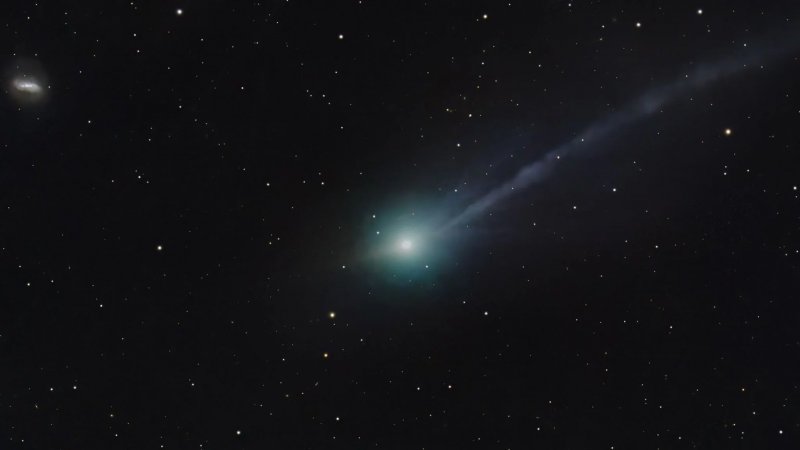
A Harvard University astrophysicist has ignited intense debate after saying he cannot rule out the possibility that extraterrestrials are visiting Earth, News.Az reportc, citing the Sky News.
A mysterious object that a controversial scientist claims could be an alien battleship reached its closest point to Earth on Friday.
The object, known as 3i/ATLAS, passed by at 130,000mph, at a distance of 170 million miles, roughly twice as far away as the sun.
While there is near consensus among astronomers that the object is a comet from outside our solar system, a Harvard University astrophysicist has sparked a furious debate by warning he cannot rule out that extraterrestrials are paying us a visit.
Professor Avi Loeb told Sky News that humanity should be on high alert for what may be a "black swan event" - something that's highly unlikely but has high consequences and might have been foreseen.
"Alien technology is a potential threat because when you go on a blind date of interstellar proportions, you never know whether you have a friendly visitor as your dating partner or a serial killer," he said.
"When there are implications to society, we must consider even an unlikely event and collect as much data as possible to convince us otherwise."
Professor Loeb said images of the object show it has an unusual tail that could come from a propulsion system, nickel in its gas cloud could be evidence of metal mining on its surface, and its trajectory, aligned with the orbits of planets in our solar system, was too unlikely to be by chance.
3i/ATLAS was first spotted in July as a distant dot of light against the starry canvas of the cosmos.
But it has moved rapidly through the solar system, passing Mars in early October, disappearing briefly behind the sun, and after coming close to Earth's orbit, flew by Jupiter before fading from view again.
The US and European space agencies have trained cameras from a dozen spacecraft on the object, and they say there is no doubt its origins are completely natural.
Amit Kshatriya, from NASA, said: "This object is a comet. It looks and behaves like a comet. All evidence points to it being a comet."
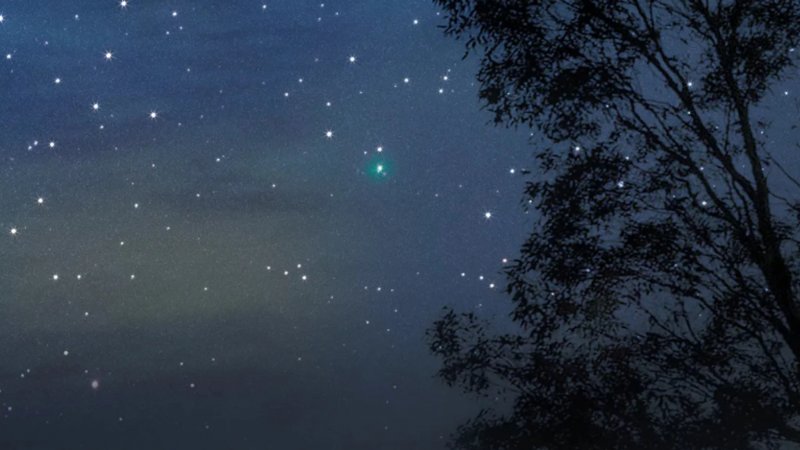
Scientists estimate the comet is around eight billion years old, twice the age of our sun and solar system, and is a cosmic fossil left over from the formation of an unknown star in the galaxy.
Professor Chris Lintott, an astronomer from the University of Oxford, told Sky News that there was nothing sinister about the object.
"It is just nonsense," he said. "It's like saying we should consider the possibility that the moon is made of cheese.
"You could consider that possibility if you like, but my first question is why would you think that?"
He said the comet's changing colour and brightness can be explained by the sun heating pockets of ice and different materials that it's picked up on its epic journey through the stars.
"There is nothing this thing has done that we haven't seen elsewhere," he said.


Similar news