Russia starts producing Shahed-238 turbofan-powered drones


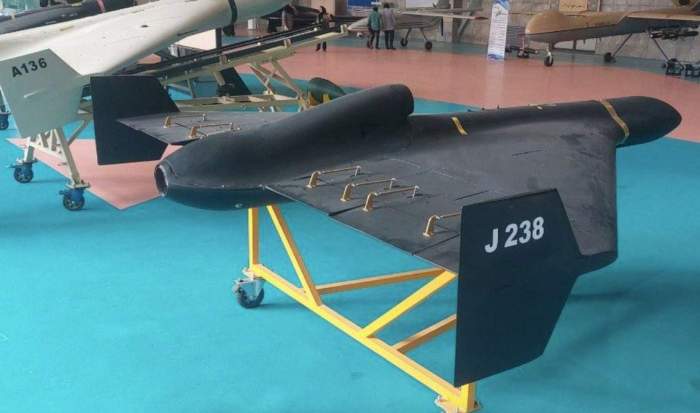
According to Ukrainian intelligence, Russia has started the local production of Iranian Shahed-238 kamikaze drones, which have been rebranded as Geran-3.
The Ukrainians suggest that these drones are equipped with a twin-spool turbofan engine, giving them a range of up to 2,500 km and a top speed of 600 km/h. This makes them extremely difficult to intercept for Ukraine’s mobile air defense teams, which rely on anti-aircraft machine guns and autocannons, News.Az reports citing foreign media.
The first recorded use of the Shahed-238, likely a test launch, took place in January 2024, but no further strikes have been reported since. Leaked documents from Russia’s Alabuga SEZ industrial hub reveal plans for domestic production of various Shahed-238 variants.
The Shahed-238 kamikaze drone represents a significant evolution in Iran’s unmanned aerial vehicle [UAV] technology, particularly noted for its integration of a jet engine over traditional propeller systems.
Unveiled in November 2023 by the Islamic Revolutionary Guard Corps during an aerospace exhibition, this drone has sparked considerable interest due to its potential military applications and its implications for international security dynamics.
The Shahed-238 is essentially an advanced variant of the Shahed-136, which has been widely used in conflicts, particularly by Russian forces in Ukraine.
What sets the Shahed-238 apart is its turbojet propulsion system, which significantly boosts its speed and maneuverability compared to its piston-engine predecessors. The drone’s design is streamlined, maintaining a delta-wing shape but adapted for the increased airflow demands of jet propulsion.
This drone is powered by either the Toloue-10 or Toloue-13 micro-turbojet engines, which enable it to reach speeds of up to 500 km/h, although there are claims from Russian sources suggesting it can achieve speeds up to 800 km/h during a dive.
This substantial increase in speed over the Shahed-136, which tops out at about 180 km/h, poses a new challenge for air defense systems. However, this speed comes at the cost of reduced range and increased thermal signature, making it potentially more vulnerable to infrared-guided missiles.
Three distinct variants of the Shahed-238 have been observed, each tailored for different operational profiles. The first variant employs a basic GPS and GLONASS-based inertial navigation system, similar to that of the Shahed-136, primarily for striking fixed targets. This model focuses on cost-effectiveness, aiming to deliver precision strikes with minimal guidance technology.


Similar news