How large is India's defence export sector today?


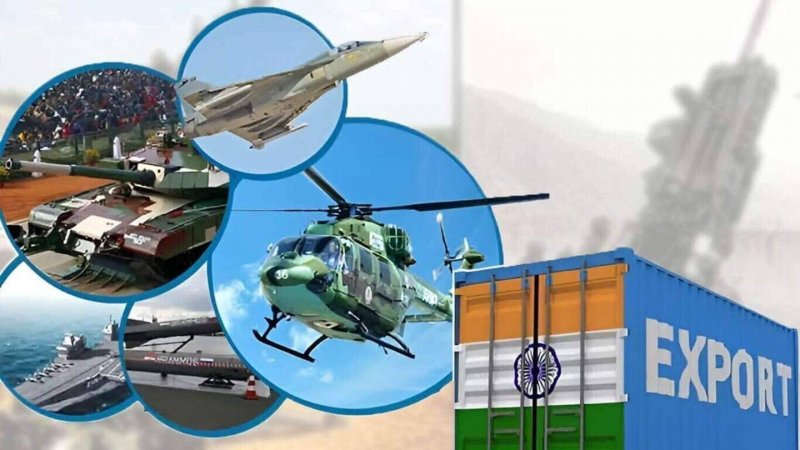
Indian Defence Minister Rajnath Singh has made an ambitious prediction: India could emerge as the world's largest arms exporter within the next 25 to 30 years.
While such a goal may appear distant given today's realities, the statement reflects a profound shift in India's strategic thinking, industrial policy and geopolitical ambitions, News.az reports.
For decades, India was known primarily as one of the world's largest importers of military equipment. Today, New Delhi wants to transform itself into a producer, innovator and exporter capable of competing in an increasingly crowded global defence market.
The central question is whether India can follow a trajectory similar to that of China and eventually become a major military-industrial power in its own right.
Why is India talking about becoming a major arms exporter now?
The statement reflects broader changes underway in India's defence sector.
For years, India relied heavily on foreign suppliers for advanced military technologies, purchasing equipment from countries such as Russia, France, the United States and Israel. While these partnerships remain important, Indian policymakers increasingly view dependence on foreign weapons as a strategic vulnerability.
The goal is no longer simply to strengthen military capabilities.
The objective is to build an indigenous defence ecosystem capable of:
-
Designing advanced weapon systems
-
Manufacturing military equipment domestically
-
Reducing import dependence
-
Creating high-technology jobs
-
Generating export revenue
-
Expanding geopolitical influence
The announcement came during the inauguration of a major ammunition manufacturing facility in Maharashtra, highlighting the government's intention to expand private-sector participation in defence production.
Why is the private sector so important to India's strategy?
One of the most significant differences between India's current approach and its historical model is the growing role of private industry.
For decades, India's defence production was dominated by state-owned enterprises. While these institutions remain important, New Delhi increasingly believes innovation and efficiency require broader participation from private companies.
The government aims to increase private-sector involvement significantly, creating a more competitive military-industrial ecosystem.
The strategy combines:
-
State-owned defence companies
-
Private industrial groups
-
Technology startups
-
Research institutions
-
Foreign joint ventures
-
Military procurement agencies
Officials hope this integrated model will accelerate innovation while reducing bureaucratic delays that have historically affected many defence projects.
How large is India's defence export sector today?
India remains a relatively modest arms exporter compared with global leaders.
However, growth has been substantial.
Defence exports reportedly exceeded 23,600 crore rupees during the 2024–2025 financial year, equivalent to roughly $2.7–2.8 billion.
Although this remains far below export levels achieved by countries such as the United States or China, the trend is encouraging from New Delhi's perspective.
Over the past decade:
-
Export volumes have risen sharply
-
New international customers have emerged
-
Domestic production capabilities have expanded
-
Defence manufacturing has become a national priority
India has also established ambitious targets for further growth by the end of the decade.
Why is China the most relevant comparison?
China offers perhaps the most instructive example of military-industrial transformation.
Several decades ago, Beijing depended heavily on imported Soviet and Russian technology. Over time, China invested heavily in domestic research, manufacturing infrastructure and technological development.
Today China produces:
-
Advanced fighter aircraft
-
Unmanned aerial systems
-
Ballistic missiles
-
Air-defence systems
-
Naval vessels
-
Armoured vehicles
-
Electronic warfare platforms
More importantly, China exports these systems to countries across Asia, Africa, Latin America and the Middle East.
Its transformation demonstrates how a country can evolve from importer to major exporter through sustained investment and industrial planning.
Can India realistically replicate China's success?
Not entirely.
While both countries seek greater defence self-sufficiency, their development models differ substantially.
China's military-industrial rise was characterized by:
-
Strong state control
-
Centralized planning
-
Massive government financing
-
Rapid industrial mobilization
-
Extensive manufacturing capacity
India is pursuing a different path.
Its model relies on:
-
Democratic governance
-
Private-sector participation
-
International partnerships
-
Joint production agreements
-
Technology transfers
-
Competitive industrial development
Rather than copying China's state-command system, India seeks to build a more decentralized and market-oriented defence ecosystem.
What advantages does China still possess?
China retains several significant advantages.
Industrial scale
China's manufacturing base remains substantially larger.
This allows Chinese producers to:
-
Manufacture equipment more quickly
-
Achieve lower production costs
-
Scale production efficiently
-
Fulfil large orders rapidly
Integrated supply chains
Chinese defence companies benefit from extensive domestic industrial networks that reduce dependence on foreign suppliers.
Export infrastructure
Beijing has developed sophisticated mechanisms for supporting overseas customers through:
-
Training programs
-
Maintenance services
-
Financing arrangements
-
Infrastructure development
-
Long-term support contracts
These capabilities make Chinese defence products attractive to many developing countries.
What advantages does India possess?
Although India cannot yet match China's manufacturing scale, it enjoys several strategic advantages.
Political flexibility
India maintains productive relations with multiple geopolitical camps simultaneously.
New Delhi cooperates with:
-
Russia
-
The United States
-
France
-
Israel
-
Gulf countries
-
Southeast Asian partners
-
African governments
This diplomatic flexibility creates opportunities in markets where buyers seek alternatives to dependence on any single major power.
Global South credibility
India increasingly presents itself as a leading voice of the Global South.
Many developing countries view New Delhi as a partner that better understands their political and economic realities.
Strategic neutrality
Unlike China, whose exports are often associated with broader geopolitical ambitions, India attempts to project a less confrontational image.
For some governments, this may make Indian defence products politically easier to acquire.
Which markets could India target?
India is unlikely to compete immediately in every segment of the global arms market.
Instead, it may focus on countries seeking:
-
Affordable military systems
-
Fewer political conditions
-
Diversified procurement options
-
Regional security partnerships
-
Long-term industrial cooperation
Potential markets include:
-
Southeast Asia
-
Africa
-
The Middle East
-
Indian Ocean states
-
Latin America
Many of these countries wish to avoid excessive dependence on either Western suppliers or China.
India could position itself as a third alternative.
What obstacles remain?
Despite progress, major challenges persist.
Technology gaps
India still depends on foreign technology in several critical areas, including advanced propulsion systems, engines, sensors and specialized components.
Production efficiency
Many domestic defence projects have experienced delays because of:
-
Bureaucratic procedures
-
Procurement complexities
-
Coordination difficulties
-
Regulatory constraints
Export credibility
Potential customers require confidence that suppliers can provide:
-
Spare parts
-
Maintenance support
-
System upgrades
-
Technical assistance
-
Long-term reliability
Building such trust takes years.
Quality consistency
India must demonstrate that its defence products can consistently meet international standards while remaining competitive on price.
How does Russia's situation affect India's ambitions?
Russia has historically been India's largest defence supplier.
However, the war in Ukraine has altered the global defence landscape.
Russian industry faces:
-
Production pressures
-
Sanctions-related restrictions
-
Supply chain challenges
-
Increased domestic military demand
For India, this creates both risks and opportunities.
The risk is continued dependence on Russian-origin platforms.
The opportunity is accelerating indigenous production and eventually offering alternatives to customers who previously relied on Russian systems.
As traditional suppliers encounter constraints, emerging exporters may find new openings in international markets.
Can India really become the world's largest arms exporter?
In the near future, this remains unlikely.
The gap separating India from leading exporters remains substantial.
Countries such as the United States, China and France possess decades of experience, mature industrial bases and extensive export networks.
However, Singh's statement should not be interpreted as a short-term forecast.
Rather, it reflects a long-term strategic objective.
If India succeeds in:
-
Expanding domestic manufacturing
-
Strengthening technological capabilities
-
Growing private-sector participation
-
Building export infrastructure
-
Reducing import dependence
-
Improving product competitiveness
then it could emerge as one of the world's leading defence exporters over the coming decades.
The bigger picture
The significance of India's defence ambitions extends beyond economics.
New Delhi is seeking to redefine its role in the international system.
Historically, India purchased security technologies from others. Increasingly, it wants to become a country capable of supplying security technologies to partners around the world.
This transformation mirrors India's broader geopolitical rise.
Just as China used industrial development to expand its global influence, India hopes to leverage defence manufacturing as a tool of economic growth, strategic autonomy and international engagement.
Whether India ultimately becomes the world's largest arms exporter remains uncertain. What is increasingly clear, however, is that New Delhi no longer sees itself merely as a customer in the global arms market. It intends to become one of its most influential players, shaping defence partnerships, technology flows and strategic relationships across the Global South and beyond.
By Faig Mahmudov


Similar news