South Korea worries about being sidelined by Trump-Kim talks revival


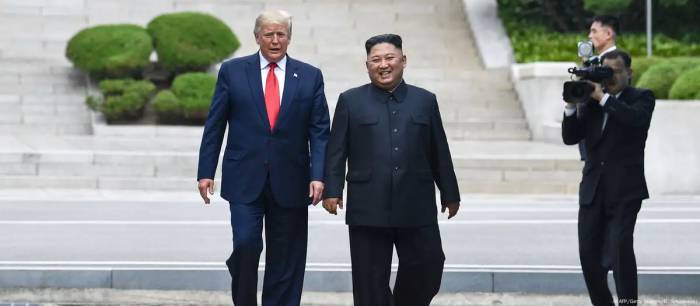
In South Korea, there is increasing concern that US President Donald Trump may attempt to bypass Seoul and directly engage with North Korean leader Kim Jong Un, reminiscent of his approach during his first term in office.
South Korea was quietly alarmed during Trump's first administration, when he held three rounds of talks with Kim, exchanged 27 "love letters" and, in June 2018, unexpectedly announced the complete suspension of joint US-South Korean military exercises during a summit in Singapore, News.Az reports citing Deutsche Welle.
"He wrote me beautiful letters, and they're great letters,” Trump said in September 2018. "We fell in love."
Shortly after being inaugurated for a second term, Trump told a Fox News interview on January 23, that he would be willing to reach out to Kim, saying they both "got along," while calling the North Korean dictator a "smart guy."
Although the Trump administration has not yet outlined any specific policy proposals on North Korea, there is once again alarm in Seoul that the US president might make another unilateral concession or a deal that benefits the US but not its regional allies.
After Trump's interview, Lee Jae-Myung, the head of the opposition Democratic Party, said bilateral US-North Korea talks without Seoul's input could imperil the South.
"If US-North Korean dialogue resumes, there is a high possibility that our Republic of Korea will be sidelined and this is a significant concern," Lee told a press conference in Seoul.
"We cannot make hasty assumptions about how the new US administration will take on the North Korean nuclear issue," he added. "We must prepare ourselves to respond to any situation."North Korea lashes out at being called a 'rogue' state
US-North Korean relations have remained tense since Trump was last in office, with Pyongyang expanding its missile development, including claims of a hypersonic test, while also cozying up to Russia's Vladimir Putin by providing weapons and manpower to help fuel Moscow's war in Ukraine.
After US Secretary of State Marco Rubio called North Korea a "rogue" state during a television interview last week, North Korea's Foreign Ministry responded, saying the "coarse and nonsensical remarks only show directly the incorrect view of the new US administration" on North Korea, which will "never help promote" US interests.
In November, Kim said the failed Trump summits were a sign of Washington's "hostility" towards North Korea, and a justification for building a nuclear arsenal.
In December, Kim said Pyongyang would implement its "toughest" anti-US policy ahead of Trump taking office.
The outcomes of the three Trump-Kim summits were largely regarded as having failed to deter Kim from advancing his weapons program, and were rather seen as a propaganda victory for a dictator seeking legitimacy on the global stage.
Nevertheless, although diplomatic outreach is always welcome, South Korea insists it needs to be included.
"I do not think that anyone is opposed to constructive dialogue or diplomatic outreach to the North and other nations," said Lim Eun-jung, an associate professor of international studies at Kongju National University.
"Basically, the fear is that Trump is going to do something, make a promise to Kim without telling his allies in the region," she told DW.
She added that former US President Joe Biden worked very hard to build a three-way security partnership in the region with South Korean President Yoon Suk-yeol and Japanese Prime Minister Fumio Kishida and enhance deterrence.
"We are worried that Trump is transactional and all that hard work will be given away," Lim said.
"The problem comes when decisions are taken that weaken the concept of extended deterrence and South Korea's national security," she said.
Lim added that analysts fear Trump could cut a deal with North Korea that could include removing the North's long-range missiles, while leaving shorter-range weapons in place that would threaten the South.
The problem in South Korea has been made worse, Lim said, by the political vacuum that has existed in Seoul since President Yoon was arrested after declaring a short-lived martial law in December.
An interim government is in place, but there is a leadership void as parties jostle for influence ahead of a likely general election.


Similar news