China's Fujian aircraft carrier: A game-changer in naval power


.jpg)
Editor's note: Nijat Babayev is an Azerbaijan-based journalist. The article reflects the author’s personal views and may not necessarily represent the position of News.Az.
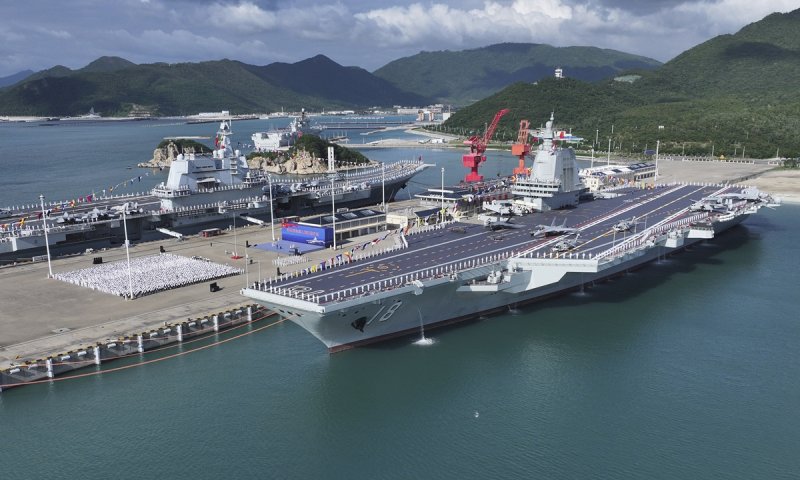
China reached a major milestone in its naval ambitions on November 8 with the official commissioning of the Fujian, the world’s first conventionally powered aircraft carrier equipped with an electromagnetic catapult system. This technological breakthrough not only marks an advancement in naval warfare but also reflects China’s growing military strength and its increasingly assertive role on the global stage.
President Xi Jinping attended the commissioning ceremony of the Fujian in Hainan Province, wearing army green in his role as chief of China’s armed forces. During the ceremony, he toured the deck, inspected aircraft, and praised the pilots, whom he called heroes.
The Fujian is China’s third aircraft carrier and its most ambitious to date. It was unveiled in 2022, but it took years to complete testing and perfect its operational capabilities before officially entering service.
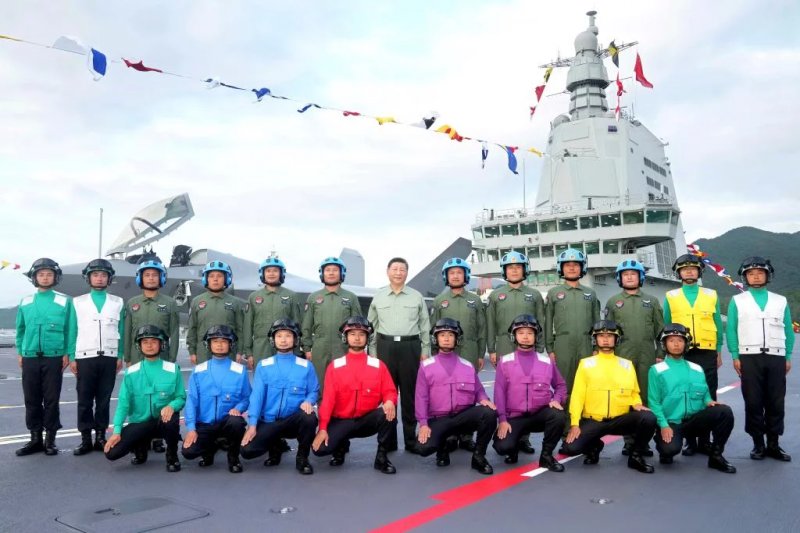 Chinese President Xi Jinping poses for a group photo with members of the Fujian aircraft carrier unit at a naval port in Sanya City. Photo: Xinhua
A new era for China’s naval forces
By commissioning the Fujian and planning to build more carriers, China is asserting its presence in the Western Pacific, signaling its intention to use these advanced naval assets to project power and deter potential adversaries. While China’s earlier carriers, Liaoning and Shandong, relied on ski-jump technology for takeoffs and landings, the Fujian’s electromagnetic catapult system will allow it to launch larger aircraft with heavier payloads at faster speeds, reducing wear and tear on the planes.
The Fujian may be China’s most advanced carrier to date, but it still lags behind the United States in both numbers and sophistication. China has three carriers, all conventionally powered by diesel engines, while the United States operates 11 nuclear-powered carriers. However, the Fujian is the first Chinese carrier to rival U.S. carriers in size and capability, and satellite images suggest that China is already constructing a fourth carrier.
China’s strategic military expansion
China’s growing fleet of carriers, including the Fujian, signals a broader shift in regional power dynamics. Over the past two decades, China has invested heavily in military modernization, including advanced missile systems, stealth aircraft, and a formidable naval force. The Fujian is a clear demonstration of China’s ambitions not only to dominate the region, but also to emerge as a global military power.
As the Fujian joins the People’s Liberation Army Navy (PLAN), China is positioning itself as a credible challenger to the United States’ longstanding naval dominance in the Indo-Pacific.
Beyond its technical capabilities, the Fujian serves as a symbol of China’s growing defense power. With the United States and its allies, including Japan and Australia, maintaining naval superiority in the region, China is no longer simply playing catch-up. Instead, the Fujian reflects China’s determination to level the playing field, particularly in contested areas like the South China Sea and the Taiwan Strait, where China’s assertiveness has sparked tension with the United States and its regional partners.
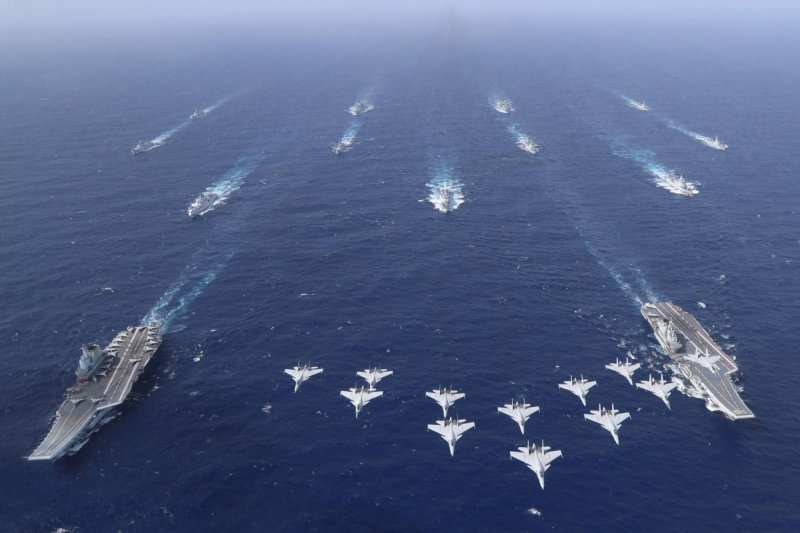 The Shandong and Liaoning sail side by side during exercises in the South China Sea. Photo: Xinhua
The Taiwan issue
The commissioning of the Fujian is especially significant in the context of China’s stance on Taiwan, which remains one of the region’s most critical flashpoints. Beijing views Taiwan as a breakaway province that must eventually be reunified with the mainland, by force if necessary.
The Fujian enhances China’s ability to project power into the Taiwan Strait, signaling both symbolic and practical military capabilities should tensions escalate.
While China has long been modernizing its military, the Fujian’s induction underscores that the country is prepared to back its territorial claims with advanced military hardware. The increased range and operational readiness of the Fujian and future carriers will give China a distinct edge in a potential conflict over Taiwan, where aircraft carriers would play a crucial role in establishing air superiority and maintaining supply lines.
China’s growing military capabilities, symbolized by the Fujian, pose a serious challenge to the United States, which has been the dominant naval power in the Pacific for decades. While the U.S. Navy remains technologically superior and more experienced, the Chinese fleet is rapidly catching up. The Fujian is just one part of China’s broader naval expansion, and it signals that the United States must increasingly contend with China’s rising naval power.
The Fujian’s induction also raises concerns among U.S. allies in the region, including Japan and Australia, who have been wary of China’s military expansion. Taiwan remains a key flashpoint, with Beijing signaling that it may be willing to use force if necessary to reunify the island with the mainland.
 Photo: Shutterstock
Conclusion: A shift in global naval power
The Fujian is more than just an addition to China’s growing military fleet — it is a game-changer. Equipped with advanced electromagnetic catapult technology, the carrier signifies China’s growing prowess in naval innovation and its ambitions on the global stage. While the true military and strategic value of the Fujian will only become clear in future conflicts, its mere existence represents a shift in the balance of global naval power.
As China continues to modernize its military, the commissioning of the Fujian sends a clear signal that the Indo-Pacific is no longer a region solely dominated by the United States. The balance of naval power is shifting, and the world must adjust to China’s increasing influence. For the United States and its allies, the Fujian underscores the need for a recalibrated strategy to maintain stability in a rapidly evolving geopolitical environment.
(If you possess specialized knowledge and wish to contribute, please reach out to us at opinions@news.az).


Similar news