Gaza: The final chapter begins




Editor's note: Moses Becker is a special commentator on political issues for News.Az, a PhD in political science and an expert on interethnic and interreligious relations. The article expresses the personal opinion of the author and may not coincide with the view of News.Az.
At 2:10 a.m. on March 18, Israel unleashed a wave of air and naval strikes over Gaza in an operation codenamed “Might and Sword.” In just ten minutes, more than 80 targets were hit. For Hamas, it was a wake-up call. For Israel, it marked the start of a new and final phase in a war it did not choose—but is now determined to finish.
The dramatic escalation followed the breakdown of U.S.-mediated talks over a possible extension of the ceasefire in exchange for more hostage releases. While Israel accepted the terms proposed by U.S. envoy Steve Witkoff, Hamas flatly rejected them. As negotiations collapsed, the Israeli Defense Forces struck deep into the terror infrastructure of the enclave. According to Israeli reports, over 200 Hamas operatives were eliminated, including key figures such as Issam al-Dalis, the de facto prime minister of the Gaza administration, and senior officials from the ministries of interior, justice, and internal security.
The timing of the offensive—during the holy month of Ramadan—caught Hamas off guard. But for a group that never paused its attacks for Jewish holidays, expecting restraint now was wishful thinking. More importantly, the rules of engagement have changed. The Biden era of caution and constraint appears to be over. And Israel, led by Prime Minister Benjamin Netanyahu, has drawn a new red line: no more negotiations under threat. From now on, as Netanyahu declared, “talks with Hamas will only happen under fire.”
This marks a fundamental shift in Israeli strategy. The stated objectives are unambiguous: the release of hostages and the complete dismantling of Hamas’s grip on Gaza. Defense Minister Israel Katz has already instructed the IDF to expand the security zone around Gaza, seize new territories, and hold them until the last hostage is freed. “As long as Hamas persists,” he warned, “it will continue to lose land—land that may ultimately become part of Israel.”
The message from Jerusalem is as blunt as it is brutal: the era of cyclical warfare and temporary ceasefires is over. Hamas gambled that time was on its side. That Israel would eventually relent. That international pressure would stall the IDF’s advance. But the gamble failed.
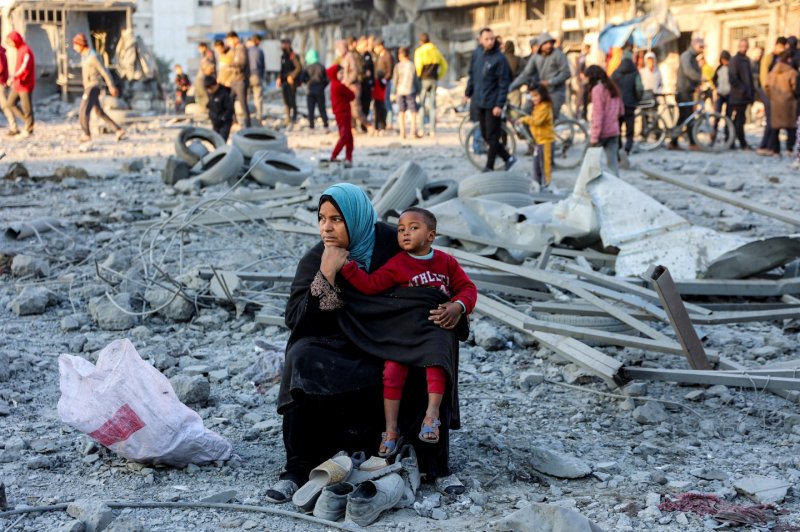
A woman sits with a child with salvaged footwear amid debris and rubble at the site of Israeli bombardment on a residential block in Gaza City on January 14, 2025. AFP via Getty Images
And even the Arab world appears to be reading the room. Egypt’s post-war reconstruction plan, endorsed by the Arab League in Cairo, envisions Gaza’s recovery within 3–5 years—on the strict condition that Hamas is removed from power. Washington has floated even more drastic ideas, including relocating Gaza’s population to other countries. Somaliland, for instance, has already signaled willingness to accept Palestinian refugees under specific conditions. For a self-declared state seeking international recognition, aligning with U.S. interests might be a strategic breakthrough.
Unconfirmed reports suggest Egypt may temporarily resettle some Gaza residents in northern Sinai. Meanwhile, two flights carrying Palestinians from Gaza have already departed Israel’s Ramon Airport for Europe, reportedly under family reunification programs.
The broader context of this renewed military push reveals an inconvenient truth: Hamas never intended to honor the terms of the hostage deal. While Israel freed hundreds of Palestinian prisoners—including convicted murderers—and opened humanitarian corridors, Hamas clung to its weapons and control of Gaza. Its leadership interpreted Israeli withdrawals not as goodwill, but as weakness.
Steve Witkoff put it plainly: “Hamas is making a very bad bet that time is on its side. It’s not.” The group rejected a chance to extend the ceasefire, to provide humanitarian aid to its own people, to bargain for political relevance. Instead, it chose war.
Now, it faces the consequences. The United States and Israel are united in the belief that Hamas—and its sister organization Islamic Jihad—must lay down arms and exit the political stage entirely. For Netanyahu, the time has come to break the toxic cycle in which hostage-taking becomes a bargaining chip for the release of mass murderers.
This isn’t just about Gaza. It’s about redrawing the map of regional power. The joint U.S.-Israeli effort now extends far beyond Hamas. It targets the Houthis, applies pressure on Iran, and—though not yet stated explicitly—entertains the possibility of regime change in Tehran.
The gates of hell have opened over Gaza not because Israel seeks war, but because Hamas refused peace. That distinction matters—and the international community would do well to remember it.
(If you possess specialized knowledge and wish to contribute, please reach out to us at opinions@news.az).


Similar news