Syria at a crossroads: Türkiye displaces Russia, Iran loses influence


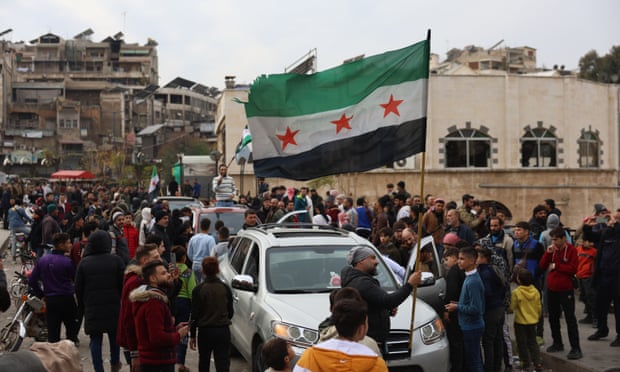
People wave a Syrian opposition flag after opposition fighters took control of the city of Hama, Syria, on 7 December. Photograph: Mohammed Al Rifai/EPA
The ongoing civil war in Syria, involving not only Türkiye, Iran, and Russia but also the United States and several other nations, highlights a significant shift in global power dynamics.
As a central state in the Middle East, Syria largely dictates the region's trajectory, which will inevitably impact all parties in the conflict.Türkiye is systematically displacing Russia as the primary player in Syria . Meanwhile, Iran, following the setbacks of Hezbollah, is retreating, rapidly losing its status as a regional hegemon. The visible exhaustion of Iranian resources underscores this decline. The country can no longer afford the promotion of its revolutionary ideals. Since the conflict began, Tehran has invested over $30 billion in military support and infrastructure restoration for the Assad regime, but such financial commitments are no longer sustainable.
Caught in the geopolitical crossfire, Iranian Foreign Minister Abbas Araghchi blamed Türkiye for the opposition's successes in Syria, later redirecting blame to the U.S. and Zionists, likely recognizing Iran cannot afford another adversary. Turkish Foreign Minister Hakan Fidan countered this narrative during a joint press conference in Ankara, stating, "It is incorrect to explain events in Syria through foreign intervention," directly addressing Araghchi.
The potential victory of anti-Assad forces could drastically alter Russia's superpower status, as losing access to the Mediterranean confines it to the Black Sea. Already, Russian naval forces are preparing to leave their long-standing base in Tartus. The rapid advances of militant groups, particularly those led by Hayat Tahrir al-Sham, threaten Russian military positions. Key strategic locations, including Aleppo and the Kuweires airbase, equipped with advanced Russian weaponry such as Pantsir-S1 systems, MiG-23 jets, and T-90A and T-72M tanks, have been overrun. Military experts warn that evacuating the Khmeimim airbase is logistically impossible.
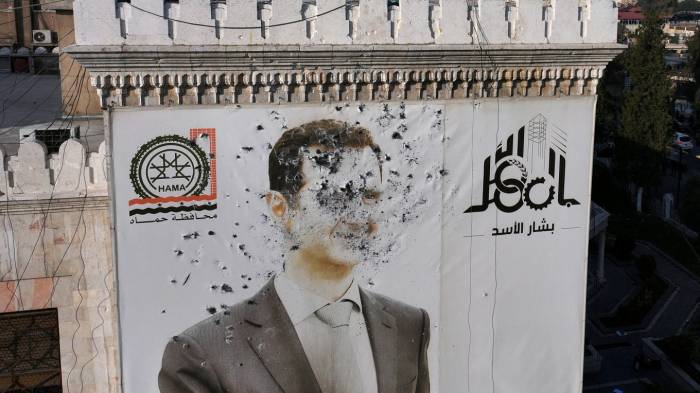
A bullet-riddled portrait of Syrian President Bashar al-Assad in the rebel-held city of Hama.
Simultaneously, uprisings in southern Syria's Daraa province, near the Israeli-occupied Golan Heights, have erupted. Emboldened by rebel victories in Hama and Homs, local militants have seized villages, confiscated weapons and vehicles, and taken soldiers and police captive. The loss of Salamiyah, Akerbat, and potentially Ithriyah threatens the Syrian Army’s positions in eastern Homs, possibly leading to the country's fragmentation.
Syria’s crisis has become a battleground for complex geopolitical maneuvers, with Israel and Türkiye playing pivotal roles in reshaping the Middle East. Israel has increasingly asserted its presence, launching airstrikes on Syrian targets. Over the past year, Iran has engaged Israel directly and through proxies like Hezbollah and Shia militias, but the outcomes have been unfavorable for the "axis of resistance." The prospect of deploying Iranian troops appears unlikely; instead, Iran has begun evacuating its diplomats and IRGC officers, along with their families, from Syria, recognizing that military support for Assad is no longer feasible. This retreat may precipitate the fall of the Ayatollah regime.
Amid these developments, Syrian rebel leaders have expressed readiness to establish friendly relations with Israel, ensuring peace and security along the Syrian-Israeli border. The "Roadmap to Peace Between Syria and Israel," presented by Fahad Almasri, the general coordinator of the Syrian National Salvation Front (SNSF), envisions a framework where Israel’s security would be guaranteed by a strong transitional government in Syria. This government would rely on Arab and Turkish military forces under UN oversight for political stability.
The roadmap also addresses Palestinian refugee issues, promising Syrian citizenship, resettlement in new housing developments, and the dismantling of refugee camps. Palestinian organizations would be banned in Syria, with representation limited to Palestine’s official authorities. The envisioned “New Syria” plans to sever all ties with Iran, expel Iranian military personnel and allied militias, and ban Shiite organizations and mosques supported by Tehran. Citizenship granted to individuals from Iran, Iraq, Lebanon, and other states since 2003 would also be revoked.
Recognizing Israel’s legitimacy and fostering strategic partnerships form another cornerstone of the SNSF's vision. Territorial disputes over the Golan Heights would be resolved by establishing a joint peace zone, transforming the area into a "haven of peace." Additionally, Jewish property in Syria would be restored, and support provided for maintaining synagogues.
The SNSF, a significant opposition coalition comprising liberal democrats, moderate Kurdish groups, Marxists, and ideologues aligned with the Muslim Brotherhood, operates from abroad with U.S. State Department backing. While the feasibility of this roadmap remains uncertain, the proposal signifies a profound shift in Middle Eastern geopolitics. Notably, newly elected U.S. President Donald Trump has appointed Massad Boules, a Lebanese-American, as his Middle East envoy. The timing of anti-Assad offensives, coinciding with peace agreements between Israel and Hezbollah, suggests coordinated action by the new American administration.
No event occurs in isolation, and the synchrony of developments in Syria lends weight to this interpretation.
(If you possess specialized knowledge and wish to contribute, please reach out to us at opinions@news.az).


Similar news