China’s space station achieves milestone by producing oxygen, rocket fuel


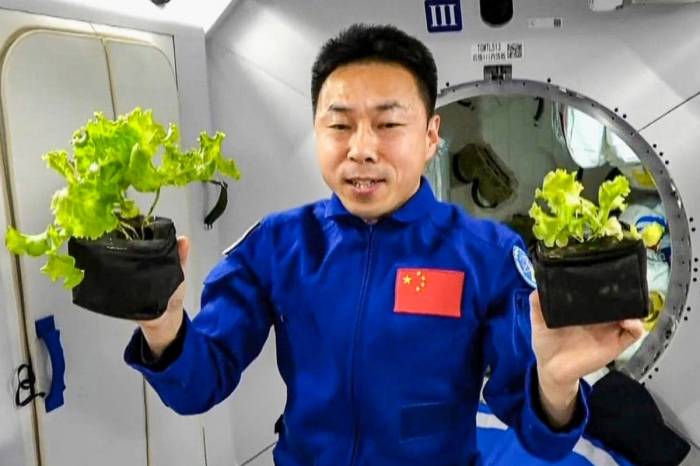
Astronauts aboard the Tiangong space station are conducting research that is expected to provide critical technical support for human survival and exploration in outer space. Photo: CCTV
A series of groundbreaking experiments aboard China’s space station have successfully produced oxygen and key ingredients for rocket fuel, marking a significant step toward ensuring human survival in space and advancing future space exploration.
The Shenzhou-19 crew aboard the Tiangong space station successfully conducted the world’s first in-orbit demonstration of artificial photosynthesis technology, producing oxygen, as well as the ingredients necessary for rocket fuel, paving the way for long-term space exploration, including a crewed moon landing before 2030,News.Az reports, citing the South China Morning Post.The 12 experiments took place inside a drawer-shaped device, using semiconductor catalysts to convert carbon dioxide and water into oxygen while producing ethylene, a hydrocarbon that can be used to make spacecraft propellants, according to the China Manned Space (CMS) website.
It said the tests focused on several technologies that would be essential for resource production and human survival, including: carbon dioxide conversion at room temperature; the precise control of gas and liquid flows in microgravity; and real-time, high-sensitivity detection of reaction products.
“This technology mimics the natural photosynthesis process of green plants through engineered physical and chemical methods, utilising carbon dioxide resources in confined spaces or extraterrestrial atmospheres to produce oxygen and carbon-based fuels,” state broadcaster CCTV reported on Sunday.
“The work is expected to provide critical technical support for human survival and exploration in outer space,” the report added.
Previous experiments on board the International Space Station (ISS) related to photosynthesis have focused on plant growth and understanding how microgravity affects natural photosynthesis.
However, the ISS largely relies on electrolysis for life support, which uses electricity from the station’s solar panels to split water into hydrogen and oxygen and supply breathable air for astronauts.
While effective, the process is energy intensive and would not be practical for long-haul missions to the moon or Mars, according to catalysis expert Katharina Brinkert, from the University of Bremen in Germany.
Generating oxygen on the ISS consumes about one-third of the total energy needed to operate its environmental control and life support system, her team reported in the journal Nature Communication in 2023.
Chinese researchers began studying the idea of “extraterrestrial artificial photosynthesis” in 2015, according to the CMS website.
Unlike conventional high-temperature, high-pressure carbon dioxide reduction methods, the novel technology works efficiently at room temperature and standard atmospheric pressure, significantly reducing energy consumption.
By adjusting the catalyst, the technology can be tailored to produce various products, including methane or ethylene for propulsion, or formic acid as a precursor for synthesising sugars.
In addition to generating oxygen and carbon-based fuels, the device installed in Tiangong has collected valuable data on gas-liquid-solid multiphase chemical processes in a microgravity environment.
The device is designed to be upgraded while in orbit, enabling scientists to test different catalysts and reactions.
The innovation has positioned China at the forefront of sustainable space technologies, crucial for addressing long-term survival and resource independence in extraterrestrial environments, the CMS website said.


Similar news