From energy to data: Azerbaijan and Kazakhstan redraw Eurasia’s map


Editor's note: Abulfaz Babazadeh is a scientist, Japanese scholar, and political observer, as well as a member of the Union of Journalists of Azerbaijan. The views expressed in this article are the author’s own and may not reflect the position of News.Az.
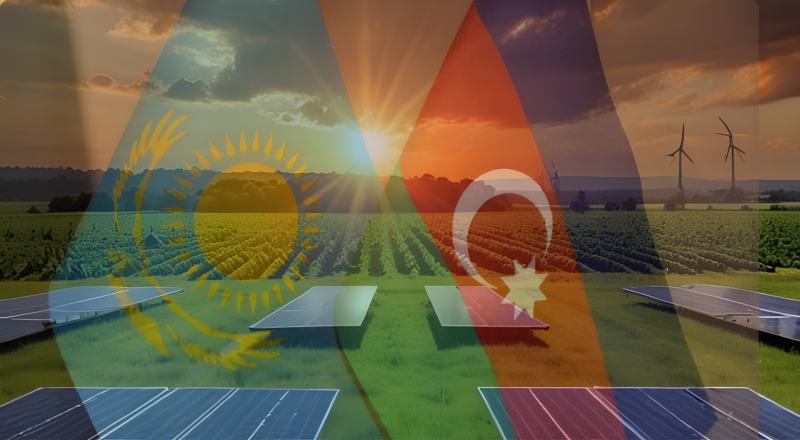
The partnership between Azerbaijan and Kazakhstan has evolved far beyond conventional diplomacy and is rapidly becoming a defining force in shaping Eurasia’s geopolitical and economic landscape. On the eve of his official visit to Kazakhstan, Azerbaijani President Ilham Aliyev gave an exclusive interview to Kazinform, emphasizing that the relationship between Baku and Astana has reached a qualitatively new level. The deepening strategic ties between the two Caspian nations now encompass not only energy and transport but also digital infrastructure, green transition, and cultural exchange.
Over the past several years, Azerbaijan and Kazakhstan have demonstrated that pragmatic cooperation built on mutual trust can yield tangible results. In 2024, bilateral trade turnover reached $470 million, a 50 percent increase over the previous year. During the first eight months of 2025, trade between the two countries exceeded $547 million, reflecting more than a fourfold increase. This growth has been driven by the expansion of the Trans-Caspian International Transport Route, also known as the Middle Corridor, and by the modernization of logistics infrastructure across both nations.
The investment dimension of the partnership has also gained strong momentum. Azerbaijani investments in Kazakhstan now total $225 million, while Kazakh investments in Azerbaijan stand at $136 million. These figures reflect the long-term confidence that underpins the strategic partnership, with both sides viewing each other not merely as neighbors but as integral allies in shaping a new transport and energy order across the Eurasian continent.
Source: AzerTAG
The Middle Corridor has emerged as a critical artery for East–West trade, offering a reliable alternative to traditional routes. In 2024, total cargo turnover between Azerbaijan and Kazakhstan exceeded 3.5 million tons, a 20 percent increase compared to the previous year. The Roadmap adopted in Aktau for 2022–2027 seeks to synchronize modernization efforts across Azerbaijan, Kazakhstan, and Georgia, including unifying tariffs, building logistics hubs, and enhancing operational efficiency.
This transformation extends beyond transport logistics. At the 21st session of the Intergovernmental Commission between Azerbaijan and Kazakhstan, held in Baku, both sides reaffirmed their commitment to giving the Middle Corridor higher institutional status. They agreed to focus on eliminating bottlenecks, simplifying customs procedures, and optimizing cargo flows. By 2024, 287 container trains had already passed through this route, while volumes in the first nine months of 2025 grew by an additional 39 percent.
The strategic vision behind these efforts is shared by both leaders. Speaking at the 12th Summit of the Organization of Turkic States in Gabala, Kazakh President Kassym-Jomart Tokayev described the Middle Corridor as the backbone of the Eurasian transport network and urged Turkic countries to modernize ports, railways, and aviation hubs.
Later, at the 7th International Transport and Logistics Forum New Silk Way in Almaty, the railway administrations of Kazakhstan, Azerbaijan, and Georgia signed a joint action plan aimed at reducing transit times and simplifying border crossings.
Source: TREND
No less significant is the energy cooperation between Baku and Astana. On August 6, the energy ministers of Azerbaijan, Kazakhstan, and Uzbekistan signed a protocol in Astana to integrate their national power systems. The agreement lays the foundation for a new green energy partnership linking the Caspian basin to Europe.
Under the plan, a high-voltage submarine cable will be built along the Caspian seabed, connecting the energy systems of the three countries and enabling the export of renewable electricity. The feasibility study is being prepared by the Italian company CESI, with a joint venture of national energy firms expected to implement the project.
This ambitious initiative will connect Kazakhstan and other Central Asian states to the Black Sea Energy Corridor, a project signed in Bucharest in December 2022 by Azerbaijan, Georgia, Romania, and Hungary. The 1,195-kilometer subsea power line, with a capacity of 1 GW, will deliver renewable energy from the Caspian region to European markets, solidifying Azerbaijan’s role as a major energy transit hub and providing Kazakhstan with a new export channel to the West.
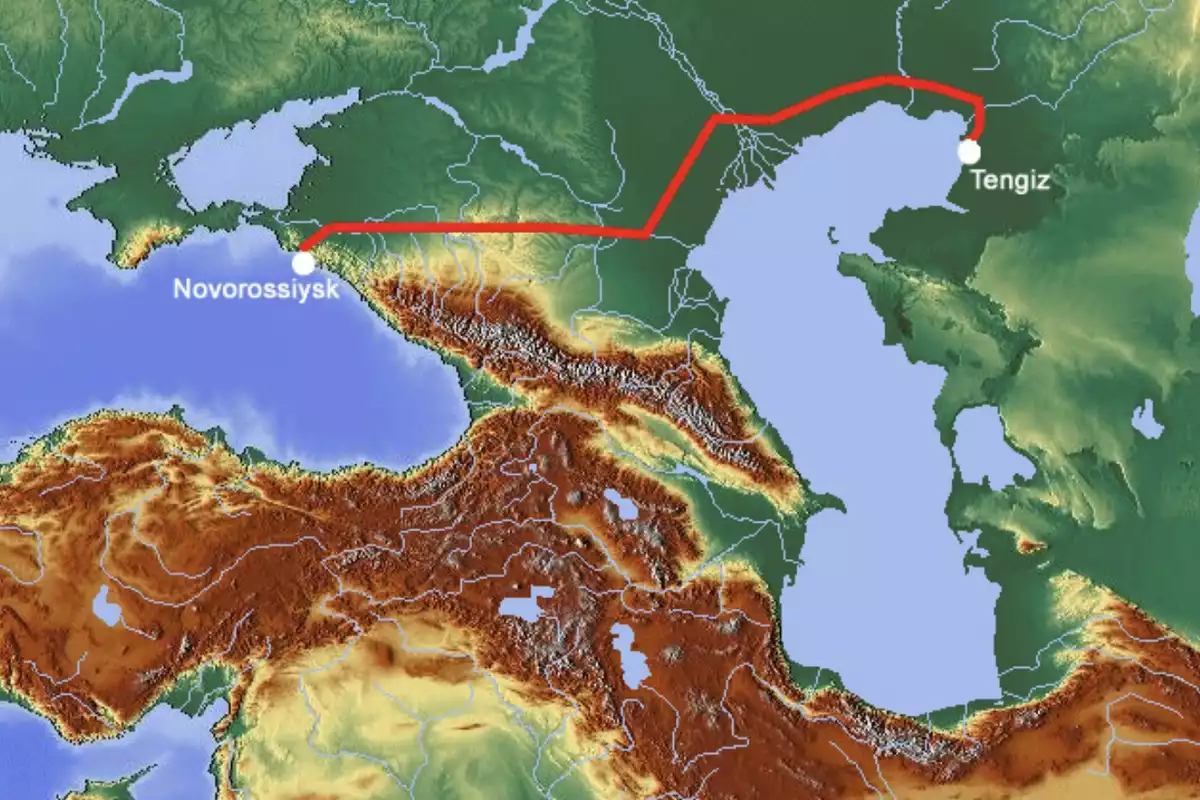
Equally transformative is the Trans-Caspian Fiber-Optic Cable Line, a joint telecommunications project between Azerbaijan and Kazakhstan. The two countries are laying a 380-kilometer fiber-optic cable along the Caspian seabed between Aktau and Sumgayit. With a planned capacity of 400 terabits per second and an investment exceeding $50 million, the project will connect the digital ecosystems of the South Caucasus and Central Asia, enhancing data security and regional connectivity.
In June, AzerTelecom and Kazakhtelecom completed seabed engineering studies, and the project is scheduled for completion by the end of 2026.
Source: Caspianpost
The energy partnership continues to deepen. According to Azerbaijan’s Ministry of Energy, the transit capacity for Kazakh oil through the Baku–Tbilisi–Ceyhan (BTC) pipeline is expected to reach 7 million tons per year by 2027. Since 2023, 3.4 million tons of Kazakh oil have already been transported via BTC.
SOCAR and KazMunayGas maintain a five-year agreement signed in 2022 to ship 1.5 million tons annually, following upgrades to the Sangachal terminal. In 2024, the pipeline carried 1.4 million tons of Kazakh oil, up from just over 1 million tons in 2023, and the figure is projected to reach 1.5 million tons in 2025.
On January 27, 2025, Kazakhstan sent its first oil tanker from the Kashagan field to Azerbaijan, a symbolic milestone highlighting the growing energy alliance between the two nations.
For Kazakhstan, expanding exports via the BTC pipeline reduces dependence on northern routes and strengthens its energy sovereignty. For Azerbaijan, it reinforces the country’s role as a reliable bridge between the Caspian and global markets, positioning it as a hub capable of linking Asia and Europe through multiple layers of energy, digital, and transport cooperation.
The partnership between Azerbaijan and Kazakhstan serves as a model of pragmatic regionalism, built not on ideology but on mutual benefit and long-term vision. Both countries recognize that the 21st century belongs to those who build connections, not divisions. The Middle Corridor, the Trans-Caspian Fiber-Optic Cable Line, and the shared commitment to green energy mark the beginning of a new phase in Eurasian integration - one in which Baku and Astana will continue to play a central, unifying role.
(If you possess specialized knowledge and wish to contribute, please reach out to us at opinions@news.az).


Similar news