Germany to acquire advanced Taurus cruise missiles: Reports


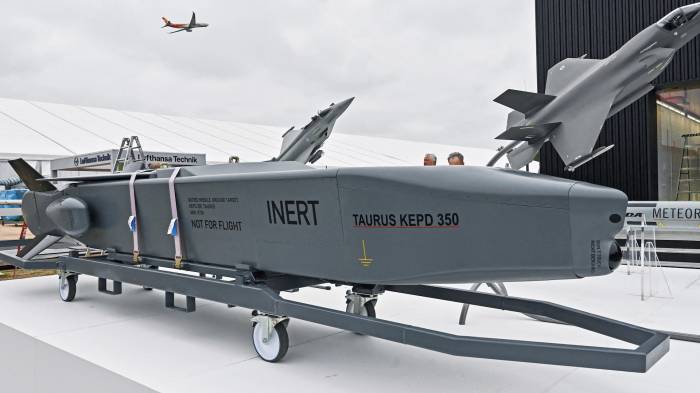
Germany has announced plans to acquire 600 examples of a new version of the Taurus air-launched conventional cruise missile, which would provide a major boost to the country’s long-range strike capabilities. Unclear is whether the Taurus Neo purchase might finally see approval for the transfer of older Taurus KEPD 350 weapons to Ukraine, with Berlin so far having blocked such a move despite Kyiv’s requests for them. Even if Ukraine gets its wish, it will be a long time before the Taurus Neo comes online, potentially freeing up older KEPD 350 versions, News.Az reports citing foreign media.
The German Minister of Defense Boris Pistorius wants to buy advanced versions of the missiles, but has yet to secure funds from the government, according to a report in the Spiegel magazine.The same source states that the 600 new missiles would cost around $2.3 billion and could see the first deliveries in 2029.
Pistorius plans for the Taurus Neo to be included as an option in the 2025 budget, which would require a starting investment of around $379 million.
The Luftwaffe or German Air Force already received 600 of the original Taurus KEPD 350 missiles, which have a range of more than 500 kilometers (311 miles). In German service, these are launched from the Tornado swing-wing strike fighter. Although they have also been tested from the Eurofighter EF2000, the Luftwaffe doesn’t currently use the more modern fighter as a Taurus delivery platform.
It’s unclear what platform the Taurus Neo would be launched from, but the upcoming retirement of the Tornado fleet makes this much less likely. That would leave the Eurofighter as the most likely option. Potential integration on the F-35A stealth fighter, which Germany has also ordered, seems highly unlikely, with the missile needing a significant redesign to even fit in the internal weapons bay on the U.S.-made jet.
Looking further ahead, Germany could plan to add the Taurus Neo to the crewed fighter that will be at the center of the next-generation combat aircraft program being pursued by Belgium, France, Germany, and Spain, known as the Future Combat Air System, or FCAS.
The original Taurus KEPD 350 was designed to destroy high-value targets deep behind enemy lines, including command bunkers, ammunition and fuel dumps, airfields, and bridges.
Designed to penetrate air defenses via a very low-level terrain following flight, the turbojet-powered Taurus missile carries a 1,060-pound dual-stage warhead, known as MEPHISTO. This uses a precursor charge to punch through hardened structures followed by the main change that can be fuzed for penetration mode when required, meaning it detonates after breaching the target. The MEPHISTO warhead can also be programmed to detonate on a specific pre-selected floor of a given building.
The missile guidance system is based on an inertial navigation system (INS) that is continuously provided with GPS updates. There is also an image-based terrain reference sensor, which provides the capability to attack what the manufacturer describes as “semi-stationary targets.”
There are so far no details available about the improvements planned for the Taurus Neo, although potential changes could involve extended range, more destructive warhead, low-observable features, a new seeker, or a combination of these. Less likely, but also potentially under consideration could be increased speed, perhaps combined with defensive countermeasures to better defeat advanced air defense systems. Other modifications to improve the chances of penetrating hostile air defenses could include electronic support measures (ESM) to autonomously avoid the highest-threat areas.
There’s also the possibility of a new-production version of the missile with relatively minor changes compared with the original KEPD 350.
Speaking this summer, Thomas Gottschild, the managing director of MBDA Deutschland GmbH, which makes the missile, confirmed that although not currently in production, the assembly line could be reactivated at short notice. “What we need is an order to activate our supply chain, a good dozen suppliers contribute to a complex missile like Taurus. These suppliers only start working for us with an order,” Gottschild said.
However, the high costs involved in the program suggest that the Taurus Neo will likely feature several enhancements over its predecessor.
Two quick points:
First, 2029 is obviously a long way off, with even more time until the order is fully completed—if it reaches that scale.
Second, funding has yet to be secured, and hopefully, they will manage to source the necessary budget. In my view, this should be an…
— Fabian Hoffmann (@FRHoffmann1) October 25, 2024
The news of Germany’s Taurus Neo plans comes just two days after the signing of a landmark defense agreement between Germany and the United Kingdom, which you can read more about here.
The two countries agreed to work together to “rapidly develop” new extended deep strike weapons. Although no more details were provided, such weapons are planned to fly further and attack targets with greater precision than the Storm Shadow air-launched cruise missile used by the U.K. Royal Air Force.
That agreement followed the announcement at the NATO Defense Ministers meeting in Brussels last week that the United Kingdom was joining the European Long-Range Strike Approach (ELSA) initiative, a French-led effort that involves Germany, Poland, and Italy. Previous announcements state that ELSA envisages a missile with a range of between 1,000 and 2,000 kilometers (621 and 1,243 miles) and that it should be in service by the 2030s.
The


Similar news