U.S. F-16s hold Gulf presence after Iran operation ends


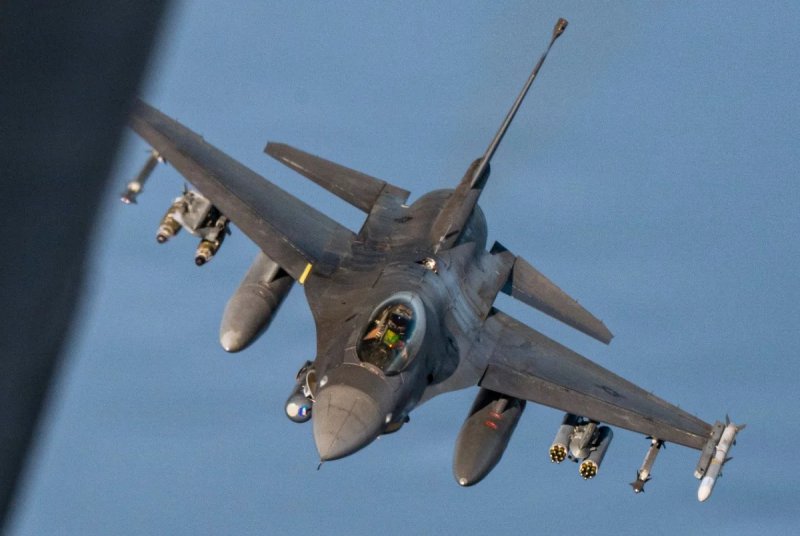
Operation Epic Fury has officially concluded, but United States Air Force F-16 Fighting Falcon aircraft continue to conduct combat air patrols over one of the world’s most volatile airspaces.
Newly released photographs taken May 14 in the U.S. Central Command area of responsibility show an F-16 Fighting Falcon carrying a weapons mix that tells the whole story of modern air combat in one snapshot: air-to-air missiles, laser-guided bombs, and a rack of 70mm laser-guided rockets designed to hunt drones on the cheap, News.Az reports, citing Defence Blog.
RECOMMENDED STORIES
Operation Epic Fury, the U.S. code name for joint military operations with Israel against Iran, began on February 28, 2026, and concluded on May 5. Secretary of State Marco Rubio told reporters that the operation had concluded because its objectives had been achieved, with Washington now preferring “the path of peace.” What that peace actually looks like on the ground, or rather in the air, is F-16s maintaining persistent patrol, ready to strike surface targets or intercept incoming threats at any moment. The ceasefire ended the campaign; it did not end the mission.
The F-16 Fighting Falcon has been a fixture of American airpower since the 1970s, and its critics have spent years arguing the jet is too old, too small, and too limited for the threat environments of the 2020s. The May 14 photographs suggest otherwise. What they show is a jet that has been continuously adapted to meet challenges that didn’t exist when it first flew, and that is now one of the primary platforms carrying the burden of force presence in the post-Epic Fury Middle East.
The weapons load visible on the aircraft captures the dual nature of the current mission precisely. The jet carries air-to-air missiles for engaging hostile aircraft and cruise missiles, laser-guided bombs for precision strikes against ground targets if called upon, and — most notably — pods of Advanced Precision Kill Weapon System II rockets, known as APKWS II, that have become the go-to cheap solution for the drone interception problem that has reshaped air combat across multiple theaters simultaneously.
The APKWS II is a 70mm rocket that began life as an air-to-ground weapon, designed to put a laser-guided warhead on target at a fraction of the cost of a guided missile. What the system brings to the air-to-air mission is a combination of affordability and volume that traditional missile loadouts simply cannot match. A single APKWS II rocket carries an estimated unit cost of around $30,000. An AIM-9X Sidewinder, the standard short-range air-to-air missile that F-16s have relied on for decades, costs approximately $500,000 per shot. The math becomes stark when the threat is a swarm of one-way attack drones worth a few hundred to a few thousand dollars each — expending a Sidewinder to down a cheap drone is a losing economic equation at scale.
The mechanics of converting a ground-attack rocket into a credible air-to-air weapon are elegant in their simplicity. The pilot uses a targeting pod — typically a Sniper or Litening pod mounted on the jet — to illuminate the drone, and the rocket homes in on the reflected beam. During operations in the CENTCOM region, F-16s have typically worked in pairs, with one aircraft designating the target using the Sniper targeting pod while the other executed the attack run with the rockets.
A standard air-to-air loadout for an F-16 consists of six missiles. Carrying one or two rocket pods with APKWS II enabled the jet to effectively triple that number — at a fraction of the cost. Against a drone swarm that might number in the dozens, the difference between six shots and eighteen or more is the difference between a mission and a catastrophe.
CENTCOM commander Admiral Brad Cooper acknowledged the shift in approach during a press conference, stating that the military has been embracing more cost-effective drone interceptors. “I think you have seen over a period of time, us kind of get on the other side of this cost curve, on drones in general,” Cooper told reporters. That comment reflects a calculation that has been years in the making. The asymmetric cost problem — where an adversary can field hundreds of cheap drones while defenders burn through expensive missiles to stop them — became impossible to ignore during the Houthi campaign in the Red Sea, where U.S. Navy and Air Force assets regularly expended million-dollar interceptors against drones that cost a fraction of that.
The F-16 visible in the May 14 photographs represents a broader institutional reality: the jets that defense commentators have repeatedly declared past their prime keep proving them wrong. The airframe is old. The fundamentals are not. An F-16 loaded with laser-guided rockets, precision bombs, and air-to-air missiles, flown by a trained crew over a contested airspace, is still a highly capable instrument of lethal force — especially when it’s been adapted to fight the threats that actually exist rather than the threats that planners originally anticipated.
By Ulviyya Salmanli


Similar news