How Charles James Kirk reshaped conservative youth politics in America


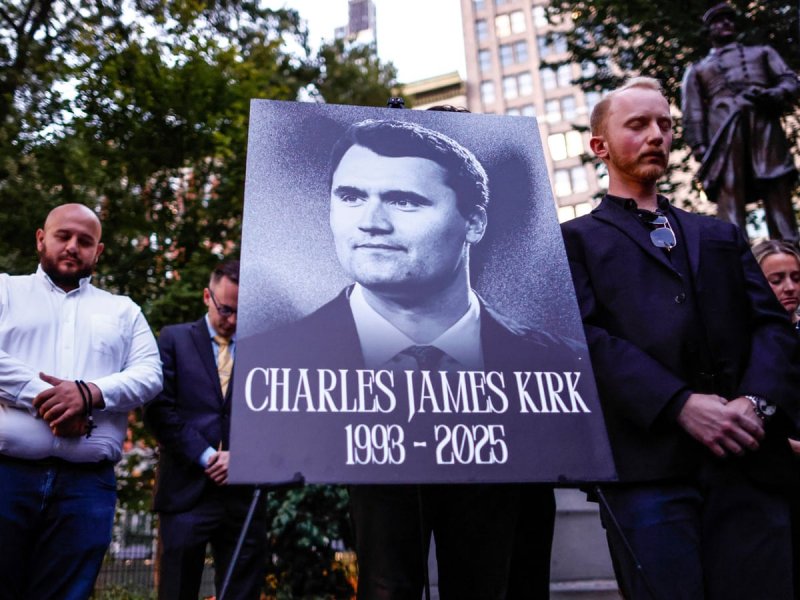
Charles James Kirk was born on October 14, 1993, in Arlington Heights, Illinois, a suburb of Chicago, to Robert and Kimberly Kirk. His father was an architect and his mother was a mental health counselor, both active in Republican circles, News.Az reports.
Kirk grew up in Prospect Heights and Wheeling, Illinois, where he attended local schools and became involved in community organizations, including the Boy Scouts, earning the rank of Eagle Scout. From an early age, he demonstrated a strong interest in politics. He volunteered on Republican campaigns in his teens and became engaged in local school politics, organizing student protests over cafeteria pricing.
During high school, Kirk began writing political commentary. At 17 he wrote an op-ed for a national conservative news site, arguing that his economics textbooks exhibited a liberal bias. The piece garnered attention and led to appearances on national media, introducing his voice to a broader audience. Conservative activist Bill Montgomery, a Tea Party figure, encouraged Kirk to channel his rising profile into building a national movement. Inspired by this opportunity, Kirk briefly enrolled at Harper College but soon decided to leave academia to focus full time on political organizing.
Founding of turning point usa
In 2012, at just 18 years old, Kirk co-founded Turning Point USA with Bill Montgomery, laying the foundation for what would become one of the most visible conservative youth organizations in the United States. TPUSA was established as a nonprofit with the stated mission of identifying, educating, training, and organizing students to promote the principles of free markets, limited government, individual liberty, and fiscal responsibility. Under Kirk’s leadership, the organization focused on building chapter networks across high schools, colleges, and universities, hosting events and conferences that drew thousands of young attendees.
From its modest beginnings, TPUSA expanded rapidly. It developed high-profile initiatives such as the Professor Watchlist and School Board Watchlist, which named educators and local officials perceived by the group as hostile to conservative viewpoints. These programs drew praise from supporters who saw them as tools to combat perceived ideological bias on campuses, and criticism from opponents who argued they fostered intimidation and harassment. The organization also hosted large annual conferences, including the Student Action Summit and AmericaFest, featuring speeches by prominent Republican leaders and conservative commentators.
Expansion into political advocacy
In 2019, Kirk launched Turning Point Action (TPA), a sister organization designed to engage more directly in political advocacy and voter mobilization. TPA deployed thousands of field organizers in key states, particularly during the 2024 United States presidential election, with efforts to register voters, mobilize turnout, and support Republican candidates. The advocacy group also hosted rallies featuring a range of conservative figures, further cementing Kirk’s role as a national organizer and political strategist.
Overall, Turning Point’s combined efforts created a multifaceted network that blended grassroots activism, media production, and political advocacy. TPUSA’s media presence – comprising social media campaigns, campus debates, and national conference coverage – allowed Kirk and his allies to reach millions of Americans with their message. These methods leveraged emerging digital platforms that resonated with younger generations and translated online engagement into real-world activism.
Media presence and authorship
Alongside his organizational responsibilities, Kirk established himself as a prominent media personality. In 2019 he launched The Charlie Kirk Show, a daily radio and podcast program that became widely syndicated, reaching audiences interested in conservative political analysis and commentary. Kirk also authored several books that articulated his worldview, blending political philosophy with cultural critique. His works often emphasized traditional values, critiques of progressive policies, and advocacy for a return to foundational American principles.
His media work and public speaking engagements significantly amplified his influence. Kirk was frequently invited onto national news programs and television networks, where he defended TPUSA initiatives and articulated conservative positions on contemporary issues, ranging from education policy to immigration and economic regulation. His style – energetic, assertive, and often controversial – helped him stand out in a crowded media landscape and made him one of the most recognizable faces of a new generation of conservative activists.
Political positions and controversies
Kirk’s political positions were firmly rooted in conservative ideology. He opposed abortion rights and gun control measures, and he was a vocal critic of diversity, equity, and inclusion (DEI) programs in educational institutions. Kirk also contested mainstream scientific consensus on issues such as climate change and public health measures during the COVID-19 pandemic, promoting narratives that challenged governmental and scientific authority. These stances endeared him to many conservative followers but also drew criticism from opponents who argued that his messages spread misinformation and fostered social divisiveness.
His alignment with Donald Trump and the broader movement commonly described as MAGA heightened his prominence within Republican circles. Although he never held elected office, Kirk’s role as a youth mobilizer and public advocate made him a key strategist behind political campaigns and electoral tactics. He welcomed debates with ideological opponents and frequently traveled to college campuses as part of TPUSA’s outreach efforts. These debates, often titled “prove me wrong,” became signature events that sought to challenge liberal students and highlight conservative perspectives.
Kirk’s approach to political engagement was both praised and criticized. Supporters credited him with reinvigorating conservative activism among young people and advocating unapologetically for principles they saw as foundational to American identity. Critics argued that his rhetoric sometimes crossed into polarizing language that deepened ideological divides and inhibited constructive discourse.
Assassination and national response
On September 10, 2025, Charles James Kirk was fatally shot while speaking at a Turning Point USA event at Utah Valley University in Orem, Utah. The shooting occurred during a public campus debate that was part of Kirk’s ongoing speaking tour. He was 31 years old at the time of his death. The news of his assassination prompted immediate national and international attention, with political leaders across the spectrum condemning the act of violence and sparking urgent discussions about public safety, polarization, and the nature of political discourse in the United States.
The aftermath of Kirk’s death was deeply polarized. Supporters viewed him as a martyr for free expression and conservative activism, while critics reflected on the broader implications of political violence and the intensity of contemporary ideological divisions. Authorities arrested a suspect in connection with the shooting, and investigations into motive and security lapses became part of a sustained public conversation. Memorial services drew thousands of mourners, including political figures who highlighted Kirk’s contributions to youth engagement and public life.
The national response included bipartisan calls for calm and renewed emphasis on safeguarding public discourse. Elected officials from both major parties spoke about the challenges of political polarization and stressed the importance of addressing extremism while preserving civil liberties. Commentators and civic leaders debated the cultural and institutional dynamics that shape American politics, exploring how individuals and organizations can engage in robust debate without fostering violence or animosity.
Legacy and organizational continuity
In the weeks following his death, Turning Point USA experienced a surge in membership and interest. Tens of thousands of new students sought to join existing chapters or form new ones, reflecting the emotional and ideological impact Kirk’s work had on many Americans. The organization’s board unanimously appointed Kirk’s widow, Erika Kirk, as its new chief executive officer and board chair. Erika Kirk – herself a public figure with a background in podcasting and entrepreneurship – pledged to continue her husband’s mission and expand the movement’s reach.
Political leaders, including senior Republican officials, publicly honored Kirk’s contributions while framing his legacy as a call to action for conservative voters. The broader Republican Party also sought to elevate Kirk’s narrative in the context of upcoming elections, using his life story and organizational achievements to highlight concerns about political engagement and civic participation.
Kirk’s family established a foundation in his name to support youth leadership programs, civic education initiatives, and scholarships for students committed to public service. The foundation’s work aimed to institutionalize aspects of Kirk’s approach to empowerment and to encourage constructive involvement in political life.
Broader influence and ongoing debates
Charles James Kirk’s career exemplified the evolving nature of political organizing in the digital age, blending grassroots activism, strategic media use, and ideological advocacy. His ability to mobilize young people, engage in campus debates, and leverage social media platforms redefined aspects of conservative outreach. These tactics influenced a generation of political communicators who recognized the power of digital networks to shape public opinion and turnout.
At the same time, his rhetoric and methods – often provocative and polarizing – fueled intense debates about political discourse, misinformation, and the responsibilities of public figures. Critics argued that certain strategies contributed to an environment in which ideological antagonism became normalized, while supporters saw those same strategies as necessary to counterbalance institutional and cultural currents they perceived as biased.
Scholars, commentators, and political analysts continue to assess Kirk’s impact, with discussions focusing on both the expansion of conservative activism and the challenges posed by heightened polarization. While supporters point to his success in energizing a new generation of voters and influencing Republican strategy, critics contend that aspects of his approach sometimes deepened divisions and hindered constructive dialogue. Such evaluations ensure that Kirk’s legacy remains a subject of ongoing reflection in American political history.
Conclusion
Charles James Kirk’s life and career left an indelible mark on American political culture in the early twenty-first century. His leadership of Turning Point USA, his media presence, and his role in shaping youth engagement with conservative politics defined a distinctive chapter in the evolution of political activism. Although his life ended in tragedy, the ongoing debates about his influence and the movements he helped build illustrate the enduring complexity of his legacy and the continuing significance of youth mobilization in democratic societies.


Similar news