INTERVIEW: How dedollarization strengthens the ruble


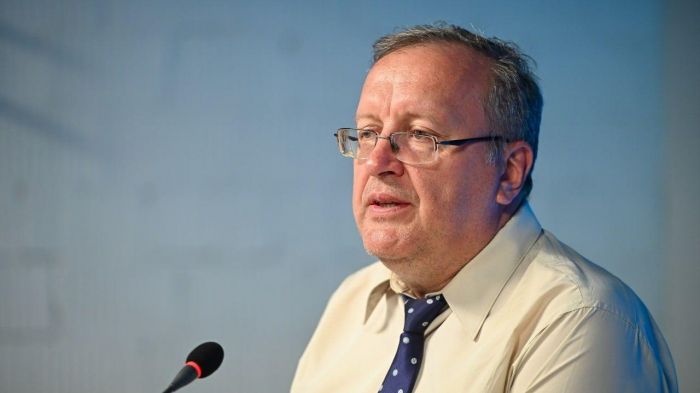
News.Az presents an interview with Stanislav Tkachenko, Doctor of Economics, Professor at St. Petersburg State University
- Why did the ruble sharply rise against the dollar, euro, and yuan on June 19?
- The sharp fluctuations in the exchange rate of the ruble against major currencies (the US dollar, euro, and yuan) were immediately triggered by the sanctions announced on June 12, 2024, by the United States against the Moscow Exchange, as well as the National Clearing Center (NCC) and the National Settlement Depository (NSD) within its group.
Since the normal operation of these platforms was impossible, Russia's monetary authorities needed time to analyze the new situation and take measures to protect the ruble and the payment system with foreign partners.
The subsequent price swings cannot be rationally explained. For a while, on June 13-14, the market was subject to panic among small players, long queues formed at exchange offices, and dollars and euros were bought at almost any price. This panic did not last long, and within four days, the market calmed down.
After that, there was a reaction from large players, including industrial companies and various types of financial institutions in Russia. They calculated that due to the Central Bank of Russia's policy of dedollarization and the shift to national currencies in foreign trade with friendly countries, demand for dollars and euros decreased. Therefore, purchases of these currencies on the market dropped sharply, and the decline in the dollar and euro exchange rates on June 19 confirms this.
The significant volatility of the Russian ruble, especially noticeable since the fall of 2014, is based on many factors. The main one is the undervaluation of the ruble due to the "manual management" of its exchange rate by Russia's monetary authorities: the Central Bank of Russia and the Ministry of Finance.
For Russia's budget, the current exchange rate was extremely important, as the weakened ruble provided additional ruble resources for state expenditures. As dedollarization progresses, this factor decreases in importance. The primary role is taken by the "ruble – Chinese yuan" pair. Russian financial market players still do not have a clear understanding of the balance of power between state institutions and private players in this segment.
- What are the possible consequences for the Russian economy if the ruble continues to strengthen?
- The Russian economy today is market-oriented, so the consequences will be exactly as described in macroeconomics textbooks: a decrease in exports and an increase in imports, rising labor costs, and a decline in the competitiveness of goods and services. A significant strengthening of the Russian ruble exchange rate does not meet the interests of any influential group in the national economy today: raw material sectors, industry, agriculture, or the service sector. I believe that Russia's monetary authorities will not allow such strengthening in the short-term.
A "strong ruble" will be necessary for the Russian economy when the task of technological re-equipment of industry through mass purchases of the latest imported equipment arises again. This is how the processes developed in 1996-1998, as well as in 2001-2008.
But whether it will come to a return to the "strong ruble" policy now is hard to say. Active measures by the Russian government for import substitution and the requirements for foreign investors to increase the scale of localization in products manufactured at Russian enterprises may make a return to the "strong ruble" policy irrelevant.
- Can the ruble strengthen further?
- Theoretically, yes, it can. For this, the state needs to stop actively intervening in the foreign exchange market, buying foreign currency for rubles. The Central Bank of Russia also needs to continue the transition to the currencies of friendly countries in foreign trade settlements and create its own payment system within the BRICS framework. If all these measures are implemented, market players will return to fundamental questions of comparing the scales and efficiency of the Russian economy with the economies of other countries.
The exchange rate ultimately reflects the result of such a comparison: the ratio of money supply volumes, inflation rates, the state of national labor markets, the balance of foreign trade, and so on.
There are many influential experts in Russia and abroad who argue that today the equilibrium exchange rate for the Russian ruble would be 30-40 rubles per US dollar. Today, this rate is 2-3 times lower; the US dollar is sold on the market for 85-90 rubles.
In theory, the Russian ruble can strengthen to these values. However, this strengthening does not align with Russia's long-term economic goals and will not be realized in the coming years.


Similar news