What we know about Pope Leo’s call to “disarm” artificial intelligence


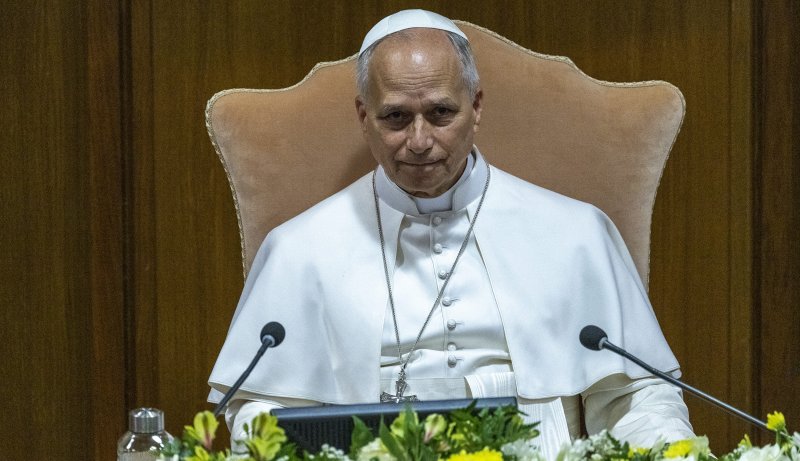
Pope Leo has used his latest encyclical to issue one of the strongest warnings yet from the Catholic Church about the rapid development of artificial intelligence, urging the world to ensure that emerging technologies serve humanity rather than control it.
His appeal to “disarm” AI has sparked global discussion among policymakers, technology companies, ethicists and religious leaders about the future of one of the most transformative technologies of the modern era, News.az reports.
The document reflects growing concerns about how artificial intelligence is reshaping societies, economies, warfare, education and human relationships. While acknowledging the enormous benefits that AI can bring, Pope Leo argues that technological progress must remain guided by ethical principles and respect for human dignity.
Here is what we know.
What did Pope Leo say about artificial intelligence?
In the encyclical, Pope Leo called for the “disarming” of artificial intelligence, arguing that technological systems should never be allowed to become instruments that undermine human freedom, dignity or peace.
The Pope emphasized that technology must remain a tool in the service of people rather than becoming a force that dictates human decisions or weakens moral responsibility.
He warned that humanity risks creating systems with enormous power but insufficient ethical oversight, potentially leading to harmful consequences for individuals and societies.
The message forms part of a broader appeal for responsible innovation and stronger international cooperation on technology governance.
What does “disarming AI” mean?
The phrase does not refer to shutting down artificial intelligence or stopping technological innovation.
Instead, it is understood as a call to prevent AI from being used in ways that threaten humanity, particularly through military applications, surveillance systems, manipulation technologies and other potentially harmful uses.
The Pope's message suggests that societies should place ethical limits on the deployment of AI and ensure that human beings remain responsible for decisions that affect lives, rights and freedoms.
In practical terms, “disarming AI” can be interpreted as reducing the risks associated with autonomous weapons, unchecked surveillance and algorithmic systems capable of causing significant social harm.
Why is the Catholic Church concerned about AI?
The Catholic Church has increasingly engaged with questions surrounding artificial intelligence over recent years.
Church leaders view AI as a technology capable of producing extraordinary benefits while simultaneously creating profound ethical challenges.
Among the concerns frequently raised are:
-
Loss of human control over important decisions
-
Threats to privacy and personal freedom
-
Manipulation of public opinion
-
Economic disruption caused by automation
-
Growing inequality between technological “winners” and “losers”
-
The development of autonomous weapons
-
The weakening of authentic human relationships
The Church argues that technological innovation must always be evaluated according to its impact on people rather than solely on efficiency or profit.
What is an encyclical?
An encyclical is one of the most important forms of papal teaching within the Catholic Church.
These documents are traditionally addressed to bishops and Catholics worldwide but are often intended for a much broader audience, including political leaders, academics and the general public.
Encyclicals typically address major moral, social, economic or global issues.
Throughout modern history, popes have used encyclicals to discuss subjects ranging from war and peace to economic justice, environmental protection and human rights.
As a result, a papal encyclical often influences debates far beyond religious communities.
Why is AI becoming a major ethical issue?
Artificial intelligence is advancing rapidly across multiple sectors.
AI systems are now capable of generating text, images, video and software code. They can analyze medical data, assist in scientific research, manage financial transactions and support military operations.
As capabilities expand, concerns are growing about how such systems should be regulated.
Questions include:
-
Who is responsible when AI makes harmful decisions?
-
How can societies prevent discrimination in algorithms?
-
Should machines be allowed to make life and death decisions?
-
How can privacy be protected in an era of advanced data collection?
-
What happens to workers whose jobs become automated?
These questions have transformed AI from a purely technical issue into a major ethical and political challenge.
What are autonomous weapons and why are they controversial?
One of the most sensitive issues surrounding AI involves military applications.
Autonomous weapons are systems capable of identifying and attacking targets with limited or no direct human intervention.
Supporters argue that such systems could improve military efficiency and reduce risks to soldiers.
Critics contend that delegating lethal decisions to machines raises profound moral and legal questions.
Many experts fear an international arms race involving increasingly sophisticated AI powered weapons.
Religious leaders, human rights groups and numerous governments have called for restrictions or international agreements governing their development and use.
The Pope’s reference to “disarming” AI is widely seen as partly connected to concerns about these technologies.
Could AI threaten jobs?
Automation has long transformed labor markets, but AI is expanding the range of tasks that machines can perform.
Unlike earlier technologies that primarily replaced physical labor, modern AI can perform certain cognitive tasks traditionally carried out by humans.
Industries potentially affected include:
-
Customer service
-
Finance
-
Transportation
-
Manufacturing
-
Media and journalism
-
Legal services
-
Administrative work
-
Software development
Some experts believe AI will create new opportunities and increase productivity.
Others warn that rapid disruption could deepen economic inequality if workers are not adequately prepared for changing labor market demands.
The Pope's concerns reflect broader fears that technological progress could leave vulnerable populations behind.
What about AI and misinformation?
Artificial intelligence has dramatically improved the ability to generate realistic text, audio and video content.
While these capabilities offer many legitimate uses, they also create opportunities for misinformation and manipulation.
Deepfake videos, synthetic audio recordings and automated content generation can potentially be used to spread false information, influence elections or damage reputations.
Governments, technology companies and researchers are exploring ways to address these risks while preserving freedom of expression and innovation.
The Pope has repeatedly stressed the importance of truth, responsibility and ethical communication in the digital age.
How are governments responding to AI concerns?
Around the world, governments are developing new regulatory frameworks for artificial intelligence.
Many countries are considering rules covering:
-
Transparency requirements
-
Data protection standards
-
Safety testing
-
Algorithmic accountability
-
Consumer protection
-
Competition policy
-
National security concerns
International organizations are also discussing common principles for AI governance.
The challenge facing policymakers is how to encourage innovation while protecting public interests and preventing misuse.
Does the Pope oppose artificial intelligence?
No.
The encyclical does not reject artificial intelligence or technological progress.
Instead, it acknowledges the positive potential of AI in fields such as medicine, education, scientific research and environmental protection.
The Pope's argument is that innovation should be guided by ethics rather than driven solely by commercial, political or military objectives.
He emphasizes that technology should enhance human flourishing and strengthen communities rather than weaken them.
The message is therefore one of caution and responsibility rather than opposition.
How might religious perspectives influence the AI debate?
Religious traditions often focus on questions that technology alone cannot answer.
These include:
-
What does it mean to be human?
-
How should power be exercised?
-
What responsibilities accompany innovation?
-
How can societies protect the vulnerable?
-
What values should guide technological development?
By raising such questions, religious leaders contribute ethical perspectives that complement technical and legal discussions.
The Pope's intervention highlights the growing recognition that decisions about artificial intelligence are not merely engineering challenges but also moral and social choices.
Why does this encyclical matter?
The document arrives at a time when artificial intelligence is rapidly transforming nearly every aspect of modern life.
Its significance lies not only in its religious authority but also in its contribution to a global conversation about technology and humanity.
As governments, companies and researchers race to develop increasingly powerful AI systems, Pope Leo's call to “disarm” artificial intelligence serves as a reminder that innovation must be accompanied by responsibility, accountability and ethical reflection.
The encyclical does not seek to halt technological progress. Rather, it urges humanity to ensure that the future of artificial intelligence remains firmly centered on human dignity, peace, justice and the common good.
By Faig Mahmudov


Similar news