NTSB Chair slams FAA over deadly DC midair collision: “67 people are dead”


National Transportation Safety Board (NTSB) Chair Jennifer Homendy delivered a scathing rebuke of the Federal Aviation Administration (FAA) during public hearings on Wednesday, criticizing the agency for failing to act on known safety concerns before a deadly midair collision in January that killed 67 people near Reagan National Airport.
The incident involved an American Airlines regional jet and a U.S. Army Black Hawk helicopter, which collided over the Potomac River on January 29. It marked the deadliest U.S. commercial airline accident since 2009. The Black Hawk was on a training mission at the time of the crash, News.Az reports, citing ABC News.
Homendy accused the FAA of ignoring clear warnings from air traffic controllers at Reagan National Airport about repeated near misses between military helicopters and civilian aircraft. She cited internal FAA data showing over 15,000 close-proximity events between helicopters and planes between October 2021 and December 2024. Despite these warnings, the agency failed to implement timely safety changes and instead reassigned several tower officials after the crash.
"Are you kidding me? Sixty-seven people are dead," Homendy said, blasting the FAA’s justification that bureaucratic processes delayed action. She revealed that it takes 21 procedural steps to implement a policy change at the FAA — a delay she called unacceptable in matters of life and death.
Newly released flight recorder data and surveillance footage revealed that the Black Hawk crew likely didn’t hear key instructions from the control tower due to a simultaneous radio transmission. Investigators also pointed to faulty altimeters in the helicopter, which may have given inaccurate altitude readings — a known issue in this model. A test flight conducted in May confirmed discrepancies of up to 100 feet between barometric and radio altitudes.
NTSB officials noted that helicopters and planes were often flying within just 75 feet of each other near Reagan National. Pilots of the American Airlines jet attempted evasive action seconds before impact, but the crash was unavoidable. Meanwhile, the Black Hawk crew appeared unaware of the danger.
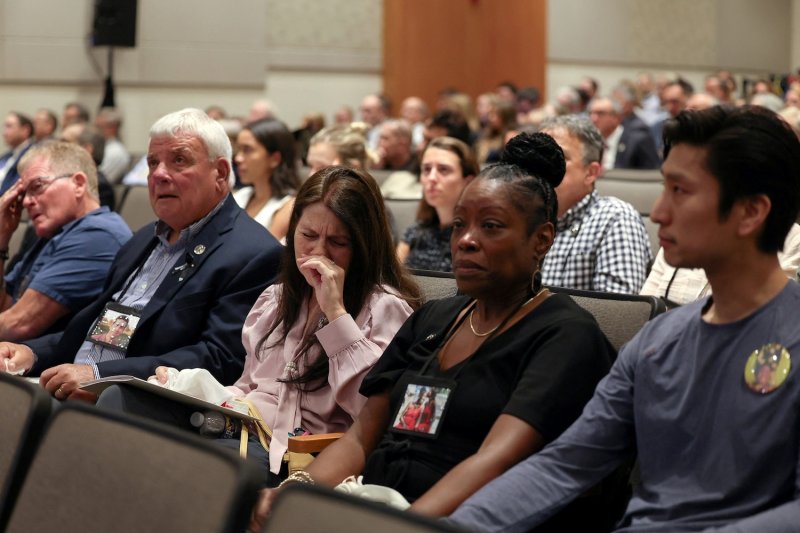
During the hearing, emotional families of the victims watched as officials played surveillance footage of the crash. Many wore photographs of their loved ones in remembrance.
The NTSB is also reviewing the military background of Capt. Rebecca Lobach, one of the pilots aboard the Black Hawk, whose past evaluations raised questions about readiness. However, Homendy emphasized that the crash may not have been caused by pilot error alone, and all contributing factors are under investigation.
Board members criticized the Army for failing to promptly address safety concerns. The Army acknowledged the faulty altimeter data but said it would not notify its aviators until mid-September. Board member J. Todd Inman condemned the delay, urging immediate action to prevent further incidents.
The hearings continue this week, with the NTSB questioning FAA and Army officials. The incident has prompted renewed calls for mandatory use of ADS-B (Automatic Dependent Surveillance–Broadcast) tracking systems, even on military aircraft. Senator Ted Cruz introduced new legislation — “The Rotor Act” — that would mandate all aircraft to broadcast their real-time location to prevent similar tragedies.
The investigation into the crash remains ongoing.


Similar news