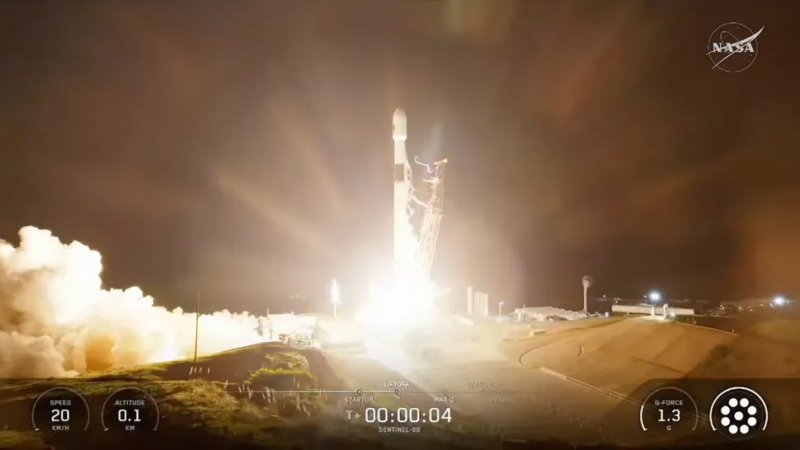
The Falcon 9 rocket lifted off from Vandenberg Space Force Base at 12:21 a.m. EDT (0521 GMT; 9:21 p.m. local time Nov. 16), News.Az reports, citing foreign media.
“Sentinel-6B rising, extending nearly four decades of the precise sea-level record from space,” NASA spokesman Derrol Nail said during the launch webcast.
The mission highlights both SpaceX’s milestone achievement in reusable rocketry and continued global efforts to monitor Earth’s oceans and sea-level changes.
🇺🇸 SPACEX LAUNCHES NASA CLIMATE DATA SATELLITE
— Mario Nawfal (@MarioNawfal) November 17, 2025
SpaceX has launched NASA’s Sentinel-6B into orbit from Vandenberg…because apparently measuring rising oceans from space is now a full-time job.
This will be the booster’s third rodeo (two Starlinks under its belt), and yes, it’s… https://t.co/pUqtQqYgmh pic.twitter.com/1DLL9M2J6b
SpaceX highlighted the reuse milestone in a post on X, as did company president and chief operating officer Gwynne Shotwell.
"Congratulations to the SpaceX team on completing 500 (!!!!) missions with flight-proven rocket boosters. You’ve made the impossible possible with reusable rockets, paving the way to land huge amounts of cargo and lots of people to establish permanent human presence on the moon and beyond with Starship!" Shotwell wrote.
The fully reusable Starship is the biggest and most powerful rocket ever built. SpaceX is developing it to help get humanity to the moon and Mars, among other feats. Starship has launched 11 times to date, but those don't contribute to the 500 count; all of Starship's liftoffs so far have been suborbital test flights.
Sentinel-6B is part of the European Union's Copernicus Earth-observing program. The new satellite will measure sea surface heights around the globe with great accuracy, continuing the work of its predecessor, Sentinel 6 Michael Frelich, which launched atop a Falcon 9 in November 2020.
"Monitoring sea-level rise is high on the global agenda," European Space Agency (ESA) officials wrote in a Sentinel-6B mission description.
"In the past 25 years, the average height of the world's oceans has risen by almost 10 cm [4 inches], according to data from Copernicus," they added. "The Copernicus Sentinel-6 mission has become the gold standard reference mission to monitor and record this key consequence of climate change."
Sentinel-6B will do this work using a radar altimeter instrument developed by ESA. The satellite also carries a NASA-provided microwave radiometer, which will determine atmospheric water content, allowing for more accurate interpretation of the altimeter's results.
During its first year of observations, Sentinel-6B will work with Sentinel 6 Michael Frelich, "enabling greater accuracy with precise cross-calibration between the two instruments," ESA officials wrote about the mission, which is a collaboration among the European Commission, ESA, NASA, Eumetsat, and the U.S. National Oceanic and Atmospheric Administration, with support from the French space agency CNES.
The Falcon 9's upper stage deployed Sentinel-6B on schedule about 57 minutes after liftoff, at an altitude of 1,322 kilometers (821 miles). The 3,175-pound (1,440 kilograms) satellite will now go through a series of checkouts, then begin its science mission.
The Falcon 9's first stage, meanwhile, came back to Vandenberg for a landing about nine minutes after liftoff as planned It was the third flight for this particular booster; its previous two missions lofted batches of SpaceX's Starlink broadband satellites, according to the company.