What is behind the US seizure of a sanctioned vessel in the Indian Ocean?


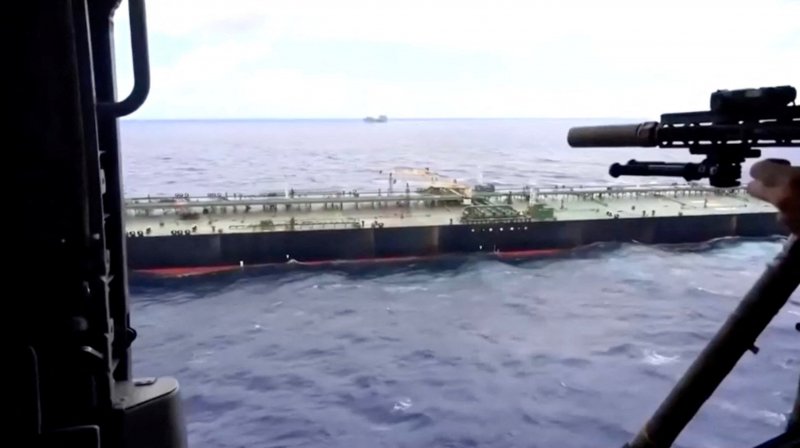
The United States military recently intercepted a sanctioned oil tanker in the Indian Ocean, triggering international attention and raising new questions about maritime security, sanctions enforcement, and geopolitical tensions.
According to US officials, the vessel was suspected of participating in activities that violated American sanctions and was allegedly involved in transporting restricted oil cargo, News.az reports.
Military personnel boarded the vessel during a coordinated operation at sea. The interception immediately became a major international story because it involved one of the world's most important shipping regions and occurred at a time of heightened tensions involving Iran, global energy markets, and maritime security.
The operation reflects Washington's growing willingness to use military assets to enforce sanctions beyond traditional financial and diplomatic measures.
Why is this story attracting so much global attention?
Several factors explain the unusually high level of interest.
First, the Indian Ocean serves as one of the most important trade corridors in the world. Every day, enormous volumes of oil, gas, manufactured goods, and raw materials pass through the region.
Second, any incident involving an oil tanker immediately attracts attention because of potential implications for global energy supplies and fuel prices.
Third, the operation occurred during a period of elevated tensions between the United States and Iran, making observers concerned about possible retaliation or escalation.
Finally, the story combines military action, international law, energy security, sanctions policy, and geopolitical rivalry, all of which are topics that typically generate significant public and media interest.
What exactly is a sanctioned vessel?
A sanctioned vessel is a ship that has been placed under restrictions by a government or international organization.
These restrictions can prohibit companies, banks, insurers, ports, and shipping operators from doing business with the vessel. Sanctions may be imposed for various reasons, including alleged violations of international law, sanctions evasion, illegal trade, support for prohibited activities, or involvement in restricted economic sectors.
When a ship becomes sanctioned, it often faces serious difficulties obtaining insurance, entering ports, receiving services, or conducting commercial operations.
In many cases, sanctioned vessels continue operating through complex shipping networks that attempt to avoid detection.
Why do governments impose sanctions on ships?
Sanctions are designed to apply economic pressure without resorting to direct military conflict.
Governments use sanctions to restrict the ability of targeted entities to generate revenue, acquire resources, or conduct international business.
Ships frequently become targets because maritime transportation plays a central role in global trade. Oil exports, commodity shipments, and industrial goods often travel by sea, making shipping networks a critical component of international commerce.
By targeting vessels, authorities aim to disrupt supply chains and reduce financial flows associated with activities they consider unacceptable.
Why is the Indian Ocean strategically important?
The Indian Ocean is one of the world's most vital maritime regions.
It connects the Middle East, Africa, South Asia, Southeast Asia, and Europe. Some of the world's busiest shipping routes pass through its waters.
A large percentage of global oil exports travel through nearby maritime chokepoints before reaching international markets. As a result, any security incident in the region can affect international trade, shipping costs, insurance premiums, and energy markets.
The Indian Ocean has also become an arena of increasing strategic competition among major powers, including the United States, China, India, and regional actors.
Because of its importance, military operations in the area are closely monitored by governments and financial markets worldwide.
Why is oil at the center of this issue?
Oil remains one of the most important commodities in the global economy.
Many countries rely heavily on energy exports for government revenue. At the same time, industrial economies depend on imported oil to power transportation, manufacturing, and electricity generation.
Because oil has such strategic value, sanctions targeting petroleum exports can have significant economic consequences.
When authorities intercept vessels suspected of transporting restricted oil shipments, the objective is often to limit revenue streams and increase pressure on the targeted actors.
This explains why oil tankers frequently become focal points in geopolitical disputes.
How common are maritime interceptions?
Maritime interceptions are not rare, but they usually receive widespread attention when they involve large tankers, strategic regions, or geopolitical rivals.
Navies around the world regularly conduct inspections, anti-piracy missions, anti-smuggling operations, and sanctions enforcement activities.
However, operations involving major oil tankers attract greater scrutiny because they can have broader economic and political implications.
Recent years have seen a noticeable increase in maritime enforcement actions as governments seek to strengthen sanctions implementation and monitor global shipping activities more closely.
How do military boarding operations work?
Boarding operations are among the most complex missions conducted at sea.
Specialized military teams approach a target vessel using helicopters, small boats, or a combination of both. Personnel then secure the ship, inspect documentation, verify cargo information, and evaluate compliance with applicable regulations.
These operations require extensive planning because they involve significant safety risks.
Weather conditions, vessel size, crew cooperation, and potential resistance all influence how an operation is conducted.
Military boarding teams undergo extensive training to prepare for these scenarios.
Could the interception affect global oil prices?
Potentially, yes.
Oil markets are highly sensitive to geopolitical developments. Even when a single tanker is involved, investors often view such incidents as indicators of broader risks.
If maritime tensions increase, traders may worry about future disruptions to supply routes. These concerns can contribute to higher oil prices and increased market volatility.
The actual impact depends on whether the incident remains isolated or becomes part of a larger pattern of confrontations.
If shipping activity continues normally, market effects may be limited. If tensions escalate, the consequences could become more significant.
What are maritime sanctions enforcement operations intended to achieve?
The primary goal is to ensure that sanctions remain effective.
Without enforcement, sanctions can lose much of their impact because targeted entities may continue conducting business through alternative channels.
By intercepting vessels, authorities attempt to identify violations, gather evidence, deter future activity, and demonstrate that restrictions will be actively enforced.
Supporters argue that such measures strengthen international compliance.
Critics contend that aggressive enforcement can increase geopolitical tensions and create uncertainty for commercial shipping.
Could this lead to a military confrontation?
While no one can predict future events with certainty, incidents involving military forces always carry some degree of risk.
When multiple countries operate naval assets in the same region, misunderstandings and miscalculations can occur.
History shows that even relatively small maritime incidents can develop into larger diplomatic disputes if tensions are already high.
For this reason, governments typically maintain communication channels aimed at preventing unintended escalation.
Most observers hope that any disagreements resulting from the interception will remain within diplomatic and legal frameworks.
How does international law apply to situations like this?
International maritime law is complex and often subject to differing interpretations.
Various legal frameworks govern navigation rights, territorial waters, exclusive economic zones, and activities on the high seas.
Governments frequently disagree about how sanctions enforcement should be conducted and what actions are legally permissible.
Supporters of maritime enforcement argue that sanctions must be actively implemented to remain credible.
Critics argue that excessive intervention could interfere with freedom of navigation and commercial shipping.
As a result, incidents like this often generate extensive legal debate.
Why are shipping routes becoming more politically sensitive?
Global trade is increasingly intertwined with geopolitics.
Major powers now view supply chains, energy transportation, and critical maritime corridors as matters of national security.
Events that might once have been considered purely commercial now carry strategic implications.
Competition over energy resources, trade routes, technology, and regional influence has transformed many shipping lanes into areas of geopolitical significance.
This trend is likely to continue as countries seek to protect their economic and security interests.
What role does technology play in tracking vessels?
Modern maritime surveillance is far more sophisticated than it was in the past.
Authorities use satellites, radar systems, drones, aircraft, artificial intelligence tools, and advanced tracking technologies to monitor vessel movements across vast ocean areas.
These capabilities allow governments to identify suspicious shipping patterns, detect unusual route changes, and monitor cargo transportation networks.
As surveillance technology continues to improve, it is becoming increasingly difficult for vessels to operate unnoticed.
This has significantly changed the landscape of sanctions enforcement.
Could shipping companies become more cautious after this incident?
Many industry experts believe so.
Whenever a high-profile interception occurs, shipping companies, insurers, and traders tend to reassess operational risks.
Businesses may increase compliance checks, review cargo documentation more carefully, and strengthen due diligence procedures.
Insurance providers may also evaluate whether certain routes or transactions involve elevated risk.
These adjustments can influence shipping costs and operational practices throughout the industry.
What does this incident reveal about modern geopolitics?
The interception highlights how economic policy, military power, and global trade have become deeply interconnected.
Sanctions are no longer enforced solely through financial institutions and diplomatic pressure. Increasingly, governments are using intelligence capabilities, maritime assets, and international partnerships to pursue enforcement objectives.
The event also demonstrates how a single vessel can become the focus of broader disputes involving energy security, international law, regional influence, and global commerce.
What could happen next?
Several outcomes remain possible.
Authorities may continue investigating the vessel and its activities.
Additional sanctions enforcement actions could follow.
Diplomatic discussions may take place between the governments involved.
Shipping companies may adopt stricter compliance measures.
Energy markets may continue monitoring developments for signs of broader instability.
Most importantly, policymakers around the world will be watching closely to determine whether the incident remains an isolated enforcement operation or becomes part of a larger geopolitical confrontation.
Why does this story matter beyond one ship?
The interception is about much more than a single vessel.
It touches on some of the most important issues shaping international affairs today: energy security, sanctions policy, maritime trade, military power, international law, and geopolitical competition.
The Indian Ocean serves as a lifeline for the global economy. Any event that affects security and stability in this region has implications that extend far beyond the ship involved.
For that reason, the interception of a sanctioned vessel in the Indian Ocean is likely to remain an important reference point in discussions about the future of global maritime security and international sanctions enforcement.
By Faig Mahmudov


Similar news