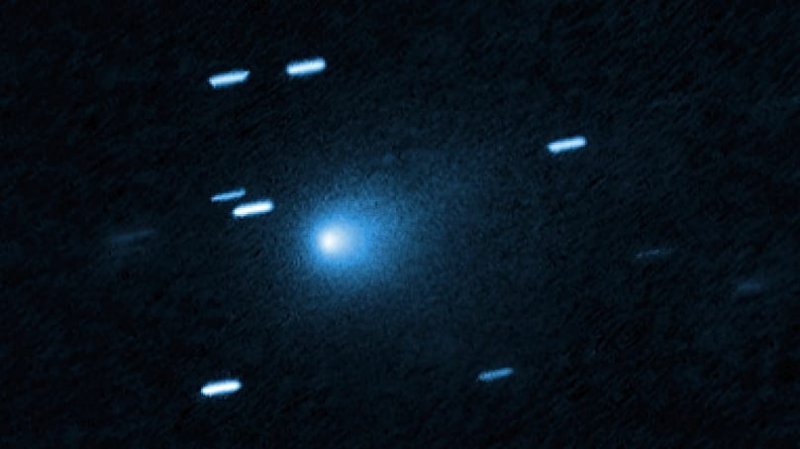
The anti-tail of 3I/ATLAS grew toward the Sun after perihelion, its closest approach to the star. The phenomenon was most prominent during the two months following perihelion, when the anti-tail extended by several hundred thousand kilometers, unusually directed sunward.
Scientists are continuing to study the comet to better understand its peculiar behavior and the factors influencing its unusual tail structure.
This direction is the opposite of what usually appears in comets. The situation raised doubts about the composition of the object and about the way in which dust and gas are distributed.
The topic gained traction because anti-glue doesn't seem to depend on just one type of material. The comparison between dust and gas became the focus of the analysis.
Dust and gas do not react in the same way in space.
Dust can be pushed along by gas escaping from the comet's nucleus. It can travel great distances and then lose speed as it moves. solar radiation pressure.
This effect helps explain why a jet can grow so large even when the gas is not clearly visible. The dust follows its own dynamics and can remain visible for a long time.
Gas has another type of obstacle. The strongest interaction occurs with the solar wind, which influences the path of material released by the nucleus.
In a natural comet, the release of gas usually occurs by sublimation of ice. This process transforms ice into gas when the object heats up as it approaches the Sun.
One example cited for this mechanism is carbon dioxide (CO2). The presence of this type of ice helps to support the formation of gas jets in comets. The discussion then becomes about the ability of this process to sustain the pattern observed in the anti-glue. The doubt centers on the energy required to maintain the gas's movement.
Observations of Hubble Space Telescope indicated that anti-glue includes moving gas at more than 5.000 km from the core of 3I/ATLASThis detail was treated as something unusual. The presence of gas so far from the core changes the weight of the analysis. It's not just dust dragged along to form a visible trail. This behavior opens the door to discussing whether the ejection velocity would be greater than expected for ordinary sublimation. The focus then shifts to speed of the expelled material.
Avi Loeb linked anti-glue to the possibility of a technological driver. The idea links the jet's launch speed to an artificial mechanism. In this scenario, the gas could flow towards the Sun on even larger scales. The basis is that a thruster would sustain a more intense pattern than natural processes. The topic remains controversial, but the anti-glue of 3I/ATLAS continues to fuel questions about what is behind this jet stream. The direct consequence is that the comet remains a priority target for observation.
This phenomenon should serve as a reference point in the coming years due to its anti-glue behavior. The phenomenon highlights the challenge of explaining jets of light directed towards the Sun using the most common models.
From here, the most likely path is to broaden the analyses on dust, gas and the interaction with the solar wind. Each new piece of information tends to weigh more heavily in the debate about the object's origin.
The interstellar comet 3I/ATLAS maintained its attention even after its peak proximity to Earth on December 19th. The direction towards the sun remains the most difficult point to fit into typical behavior.
With evidence of gas exceeding 5.000 km from the nucleus, the debate takes on a new level of complexity. The practical impact is clear: the comet remains on the radar and may influence how cometary phenomena are interpreted going forward.