Azerbaijan–China: From 1990s diplomacy to a comprehensive strategic partnership


On December 24, Baku hosted the presentation of “Azerbaijan–China: Presidential Chronicle (2003–2025)”, authored by Professor Rafig Abbasov, Director of the Confucius Institute at the Azerbaijan University of Languages.
The event was attended by Chinese Ambassador to Azerbaijan Lu Mei, who highlighted the book’s significance in tracing the evolution of bilateral relations between China and Azerbaijan over recent decades. The ambassador emphasized that the work symbolizes the continuity of a course established by Heydar Aliyev and successfully advanced by Ilham Aliyev, a trajectory aimed at fostering closer ties with China, building mutual trust, and cultivating a long-term, comprehensive strategic partnership.
The history of Azerbaijan-China relations is deeply intertwined with the restoration of Azerbaijan’s independence in 1991. For a newly sovereign state facing economic challenges, the Karabakh conflict, and the task of establishing a foreign policy framework from scratch, cultivating stable international partners was essential. Heydar Aliyev played a crucial role during this period, introducing multi-vector diplomacy as the cornerstone of Azerbaijan’s foreign policy. China became one of the first major powers to establish diplomatic relations with Azerbaijan on April 2, 1992, a significant political gesture affirming the country’s sovereignty.
In 1994, Heydar Aliyev made his inaugural visit to Beijing, during which eight intergovernmental agreements were signed, covering the economy, science, education, culture, and investment protection. These agreements laid the first firm foundation for bilateral relations. China closely observed regional developments, recognizing Azerbaijan’s strategic location along transport corridors and its considerable energy potential. For Azerbaijan, China emerged as a geopolitical ally beyond the post-Soviet space—a partner that respected the country’s sovereignty and domestic policies. Under Heydar Aliyev, key principles of cooperation were established that remain relevant today: non-interference in internal affairs, mutual respect for territorial integrity, long-term partnership, and a pragmatic, economically-driven approach rather than ideological alignment. These principles allowed bilateral relations to develop steadily and without abrupt fluctuations, distinguishing them from many other international partnerships.
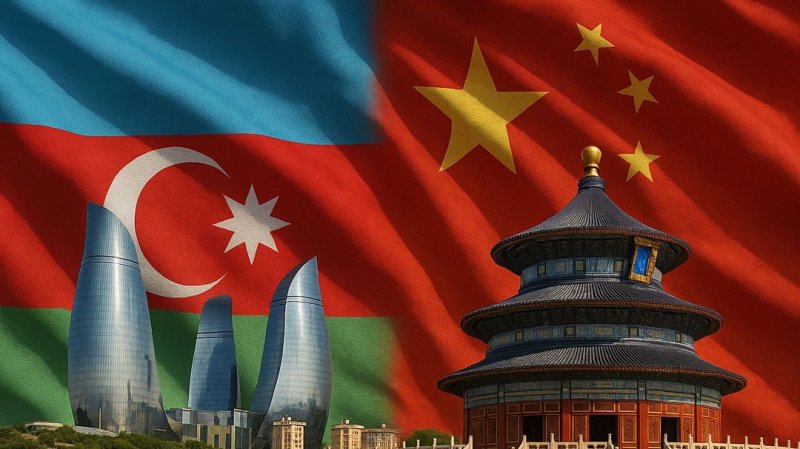 Photo: Trend
By the late 1990s and early 2000s, trade turnover and initial investment projects began to grow. Chinese companies entered Azerbaijan’s infrastructure sector, while technological equipment, telecommunications systems, and construction machinery were supplied from China. Scientific exchange expanded, student programs were launched, and the first Azerbaijani students began studying at Chinese universities. Although modest, these steps set the stage for deeper cooperation.
After being elected as Azerbaijan’s President in 2003, Ilham Aliyev built upon his father’s foundation, making China a central pillar of Azerbaijan’s Eurasia-focused foreign policy. If Heydar Aliyev’s era laid the groundwork, Ilham Aliyev’s tenure has been marked by the construction of an extensive cooperation infrastructure, the expansion of trade and investment, and Azerbaijan’s integration into China’s major international initiatives.
Regional dynamics have also evolved. With the launch of the Belt and Road Initiative, China developed a network of logistics corridors connecting Asia and Europe. Azerbaijan has become a key node in this network, geographically, logistically, and politically. The country now plays a central role in the Trans-Caspian Corridor, through which cargo from China travels via Kazakhstan, crosses the Caspian Sea to Baku, and continues to Georgia, Türkiye, and Europe. This route reduces delivery times from 30–45 days by sea to roughly 12–21 days. Cargo transiting through Azerbaijan grows annually by tens of percent, with some years witnessing increases of more than 34%.
Economic cooperation has strengthened consistently. Trade turnover, which stood at approximately $1.3 billion in 2018, reached $3.2 billion by 2023 and exceeded $3.7 billion in 2024—an increase of nearly threefold in six years. China has become one of Azerbaijan’s largest trading partners, supplying technological equipment, construction materials, and electronics, and accounting for over 17% of Azerbaijan’s imports.
 Photo: AZERTAC
Investment cooperation has also expanded. Since 1995, total Chinese direct investment in Azerbaijan is estimated at around $920 million. Equally important is the growth in the number of Chinese-owned enterprises, which now exceeds 375, with over 298 actively operating. These companies are involved in construction, oil and gas logistics, telecommunications, green energy, agriculture, and manufacturing. Energy cooperation has extended to renewable projects, including solar and wind initiatives, aligning with Azerbaijan’s environmental strategy and COP commitments.
Humanitarian and cultural exchanges have flourished. The Confucius Institute in Baku serves as a hub for cultural diplomacy, attracting hundreds of students annually to learn Chinese, participate in internships, summer schools, academic exchanges, and competitions. Visa-free travel for ordinary passport holders has boosted tourism, with the number of Chinese visitors to Azerbaijan rising by over 50%, exceeding 57,000 in some years. Meanwhile, Azerbaijanis are increasingly traveling to China for tourism, business, cultural missions, and scientific programs.
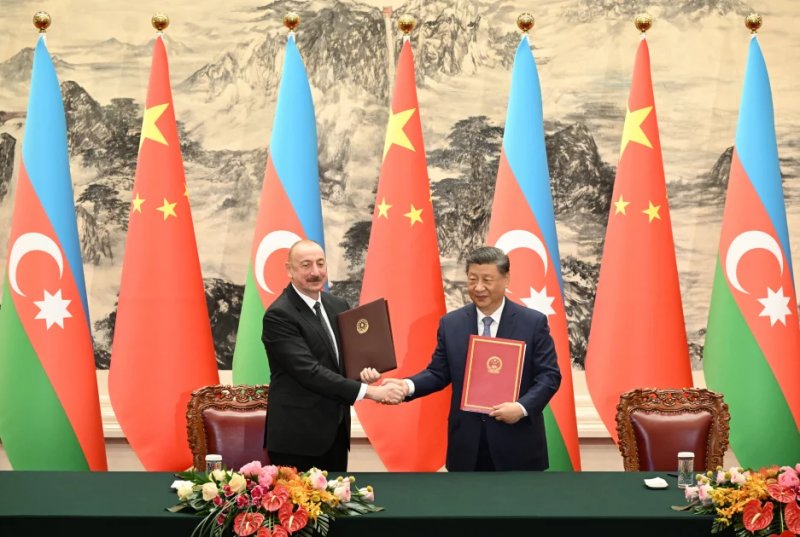
Political dialogue has also intensified. Presidents Ilham Aliyev and Xi Jinping have met repeatedly at international summits, including within the Shanghai Cooperation Organization, Belt and Road forums, and global energy and transport gatherings. During Ilham Aliyev’s state visit to China in 2025, a joint statement established a comprehensive strategic partnership, committing to deeper collaboration in energy, infrastructure, the digital economy, cybersecurity, transport corridors, and business legal frameworks.
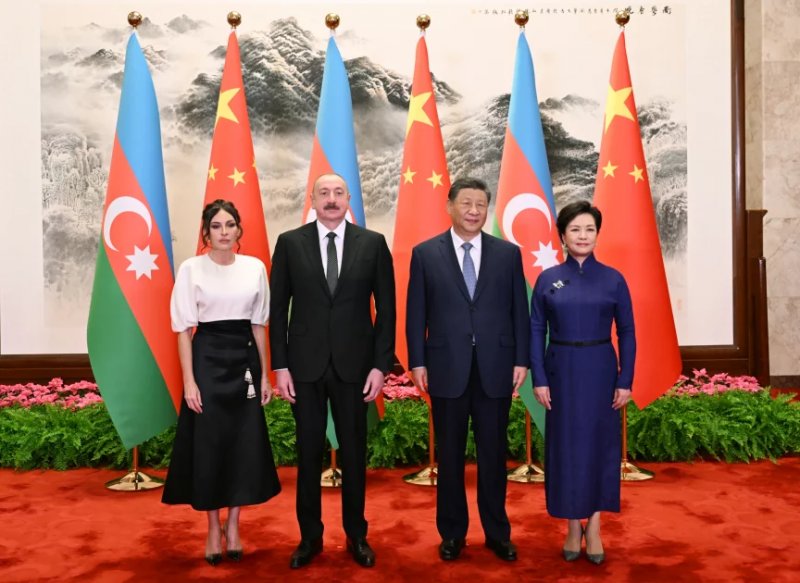 Photo: AZERTAC
The book “Azerbaijan–China: Presidential Chronicle (2003–2025)”, presented in the presence of Ambassador Lu Mei, is more than a political record. It embodies continuity — from Heydar Aliyev’s first diplomatic initiatives to Azerbaijan’s emergence as a regional transit and energy hub under Ilham Aliyev. China views the work as a testament to a friendship grounded not merely in declarations, but in practical, mutually beneficial cooperation.
Today, Azerbaijan-China relations extend beyond visits, meetings, and trade. They encompass a shared vision for the future, including joint technology parks, renewable energy projects, trans-Eurasian railways, educational clusters, cultural programs, and digital initiatives. The partnership has evolved into a model of comprehensive strategic cooperation, designed to endure for decades.
Azerbaijan and China are united by principles of state sovereignty, multipolarity, mutual benefit, and respect for historical choices. This foundation ensures that the relationship remains sustainable and promising, and Abbasov’s book stands as a symbol of the journey that began with Heydar Aliyev’s diplomatic outreach and continues with strategic momentum under Ilham Aliyev.


Similar news