Conflict in Bangladesh: What's behind the mass protests against the president?


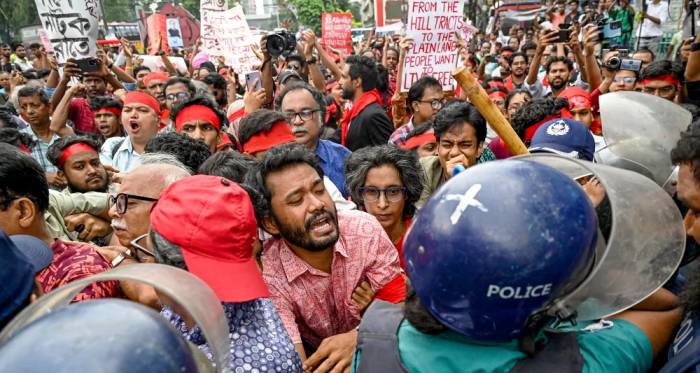
In recent weeks, protests in the capital of Bangladesh, Dhaka, have escalated rapidly, with demonstrators demanding the resignation of President Mohammed Shahabuddin.
These events have heightened the political tension in a country already on edge following the high-profile departure of former Prime Minister Sheikh Hasina in August. Although the role of the president in Bangladesh is largely ceremonial, his recent comments about a supposedly "missing" resignation letter from Hasina have reignited national debate, deepening divisions among political elites and sparking a wave of public discontent.According to recent reports, Shahabuddin, who had supported the student movement that led to Hasina's fall, now surprisingly claims he never saw her written resignation. His statement casts doubt not only on her departure but also on the legitimacy of the interim administration led by Mohammed Yunus. In the eyes of protesters, Shahabuddin, appointed by Hasina before her ousting, appears as her ally, supporting what they view as an illegitimate regime.
Activists, particularly the student movement that played a key role in August, are now calling for the president’s complete resignation. Protest leader Faruk Hossain calls Shahabuddin “a symbol of the old regime,” emphasizing that a head of state associated with the former government cannot remain in power. This sentiment is backed by mass demonstrations and clashes with the police outside the president’s residence. Police report that around 25 officers were injured when protesters began throwing stones in an attempt to break through the barricades.
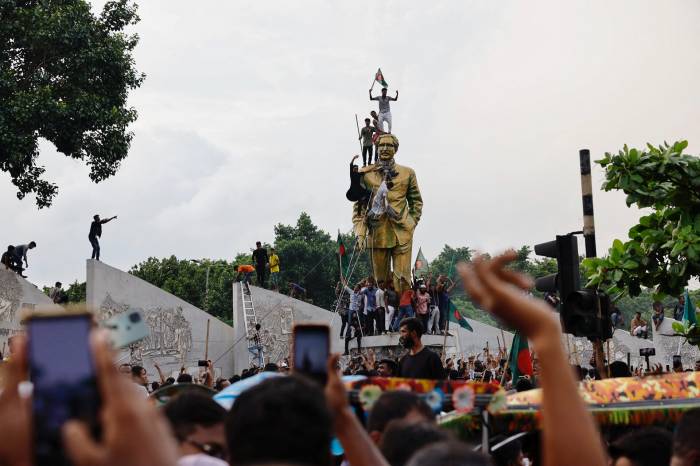
The situation took a sharper turn in October when the president, in an interview with journalist Matiur Rahman Chowdhury, stated that he had not seen any documents confirming Hasina’s resignation. He explained that he only learned of her decision through General Wakir-uz-Zaman, the head of the army. The question of whether such an “oral” resignation is legitimate quickly gained importance, especially given that in August, the president had himself stated that he had received her resignation letter. As he shifts between these contradictory narratives, Shahabuddin enters a precarious position, where each word he utters could either stabilize or further destabilize the fragile balance.
The ongoing crisis in Bangladesh is already marked by legal ambiguities; the constitution has no clear provisions for establishing a caretaker government, prompting critics to label the situation a “concealed coup.” The role of the military, whose leaders announced Hasina’s resignation, raises doubts about the legality of the entire process. Critics argue that the lack of official documentation undermines the legitimacy of Yunus’s interim government, which operates under the Supreme Court’s mandate to maintain stability in exceptional circumstances.
Led by Yunus, the interim government, despite its goal of stabilization, has been conducting political purges among Hasina loyalists, including high-ranking judges and the head of the Central Bank. Public statements accompanying these actions reflect the new regime’s desire to prevent former loyalists from returning to power. Meanwhile, the president’s increasingly contradictory statements place him in a difficult position: on one hand, he must remain neutral and support the new government; on the other, his past ties with Hasina and apparent contradictions in his statements complicate this role.
It’s clear that the student movement and opposition forces view Shahabuddin as a political symbol of the Hasina era, adding pressure on him and his team. The interim cabinet, through legal advisor Asif Nazrul, insists that the president must “retract false statements” or face removal. Meanwhile, student protesters are making even sharper demands, accusing Shahabuddin of “fascist” policies and calling for a “president of the people” who can truly defend national interests.
The situation surrounding Shahabuddin illustrates a deep crisis of trust and legitimacy that has taken hold in Bangladesh. Despite his nominally ceremonial role, the president finds himself at the heart of a political storm. His statement about the “nonexistent” resignation letter not only raises doubts about Hasina’s departure but also threatens the process of transferring power itself. As protests continue to grow, Bangladesh finds itself on an uncertain path, where each step could either restore trust or irreparably undermine the foundations of its state system.


Similar news