Pashinyan announces alternative to Russian gas — TRIPP?


The Russian Foreign Ministry has confirmed media reports that Moscow is considering terminating its gas agreement with Armenia. Indeed, the Russian Embassy in Yerevan has handed Armenian authorities a letter from Energy Minister Sergei Tsivilev outlining the possible consequences of Armenia maintaining its course toward joining the European Union. The letter states that Russia may suspend or unilaterally denounce the agreement on supplies of natural gas, petroleum products, and uncut diamonds to Armenia, which was signed in December 2013.
Under the 2013 agreement, Russia indefinitely abolished export duties on supplies of petroleum products, gas, and diamonds to Armenia. Today, Armenia receives gas at a price three times lower than the rate at which Russia sells gas to Europe.
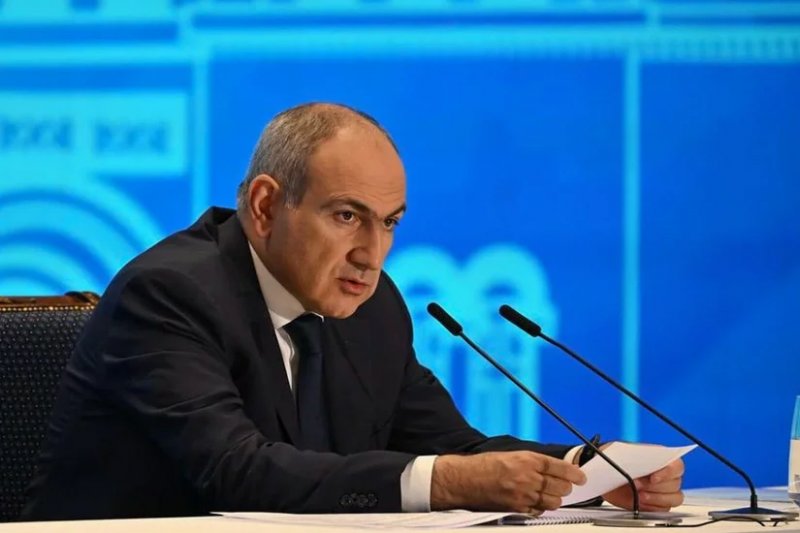
Prime Minister Nikol Pashinyan responded to the Russian side by saying that it is illogical to scare Yerevan with high gas prices, since Armenia will have “much more money, enough so that it will not seem expensive,” Armenian media reported. The Armenian prime minister stressed that Armenia is becoming a “Crossroads of Peace,” has a military-industrial complex, and is already selling weapons to developed countries.
“It is illogical to threaten Armenia, for example, with high prices, because there is an answer to threats of high prices: we will have much more money — so much that it will not seem expensive to us. Today, Armenia is becoming a ‘Crossroads of Peace’ — this means Armenia will become a country not of thousands and millions, but of billions and trillions,” Pashinyan said at a campaign rally in the town of Garni. “From now on, we will no longer rely on one road, one ally, or one pipeline. [...] A gas pipeline will pass through Armenia’s territory, and through this transit we will have our own gas, because we will be paid for transit in gas,” TASS quoted the Armenian prime minister as saying.
In other words, the country will manage without Russian gas. This is exactly the message Armenia’s prime minister wanted to send. In the long term, such a scenario is possible, but not now — when Armenia has only one pipeline and remains fully dependent on Russian gas. According to Reuters, in 2025 Armenia imported 82% of the gas it consumed from Russia. In other words, the country is heavily dependent on Russian supplies in the absence of alternative sources and infrastructure.
Russian media recall that just a week ago, the Armenian prime minister said Armenia and Russia had a “strategic agreement on the gas price, and it cannot change.” Russian analysts link the current shift to a framework memorandum on the extraction and processing of critical minerals and rare earth metals signed in Yerevan in the presence of U.S. Secretary of State Marco Rubio. Armenia and the United States initialed a framework agreement on strategic cooperation under the TRIPP project. The signing took place at Yerevan airport, where the U.S. Secretary of State’s plane stopped for one hour.
In principle, the document signed with the United States opens certain prospects for Armenia. If Pashinyan wins the elections and the “turn to the West” continues, the rare earth materials agreement could significantly replenish Armenia’s budget. But this is possible only if Pashinyan remains in power. The pro-Russian opposition would not complete the deal with Washington and would instead replace it with Moscow.
Now, to the pipeline announced by Nikol Pashinyan.
It is almost certainly a gas pipeline planned along the TRIPP route, parallel to transport corridors and power transmission lines.
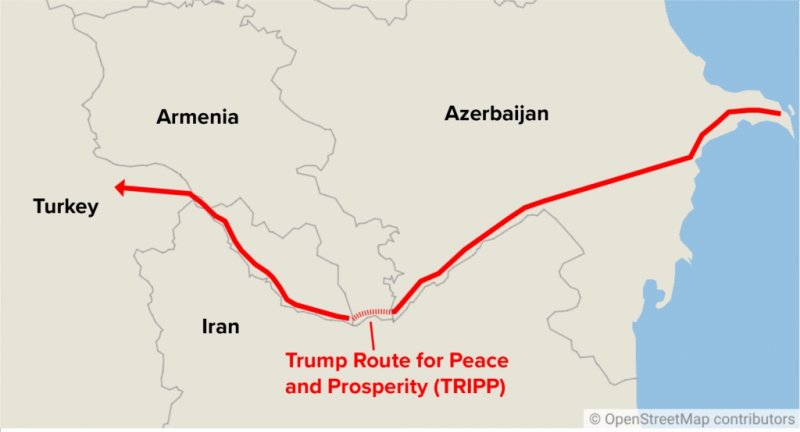
Credit: OpenStreetMap
Russian experts suggest that this will be a pipeline through which gas from Turkmenistan will flow via Armenia. In any case, as they believe in Russia, by trying to join projects linked to the Turkish and Azerbaijani directions, Yerevan will only complicate its own situation, since it will have to depend on peace with Azerbaijan and relations with Türkiye.
As for the transit of Turkmen gas, there is still no pipeline between the eastern and western shores of the Caspian Sea. However, as Luke Coffey, a senior fellow at the Hudson Institute, previously wrote in an article for Arab News, the construction of the Trans-Caspian Gas Pipeline fits perfectly into the U.S. foreign policy agenda, including the “Trump Route” — TRIPP — which would connect Europe with Central Asia through the South Caucasus. According to Coffey, the current geopolitical environment is favorable for implementing the project. Since the 1990s, there has never been a better opportunity to realize the dream of the Trans-Caspian Pipeline. If built, it would become a turning point for the entire region: strengthening Europe’s energy security, bringing new revenues to Turkmenistan, and reinforcing geopolitical stability across Eurasia, Coffey believes.
If a final decision is made to build a gas pipeline through Armenia, the Trans-Caspian Pipeline project may well return to the agenda. At present, the region lacks additional capacity for the transit of Turkmen gas, as the Southern Gas Corridor was not designed for such extra volumes, while a new gas pipeline could serve precisely this purpose. However, the question of financing remains open. Who will pay for a pipeline from Turkmenistan to Europe through the Caspian Sea, Azerbaijan, Armenia, and Türkiye?
It is difficult to say whether transit along such a short section of the pipeline would be enough to cover Armenia’s required gas volumes. But if Armenia continues its current policy, it has an alternative in the form of Azerbaijani gas. The possibility of purchasing Azerbaijani gas was discussed in Yerevan two years ago, and at that time Baku did not reject the idea.
By Tural Heybatov


Similar news