From enemies to allies: Why Assad’s rivals are now embracing Putin


Editor's note: Russian military-political analyst, expert in the field of strategic security, specialist in the Middle East and Africa Vladimir Bekish. The article expresses the personal opinion of the author and may not coincide with the view of News.Az.
Perhaps there is something mysterious in what is happening. Something with deep-rooted or psychological factors that cannot be explained with simple reasoning and clarifications.
I am referring to the relationship between Russia and Syria — today’s Russia, and some time ago, the Soviet Union and Syria. One could try delving into history, bringing up arguments about ideological cooperation, communism, and socialism, as well as decisive assistance from the USSR — and later from its successor, Russia — to many countries that at some point chose the path of socialism, anti-colonialism, and anti-imperialism. Naturally, they immediately became friends of Russia, including in our own time.
However, let’s not plunge too deeply into history. Let us assess what is happening between Russia and Syria right now, in 2025. So, the latest events:
Source: Russiaspivottoasia
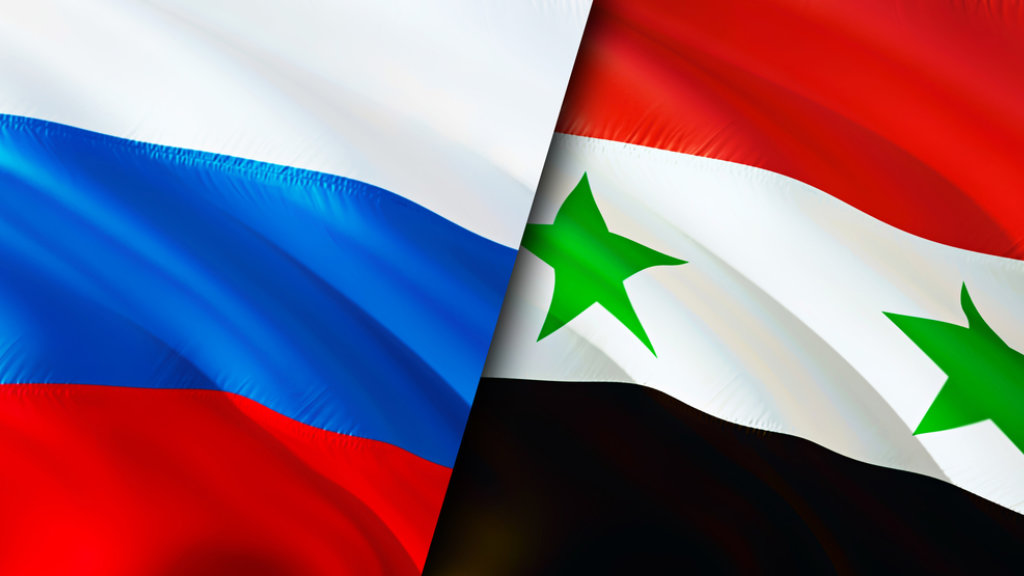
On July 31, Vladimir Putin received in the Kremlin a Syrian delegation headed by the Foreign Minister of the Syrian Arab Republic’s transitional government, Asaad al-Shibani. Before this meeting, the Syrian foreign minister met with Russia’s Foreign Minister Lavrov. According to the Syrian side, this event marked the beginning of a new stage — not only of political, but also of military understanding between the two states. Military understanding, it seems, was also being forged through the efforts of Russia’s Defense Minister Belousov and his Syrian counterpart, the Syrian Defense Minister Murhaf Abu Kasra, who was also part of the Syrian delegation and held talks with Belousov. According to official statements, the defense chiefs discussed “cooperation between the defense ministries and the situation in the Middle East.”
One might well ask — what is strange or illogical about these meetings and negotiations? Syria and Russia have had long-standing, strong relations… Yes, the ties were indeed long-lasting and solid. But the fact remains that these relations collapsed because Russia’s long-time friend and the leader of Syria — friendly to Russia — Bashar al-Assad, was overthrown. And he was overthrown by the very people who now lead Syria and who came to Moscow to meet with Russia’s president, defense minister, and foreign minister. Moreover, Bashar al-Assad was not only deposed by these current visitors but had to hide from them, receiving asylum in Russia so that they would not execute or imprison him.
You will agree that this combination of circumstances looks somewhat ambiguous. And naturally, one is inclined to think of the most logical explanations — namely, pragmatism and the pursuit of benefits, on both sides.

Source: iiss
Indeed, let us suppose that the current Syrian authorities are willing to turn a blind eye to the fact that Russia, for many years and with billions of dollars in military aid, supported Assad, who used this Russian assistance to crush the opposition of the time — the very same opposition that is now in power. Let us further suppose that this former opposition will not demand that Russia hand over Assad. This would mean, for Russia, first of all, removing a serious headache in interstate relations and in Russia’s international policy. Secondly, it would be an open window of opportunity for Russia — an opportunity to restore its positions in Syria, including securing some positive outcome for the fate of its military bases on Syrian territory, which it had obtained from Assad and from which it was being pushed out. And of course, it would be a chance for Russia to once again become a factor influencing the overall situation in the Middle East, in the current climate of confrontation between Israel and Syria, Gaza, and Iran. Judging by appearances, this last point is of considerable importance for Russia.
This follows from one of the Syrian Foreign Ministry’s statements about these talks: “…President Putin stressed Russia’s absolute rejection of any Israeli intervention or attempts to divide Syria.” And here we should add another fact: on July 4, Putin had a telephone conversation with Benjamin Netanyahu. The details have not been disclosed, but the mere fact that the conversation took place right after the visit of the current Syrian leadership’s representatives to Russia speaks volumes.
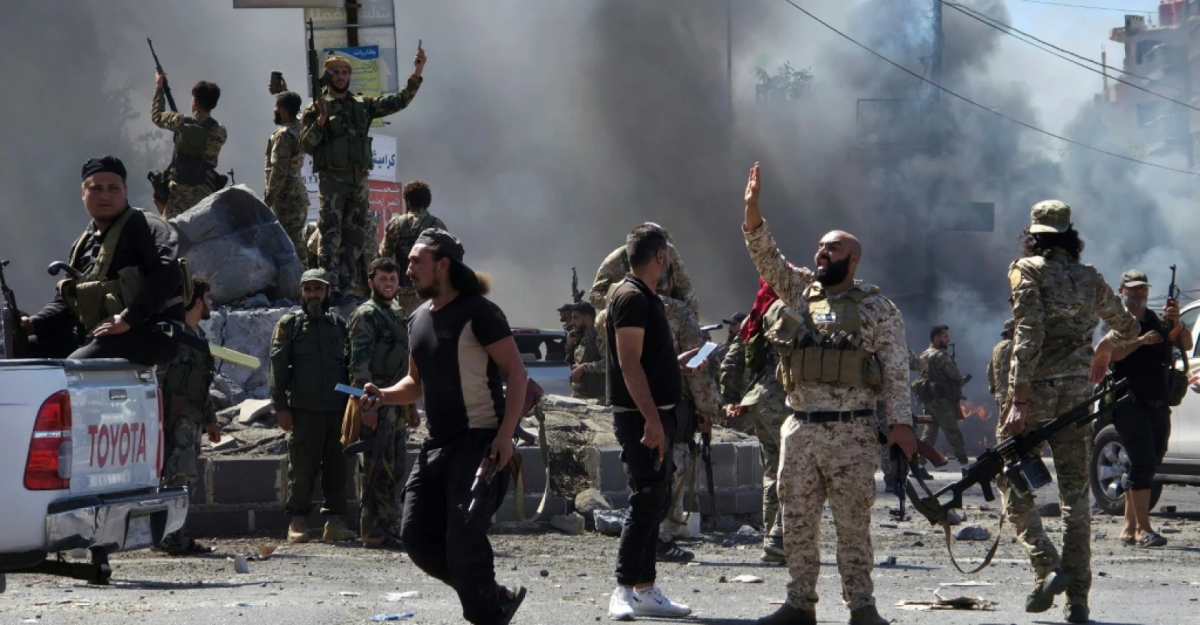
It seems that against the backdrop of ongoing conflicts in Syria — between Druze and Bedouins and other local groups — and Israel’s active involvement in these conflicts, the current Syrian regime needs any assistance from any helper in order to maintain power and counter Israel. And then it becomes clear why Assad’s opponents came to Assad’s friends to start befriending them. Accordingly, they themselves are ready to make concessions — possibly including allowing Russia to continue its military presence in Syria. And it is obvious that there will be an effort to find every possible avenue of cooperation — both as a continuation of what existed under Assad, and through new arrangements.
Source: Lorientlejour
In particular, as a result of this visit, both sides — with Russia’s position voiced by Sergey Lavrov — stated: “…We have agreed to carry out an inventory of all existing agreements. This topic has already been touched upon, there have been some contacts, but today we decided that this process should be put on a regular basis.”
And further, another statement by Mr. Lavrov that sheds light on the positions of both sides regarding any cooperation: “…Russia regards Syria as a friendly country, aiming to strengthen relations with it regardless of the political situation and changes of government. Moscow is ready to provide support in the post-conflict reconstruction of the country.”
So there you have it — “…regardless of changes of government.” In other words, it does not matter at all what government Syria has or what policy it pursues. And it is also interesting that “…Moscow is ready to provide support in the post-conflict reconstruction” of Syria. This is undoubtedly humane. The only question is — when will this “post-conflict” time come? And will it come at all, given the history and duration of conflicts in the Middle East…
(If you possess specialized knowledge and wish to contribute, please reach out to us at opinions@news.az).


Similar news