Is it time to give a decisive response to US over disrespect for Azerbaijan's sovereignty?


By News.Az
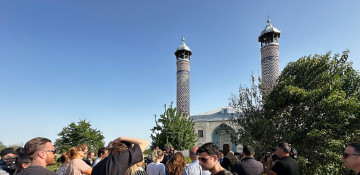
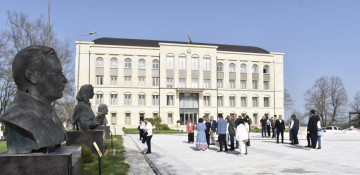
Mark Libby was recently appointed US ambassador to Azerbaijan, formally taking up his duties after handing credentials to President Ilham Aliyev in January this year. Despite the declared intention to strengthen bilateral ties, his actions raise questions about whether he adheres to diplomatic etiquette and respects the sovereignty of the host country.There is great concern in Azerbaijan over the refusal of American ambassadors, including Libby to visit Shusha — the symbolic jewel of Karabakh that was freed from occupation. This refusal, motivated by unclear and, in the view of many, contrived reasons, is perceived as disrespect for the territorial integrity of Azerbaijan, which contradicts the official US position on recognizing the sovereignty of our state.
Moreover, Libby's recent meeting with opposition journalist Khadija Ismayilova, known for her criticism of the Azerbaijani government, has raised further questions about the objectives of his mission. Such meetings may be seen as support for certain political forces, which constitutes clear interference in the internal affairs of the state.
In this context, I recall the Vienna Convention on Diplomatic Relations , which requires diplomats to respect the laws of the host country and not to interfere in its internal affairs. Non-compliance with these principles may call into question a foreign ambassador's further stay in the country.
Analyzing historical parallels and contemporary challenges, we see that despite changes in international politics and diplomacy, some methods and approaches remain unchanged. The behaviour of US Ambassador Mark Libby illustrates how long-standing diplomatic "traditions" influence the perception of foreign missions in the modern world.
The refusal of Libby and his predecessors to visit Shusha despite US recognition of Azerbaijan's territorial integrity raises serious questions about the real intentions and policies of the United States in our region. This refusal not only disappoints Azerbaijani society but can also be considered as disregard for the importance and symbolic significance of Shusha as a cultural and historical centre.
Libby's meetings with opposition representatives critical of the government may be interpreted as support for a specific political agenda, which contradicts the spirit of the Vienna Convention. These actions can be perceived not only as interference in internal affairs but also as an attempt to influence Azerbaijan's domestic policy.
There is a question: are such actions accidental or part of a broader strategy? And if so, what could be the long-term consequences for bilateral relations between Azerbaijan and the United States?
Given all of the above, perhaps it is time for Azerbaijani diplomatic officials to consider the expediency of Libby's further stay in our country. According to Article 9 of the Vienna Convention, if the accrediting state fails to fulfill its obligations, the host state may stop recognizing that person as a member of the mission.
The case of Ambassador Libby leaves Azerbaijan face-to-face with questions not only about adherence to international norms but also about protection of its own state independence and diplomatic honour. Should violations and disrespect for sovereignty continue to be tolerated, or is it time to give a decisive and lawful response? Perhaps these questions will define the future direction of Azerbaijani-American relations on the international stage.


Similar news