Pakistan is seeking a replacement for Iran


.jpg)

Editor's note: Hamza Azhar Salam is the Editor of The Pakistan Daily.
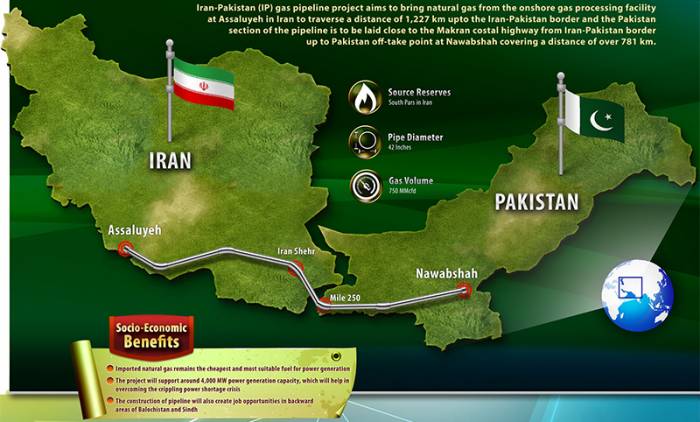
The Iran-Pakistan Gas Pipeline, long seen as a potential remedy for Pakistan’s chronic energy shortages, now stands in limbo—held hostage by geopolitical complications, regional dynamics, and cross-border tensions that extend far beyond the realm of energy cooperation.While Pakistan grapples with the lingering consequences of missing its March 2024 deadline to complete its portion of the pipeline, a web of new complexities has further clouded its prospects, including U.S. sanctions, Iran’s penalties, and recent military skirmishes between the two nations.
For Pakistan, energy is not just an economic priority—it’s a matter of national survival. The pipeline, initially envisioned to deliver 750 million cubic feet of Iranian gas per day, could alleviate severe energy shortages, reduce reliance on imported liquefied natural gas (LNG), and stabilize Pakistan’s struggling economy. Yet, the potential benefits are mired in a landscape fraught with significant risks.
The potential discovery of new domestic gas reserves has created a possible alternative, easing the immediate pressure to import Iranian gas. Still, Pakistan’s energy needs to remain vast, and the pipeline continues to be viewed as a long-term solution.
One of the largest obstacles to completing the pipeline remains U.S. sanctions under the Countering America’s Adversaries Through Sanctions Act (CAATSA). Washington’s opposition to the project stems from concerns that it would bolster Iran’s economy and enable its regional ambitions. Despite calls from Pakistani leaders for sanctions waiver—similar to the one India secured for Iranian oil imports—no relief has been forthcoming.
Pakistan’s reluctance to confront U.S. pressure reflects the fragility of its relationships with Western financial institutions, on which it heavily relies. Islamabad finds itself in a precarious position, torn between its pressing energy needs and the threat of economic isolation.
Iran, meanwhile, claims to have completed its portion of the pipeline and is growing increasingly impatient. Tehran has issued warnings of an $18 billion penalty if Pakistan fails to uphold its contractual obligations, though Pakistan’s Petroleum Minister has expressed doubts over the accuracy of this figure.
For Iran, the pipeline is not just an economic project but a means to demonstrate resilience in the face of Western sanctions. By threatening to hold Islamabad accountable, Tehran can reassert its influence and reaffirm its role as a regional energy supplier.
Further complicating matters are the unpredictable cross-border tensions between Iran and Pakistan, recently exacerbated by military skirmishes. In January 2024, Iran launched unprovoked missile strikes into Pakistan’s Balochistan province, killing several civilians.
In retaliation, Pakistan responded by targeting suspected insurgent hideouts in Iran’s Sistan-Balochistan province.
While these skirmishes have not yet escalated into full-blown conflict, they have injected a new layer of volatility into the already fragile relationship between the two neighbors.
These strikes have highlighted the deepening distrust, as Iran grows frustrated with perceived Pakistani inaction against insurgent groups operating within its territory.
The cross-border violence also complicates the feasibility of the pipeline, as the route would pass through the very region now embroiled in these tensions. Ensuring security for such a vital infrastructure project becomes more challenging amid rising militancy and insurgency concerns.
Pakistan is also exploring alternative energy partnerships, notably with Russia, which has offered to build a separate pipeline. Russia’s emergence as a potential partner presents a strategic counterweight to Iran and allows Pakistan to diversify its energy imports.
At the same time, China—Pakistan’s long-time strategic ally—has remained relatively silent on the pipeline issue, likely balancing its interests with both Pakistan and Iran.
China’s broader investments through the China-Pakistan Economic Corridor (CPEC) suggest that Beijing could eventually play a mediating role, but for now, China’s priority seems to be maintaining stability rather than actively involving itself in Pakistan’s energy dilemmas.
At this juncture, the future of the Iran-Pakistan pipeline remains shrouded in uncertainty. On the one hand, the project offers a lifeline for Pakistan’s energy crisis, potentially alleviating domestic shortages and boosting economic growth. On the other hand, the specter of U.S. sanctions, coupled with Iran’s looming penalty, poses significant economic and geopolitical risks.
Further complicating Pakistan’s decision are the volatile security dynamics along its border with Iran, where recent military strikes have deepened mistrust. If Pakistan can navigate these myriad challenges—whether through securing a U.S. waiver, bolstering security in Balochistan, or diversifying its energy partnerships—the pipeline may still have a future.
The window for decisive action is closing, and Pakistan’s hesitancy reveals more than analysts may perceive.
(If you possess specialized knowledge and wish to contribute, please reach out to us at opinions@news.az).


Similar news