The “Trump plan”: Middle East on the brink of a new era?


Editor’s note: Teymur Atayev is an Azerbaijani publicist, historian, and political scientist, and hosts the program Aspects of Foreign Affairs on Azerbaijan’s CBC TV channel (broadcast in Russian). The article reflects the author’s personal views and does not necessarily represent the position of News.Az.
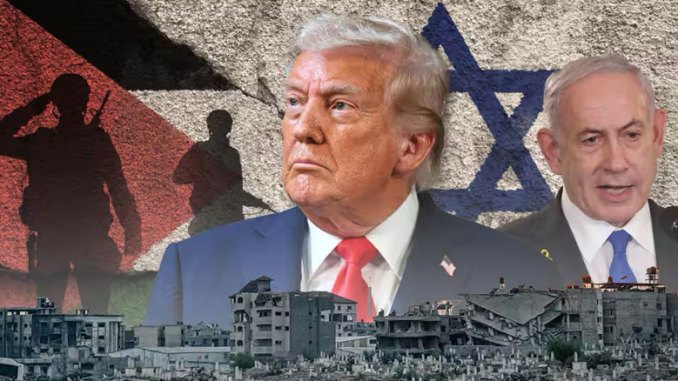
Undoubtedly, one of the most discussed issues on the global stage is the “Trump plan” to end the war in Gaza, which the U.S. president has described as “historic.” Trump himself claimed that “the war between Israel and Hamas is the eighth conflict that has ended thanks to him.” At the same time, he spoke of the possibility of establishing a situation in the Middle East far broader than the Gaza issue.
This statement reminded many observers of Trump’s previous assurances about how the Middle East could become “essentially new.” Analysts have drawn parallels with the book The New Middle East by former Israeli president and two-time prime minister Shimon Peres, published in the early 1990s. In it, Peres envisioned “comprehensive regional cooperation within a stable community of states responsible for shared infrastructure.” His vision included, among other things, using ports on the Mediterranean and Red Seas to serve regional tourist routes, as well as creating commercial and recreational centers that could operate successfully “in the Gaza Strip and along the planned Red Sea–Dead Sea canal.”
Source: adminassets
In 2006, on the eve of her visit to Israel, Palestine, and Europe during the Lebanon–Israel war, U.S. Secretary of State Condoleezza Rice referred to “the birth pangs of a new Middle East.” During her meeting with Israeli Prime Minister Ehud Olmert, she emphasized the importance of understanding “what kind of Middle East we are trying to build,” underlining that the time had come for a new regional format.
Nearly 20 years have passed since Rice’s statement, and now the 47th U.S. president is once again proposing the creation of a “Middle Eastern Riviera.” However, for now, the focus is on more grounded, both literally and figuratively, aspects of the perpetually volatile Middle East. Many experts are increasingly speaking of a return to the historical period of “Mandatory Palestine.”
This argument centers on a key point of Trump’s plan: the governance of Gaza by a so-called Temporary Transitional Non-Political Technocratic Palestinian Committee, composed of “qualified Palestinians and international experts,” operating under the supervision of a new international transitional body — the “Peace Council.” Although Trump would formally lead this Council, his role would be largely nominal. In reality, “another British mandate” is emerging in the figure of former U.K. Prime Minister Tony Blair, who is reported to have contributed to drafting the provisions of the “Trump plan.”

Source: Reuters
In this context, Iranian and several Arab sources have described these developments as attempts to revive “Western neocolonialism, now manifesting itself through political and institutional mechanisms.” Supporters of this view point to the deterioration of the settlement situation during Blair’s tenure as the Quartet’s (UN, EU, Russia, and U.S.) special envoy to the Middle East, which led to a freeze in the peace process. Some media cited UN Special Rapporteur on the situation of human rights in the Palestinian territories Francesca Albanese, who said, “Blair’s actions are better discussed in The Hague.”
Many observers believe that emphasizing the “temporary” nature of international administration over Gaza could, in practice, turn into an endless process, with plans to extend the mandate indefinitely. Notably, U.S. Central Command (CENTCOM) has already begun implementing steps to establish a Center for Command, Control, and Coordination of operations in Gaza, based in Israel. However, it is emphasized that the deployment of U.S. troops into Gaza is not planned; instead, they will coordinate their activities with partner countries, the private sector, and NGOs.

Sourse: CNN
Critics of the plan welcomed Trump’s acknowledgment of Türkiye’s significant role in achieving the Gaza ceasefire. He described Turkish President Recep Tayyip Erdoğan as a “remarkable and very strong man.” Erdoğan, in turn, confirmed that Ankara has assumed responsibility for ensuring strict implementation of the ceasefire agreement, warning that “the price of returning to a situation of genocide in Gaza will be very high.”
As this demonstrates, forecasts regarding the future of Gaza and its surroundings abound. The real question is what will happen “the day after.” Shimon Peres once highlighted that the prerequisite for peace and prosperity in the Middle East is the “breaking of the psychological barrier,” meaning that both sides must understand “each other’s aspirations and doubts, hopes and fears.” Achieving this requires changes not only in political, defense, and economic dimensions but, above all, in “the way we think.” Only this path will allow a region long accustomed to war to “realize the revolutionary significance of peace.”
Peres’s words from the early 1990s remain compelling. The only question is whether the parties are ready to move in that direction.
(If you possess specialized knowledge and wish to contribute, please reach out to us at opinions@news.az).


Similar news