US sanctions against Russia: India faces the risk of a looming oil crisis


A model of an oil pump jack and oil barrels are seen in front of Russian and Indian flags in this illustration taken, December 9, 2022. REUTERS/Dado Ruvic/Illustration
By Asif Aydinly
The introduction of new US sanctions on Russian oil marks the beginning of a challenging phase for India, an emerging economic powerhouse that heavily relies on imported energy resources. As the third-largest economy in Asia and one of the fastest-growing globally, India’s dependence on foreign oil leaves it vulnerable to external shocks. The sanctions targeting Russian oil producers and transporters have the potential to disrupt energy stability, fuel inflation, and create significant macroeconomic imbalances. These developments will have far-reaching consequences, not only for India’s economy but also for the global energy market.
India imports 88% of the crude oil it consumes, with approximately 40% of this supply coming from Russia. This dependency represents a sharp increase from just 12% in 2021, a result of India capitalizing on steep discounts offered by Moscow in the wake of Western sanctions imposed after Russia’s invasion of Ukraine. These favorable pricing conditions allowed India to manage surging domestic demand while maintaining relatively low fuel prices for its consumers. However, this reliance on discounted Russian oil has left India exposed to geopolitical risks, as the current sanctions threaten to choke a significant portion of its supply.Under the new restrictions, nearly one-third of India’s imports of Russian oil — equivalent to around 500,000 barrels per day — are at risk. The sanctions have already begun affecting global oil markets, with Brent crude prices trending upward. For India, a $10-per-barrel increase in oil prices translates into a 0.4% rise in inflation, creating a significant strain on consumer purchasing power and corporate profit margins. This puts the government in a difficult position: Should it absorb the increased costs through subsidies, pass them on to consumers, or force businesses to shoulder the burden? Each choice carries its own economic and political consequences.
Opting for subsidies may temporarily shield consumers and maintain political stability, but this approach would widen the fiscal deficit and add to India’s already substantial public debt. Alternatively, transferring the cost to businesses could stifle private sector growth, while placing the burden on consumers risks triggering widespread public discontent. Rising fuel prices are historically a flashpoint for social unrest in India. In 2018, for instance, a similar scenario led to large-scale protests against record-high fuel prices, and the current situation could provoke a repeat of such unrest.
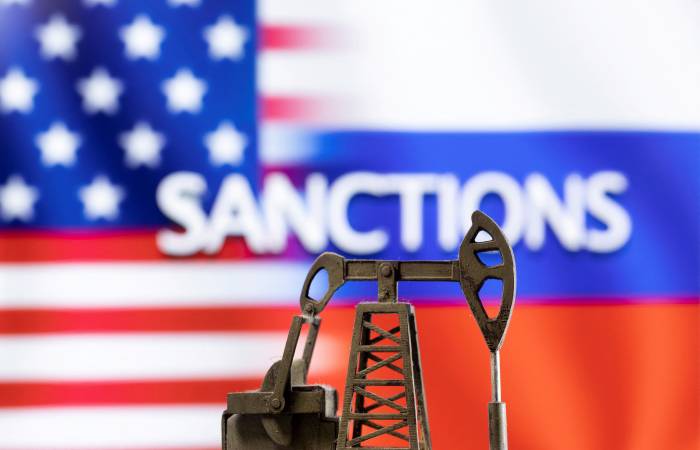
A model of a pump jack is seen in front of the displayed word "Sanctions", U.S. and Russia flag colours in this illustration taken March 8, 2022. REUTERS/Dado Ruvic/Illustration.
India’s vulnerability is further exacerbated by the weakening rupee, which has depreciated against the US dollar in recent months. A weaker currency increases the cost of imports, compounding the financial strain of rising oil prices. Moreover, the shipping sanctions imposed on 183 vessels engaged in transporting Russian crude oil are expected to drive up transportation costs, further inflating oil prices for import-dependent nations like India. These compounding factors create a perfect storm, intensifying the economic and social pressures on the country.
In response to the looming crisis, the Indian government has been exploring alternative sources of crude oil, particularly from the Middle East. While this strategy may mitigate some of the immediate risks, it is unlikely to match the cost advantages provided by discounted Russian oil. Moreover, shifting to alternative suppliers requires significant adjustments to logistical and infrastructural frameworks, which could take time and incur substantial costs. Middle Eastern suppliers, unlike Russia, are less inclined to offer long-term price concessions, further limiting India’s flexibility in negotiating favorable terms.
This crisis also underscores India’s precarious position in the global geopolitical landscape. As it seeks to maintain strong ties with both the US and Russia, India finds itself walking a tightrope. Its strategic partnership with the US requires compliance with sanctions, while its longstanding energy ties with Russia provide the volumes of oil necessary to meet domestic demand at competitive prices. This balancing act becomes even more challenging when considering China’s approach. Although China also imports significant volumes of Russian oil, its diversified energy portfolio leaves it less exposed to the risks associated with a single supplier. This relative advantage enhances China’s competitive position in the region, adding to the pressure on India.
The potential consequences of an oil shock extend beyond energy and economics, touching on the broader strategic ambitions of the Indian government. As the world’s most populous nation and a rapidly industrializing economy, India has aspirations to play a leading role on the global stage. However, its dependence on imported energy undermines these ambitions by exposing the economy to external vulnerabilities. The current crisis is a stark reminder that energy security is fundamental to economic sovereignty and geopolitical influence.
In the short term, India may adopt a range of stopgap measures to weather the crisis, including subsidies, tax reductions, and strategic oil reserves. However, these measures only provide temporary relief. To achieve long-term resilience, India must accelerate its efforts to diversify its energy sources and invest in renewable energy infrastructure. Expanding domestic oil and gas production could also help reduce dependency on imports, although this would require substantial investments and policy support. Additionally, the government should consider fostering regional energy partnerships to secure more stable supply chains.
Photo: Fortune India
The crisis also presents an opportunity for India to assert itself as a leader in renewable energy adoption. With significant investments in solar, wind, and hydroelectric power, India could reduce its reliance on imported oil while addressing environmental concerns. Transitioning to green energy would not only enhance energy security but also position India as a global leader in the fight against climate change. This strategic pivot could strengthen the country’s economic and geopolitical standing in the long term.
Diplomatic engagement will also play a critical role in mitigating the impact of the sanctions. India could
leverage its influence in international forums to advocate for exceptions or adjustments to the sanctions regime, particularly given its unique position as a major developing economy with growing energy needs. Simultaneously, New Delhi must navigate its relationships with Washington and Moscow carefully to avoid alienating either partner.
Ultimately, the ongoing oil crisis serves as a wake-up call for India to address its structural energy vulnerabilities. While the immediate challenges are daunting, the crisis also provides an impetus for transformative change. By pursuing a multi-faceted strategy that combines diversification, innovation, and diplomacy, India can emerge from this period of uncertainty stronger and more self-reliant. However, failure to act decisively risks leaving the country increasingly dependent on external actors and vulnerable to future crises. The stakes are high, but so too are the opportunities for India to reshape its energy landscape and secure a more sustainable future.


Similar news