Benjamin Netanyahu deliberately prolongs Gaza war to stay in power... Secret meetings, altered records: Media


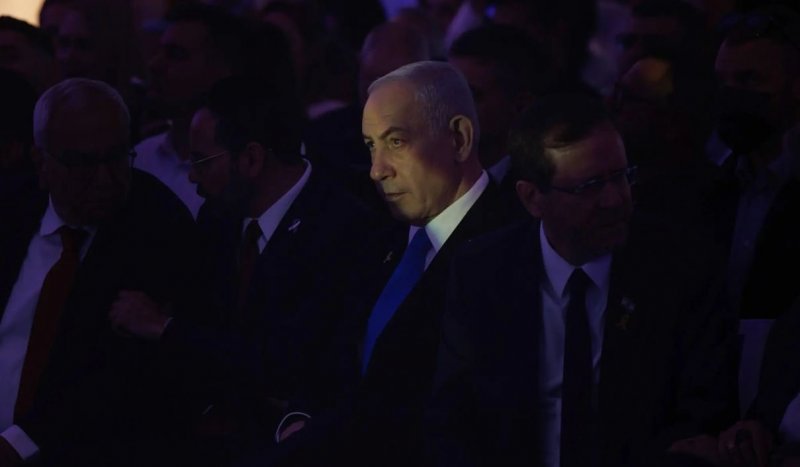
The New York Times wrote an article about how Netanyahu prolonged the War in Gaza to stay in Power
Secret meetings, altered records, ignored intelligence: the inside story of the prime minister’s political calculations since Oct. 7...
Six months into the war in the Gaza Strip, Benjamin Netanyahu was preparing to bring it to a halt. Negotiations were underway for an extended cease-fire with Hamas, and he was ready to agree to a compromise. He had dispatched an envoy to convey Israel’s new position to the Egyptian mediators. Now, at a meeting at the Ministry of Defense in Tel Aviv, he needed to get his cabinet onboard. He had kept the plan off the meeting’s written agenda. The idea was to reveal it suddenly, preventing resistant ministers from coordinating their response.
It was April 2024, long before Netanyahu mounted his political comeback. The proposal on the table would have paused the Gaza war for at least six weeks. It would have created a window for negotiations with Hamas over a permanent truce. More than 30 hostages captured by Hamas at the start of the war would have been released within weeks. Still more would have been freed if the truce was extended. And the devastation of Gaza, where roughly two million people were trying to survive daily attacks, would have come to a halt.
Ending the war would then have raised the chances of a landmark peace deal with Saudi Arabia, the Arab world’s most powerful country. For months, the Saudi leadership had secretly signaled its willingness to accelerate peace talks with Israel — as long as the war in Gaza stopped. The normalization of ties between the Saudi and Israeli governments, an achievement that had eluded every Israeli leader since the state’s founding in 1948, would have secured Israel’s status in the region as well as Netanyahu’s long-term legacy.
But for Netanyahu, a truce also came with personal risk. As prime minister, he led a fragile coalition that depended on the support of far-right ministers who wanted to occupy Gaza, not withdraw from it. They sought a long war that would ultimately enable Israel to re-establish Jewish settlements in Gaza. If a cease-fire came too soon, these ministers might decide to collapse the ruling coalition. That would prompt early elections that polls showed Netanyahu would lose. Out of office, Netanyahu was vulnerable. Since 2020, he had been standing trial for corruption; the charges, which he denied, mostly related to granting favors to businessmen in exchange for gifts and favorable media coverage. Shorn of power, Netanyahu would lose the ability to force out the attorney general who oversaw his prosecution — as indeed his government would later attempt to do.
As the cabinet discussed other matters, an aide hurried into the meeting room with a document summarizing Israel’s new negotiating position, quietly placing it in front of Netanyahu. He gave it one last read, ticking off various points with his pen. The route to a truce presented real danger, but he seemed ready to move ahead.
Then Bezalel Smotrich, his finance minister, interrupted the proceedings. As a young activist in 2005, Smotrich was detained for weeks — though never charged — on suspicion of plotting to blow up vehicles on a major highway in order to slow the dismantling of Israeli settlements in Gaza. Along with Itamar Ben-Gvir, the far-right national-security minister, Smotrich was now one of the strongest advocates in the cabinet for re-establishing those settlements. He had recently called for most of Gaza’s Palestinian population to leave. Now, at the cabinet meeting, Smotrich declared that he had heard rumors of a plan for a deal. The details disturbed him. “I want you to know that if a surrender agreement like this is brought forward, you no longer have a government,” Smotrich said. “The government is finished.”
It was 5:44 p.m., according to minutes of the meeting. At that moment, the prime minister was forced to choose between the chance of a truce and his political survival — and Netanyahu opted for survival. There was no cease-fire plan, he promised Smotrich. “No, no, there’s no such thing,” he said. And as the cabinet discussion moved on, Netanyahu quietly leaned over to his security advisers and whispered what must have by then become obvious to them: “Don’t present the plan.”
‘A political resurrection’
The 12-day war with Iran in June has been widely understood as a moment of glory for Netanyahu, one that marks the culmination of a hard-fought comeback from the lowest point in his long political career, when he oversaw, in October 2023, the deadliest military failure in Israel’s history.
But in the aftermath of this apparent triumph, a more fateful reckoning awaits Netanyahu over the war in Gaza. The conflict has flattened much of the territory, killing at least 55,000 people, including Hamas combatants but also many civilians, nearly 10,000 of them children under the age of 11. Even if negotiations finally bring Israel’s strikes to a halt in the coming days, it is already the longest high-intensity war in Israel’s history — longer than the wars surrounding its establishment in 1948, longer than the Yom Kippur War that defended its borders in 1973 and far longer, of course, than the six-day Arab-Israeli war of 1967 that brought Gaza and the West Bank under its control.
As the war has dragged on, the global sympathy that Israel earned in the aftermath of the deadliest attack on Jews since the Holocaust has instead transformed into growing ignominy on the international stage. The International Court of Justice is weighing claims that Israel has committed a genocide. In America, President Joseph R. Biden Jr.’s failure to end the war split the Democratic Party and helped spur the upheaval that returned President Trump to power. And in Israel, prolonged war has heightened bitter disagreements about the nation’s priorities, the nature of its democracy and Netanyahu’s legitimacy as a leader.Image
Photo: Palestinians outside Gaza City on June 16, after aid trucks loaded with food entered for the first time following a lengthy closure of the border.Credit...Saher Alghorra for The New York Times
Why, after nearly two years, has the war yet to reach a definitive conclusion? Why did Israel frequently turn away chances for de-escalation, instead expanding its military ambitions to Lebanon, to Syria and now to Iran? Why has the war dragged on, even as the leadership of Hamas was decapitated and more Israelis called for a cease-fire? For many Israelis, the war’s protraction is mainly the fault of Hamas, which has refused to surrender despite Palestinians’ suffering unfathomable losses. Most Israelis also see the war’s expansion to Lebanon and Iran as an essential act of self-defense against allies of Hamas that also seek Israel’s destruction. But many increasingly believe that Israel could have struck an earlier deal to end the war, and they charge Netanyahu — who wields ultimate authority over Israel’s military strategy — with preventing that deal from being reached.
To understand the role that Netanyahu’s own calculations played in prolonging the war, we spoke with more than 110 officials in Israel, the United States and the Arab world. These officials — both supporters and critics — have all met, observed or worked with the prime minister since the start of the war and sometimes long before it began. We also reviewed scores of documents, including records of government meetings, communications among officials, negotiation records, war plans, intelligence assessments, secret Hamas protocols and court documents.
For obvious reasons, one of the most sensitive accusations about Netanyahu’s conduct of the war is that he prolonged it for his own personal political benefit. Whether or not they thought he had, everyone we spoke to agreed on one thing: The war’s extension and expansion has been good for Netanyahu. When the war began on Oct. 7, 2023 — the day that Hamas and its allies killed roughly 1,200 people, both civilians and security personnel, and abducted some 250 — it seemed set to end Netanyahu’s political career. The general expectation was the war would subside early in 2024, Netanyahu’s coalition would collapse and Netanyahu would soon be held accountable for the disaster.
Instead, Netanyahu harnessed the war to improve his political fortunes, at first simply to survive and then to triumph on his own terms. Nearly two years after the catastrophic attack on Israel, and still facing serious charges of corruption, he has a good chance of governing Israel until a general election scheduled to occur by October 2026, when he will be 77 — and he could well win it.Image
Photo: A couple of weeks after the 2023 Hamas attack, Lea Yanai taped a photo of her sister, Moran Stela Yanai, to a wall in Tel Aviv, covered with people believed to be held hostage in Gaza.Credit...Tamir Kalifa for The New York Times
It is of course impossible to say that Netanyahu made key wartime decisions entirely in the service of his own political survival. His personal quest for power is often inextricably enmeshed with genuine patriotism and the belief, which infuses his public pronouncements, that he alone knows how best to defend Israel. Beyond his own motives, war is a complex, chaotic process with many daily variables that take a course of their own. Like all Israeli prime ministers, Netanyahu lacks full executive control over a sprawling administration full of competing factions and interests. His enemies in Lebanon and Iran posed genuine threats to Israel, and their defeat has strengthened Israeli security. And his adversary in Gaza, Hamas, has blocked or slow-walked cease-fire negotiations during key stretches of the war, including at a point early last summer when Netanyahu appeared more willing to reach a truce.
Yet for all these caveats, our reporting has led us to three unavoidable conclusions. In the years preceding the war, Netanyahu’s approach to Hamas helped to strengthen the group, giving it space to secretly prepare for war. In the months before that war, Netanyahu’s push to undermine Israel’s judiciary widened already-deep rifts within Israeli society and weakened its military, making Israel appear vulnerable and encouraging Hamas to ready its attack. And once the war began, Netanyahu’s decisions were at times colored predominantly by political and personal need instead of only military or national necessity.
We found that at key stages in the war, Netanyahu’s decisions extended the fighting in Gaza longer than even Israel’s senior military leadership deemed necessary. This was partly a result of Netanyahu’s refusal — years before Oct. 7 — to resign when charged with corruption, a decision that lost him the support of Israel’s moderates and even parts of the Israeli right. In the years since his trial, still ongoing, began in 2020, he instead built a fragile majority in Israel’s Parliament by forging alliances with far-right parties. It kept him in power, but it tied his fate to their extremist positions, both before the war and after it began.Image
Photo: Netanyahu arriving in court in December for a session of his long-running corruption trial.Credit...Menahem Kahana/Associated Press Images
Under political pressure from those coalition allies, Netanyahu slowed down cease-fire negotiations at crucial moments, missing windows in which Hamas was less opposed to a deal. He avoided planning for a postwar power transition, making it harder to direct the war toward an endgame. He pressed ahead with the war in April and July 2024, even as top generals told him that there was no further military advantage to continuing. When momentum toward a cease-fire seemed to grow, Netanyahu ascribed sudden significance to military objectives that he previously seemed less interested in pursuing, such as the capture of the southern city Rafah and later the occupation of the Gaza-Egypt border. And when an extended cease-fire was finally forged in January, he broke the truce in March in part to keep his coalition intact.
The cost of delay has been high: With each passing week, the delay has meant death to hundreds of Palestinians and horror to thousands more. It also meant that at least eight more hostages died in captivity, deepening the divisions in Israel between those who sought a hostage-release deal above all else and those who thought the war should run until Hamas was destroyed. It delayed the Saudi deal and sullied Israel’s image abroad. And it led prosecutors at the International Criminal Court to call for Netanyahu’s arrest.
But for Netanyahu, the immediate rewards have been rich. He has amassed more control over the Israeli state than at any other point in his 18-year tenure as prime minister. He has successfully prevented a state inquiry that would investigate his own culpability, saying that the fallout must wait until the Gaza war ends, even as the defense minister, army chief, domestic spymaster and several top generals all either have been fired or have resigned. As he attends court up to three times a week for his corruption trial, his government is now moving to fire the attorney general who oversees that prosecution. The war’s continuation has also shored up his coalition. It gave him time to plan and enact his attack on Iran. Above all, as even his strongest supporters note, it kept him in office. “Netanyahu pulled off a political resurrection that no one — not even his closest allies — thought possible,” said Srulik Einhorn, a political strategist who is part of Netanyahu’s inner circle. “His leadership through a prolonged war with Hamas and a bold strike on Iran has reshaped the political map. He’s now in a strong position to win elections again.”
This is the inside story, containing many details that have never been previously reported, of Netanyahu’s role in the events that led to the Oct. 7 attacks and of the way that his political calculations affected the conduct of the war that followed. It reveals how — in cabinet meetings, closed-door sessions with his top advisers and phone calls with international allies — Netanyahu made a series of decisions that prolonged a cataclysmic war in part to keep himself in power.
‘The internal crisis’
In late July 2023, Israel’s military-intelligence directorate produced an alarming report that synthesized all intercepts gathered by Israeli intelligence in recent months. Its conclusion was dire: Israel was in grave danger. The country was convulsed by intense domestic turmoil over a divisive plan, pushed by Netanyahu’s government, to exert greater control over the country’s judiciary. For months, hundreds of thousands of citizens, including a growing number of military reservists, had joined weekly protests against the plan. The report said that Israel’s chief enemies — Hamas in Gaza, Hezbollah in Lebanon and the government in Iran — had observed the growing divisions within Israeli society and particularly the armed forces. Now those foes were secretly discussing whether Israel was vulnerable enough to attack.
“I will start with the bottom line,” wrote Brig. Gen. Amit Saar, the army’s top intelligence analyst, in a letter introducing the report. “The deepening of the internal crisis, in my view, further erodes Israel’s image, exacerbates the damage to Israeli deterrence and increases the likelihood of escalation.”
By July 23, 2023, the protests had reached a climax. At least 10,000 military reservists, including scores of reserve pilots who formed the backbone of Israel’s flying corps, had threatened to stop serving if Netanyahu went ahead with a vote in Parliament, planned for the next day, to enact the first part of the overhaul.Image
Photo: Protesters in Tel Aviv in March 2023, after Netanyahu fired the minister of defense, Yoav Gallant, who had called on him to halt his proposed overhaul of Israel’s judiciary.Credit...Ziv Koren/Polaris
Sensing disaster, Herzi Halevi, the commander in chief of the Israel Defense Forces, tried to reach Netanyahu, in a previously unreported effort to get the prime minister to read Saar’s findings. Halevi and other senior officials, including the defense minister, had presented similar findings to Netanyahu in previous months and weeks, to no avail. This was the fourth written warning that Saar had sent since the start of the year, all of which had been ignored. Back in March, Netanyahu even fired the defense minister, Yoav Gallant, for issuing a public warning about the growing dangers, before reversing his decision under public pressure. Still, this new report was so dire that Halevi decided to try again.
The problem was that Netanyahu had just been admitted to the hospital. Days earlier, he fainted. Now he was being fitted with a pacemaker at a medical center outside Tel Aviv. Halevi had no means of reaching him. Instead, he persuaded Netanyahu’s top military adviser, Maj. Gen. Avi Gil, to take the alarming intelligence to the prime minister’s ward. It was 8 p.m. by the time the aide arrived — just 16 hours before Netanyahu’s coalition was set to vote on the bill in Parliament.
Netanyahu sat in his pajamas at a table, tired but alert. Gil presented him with the general’s letter, summarizing its contents. But Netanyahu remained unmoved. His alliance had two factions that saw the vote as a top priority. Hard-right ultranationalists, including Bezalel Smotrich, saw the Supreme Court as an obstacle to their efforts to increase the number of Israeli settlements in the occupied West Bank. Ultra-Orthodox Jewish members, meanwhile, resented how the court had pressed to end their voters’ exemption from military service. Netanyahu did not want to alienate these allies by stopping the legislation. With their support, he would remain prime minister. Without them, he was merely an opposition lawmaker on trial for corruption.
Moments later, Ronen Bar, the head of the Shin Bet, Israel’s internal intelligence agency, made his own attempt to press Netanyahu. Bar had also been unsuccessfully trying to reach him for days. Knowing Gil would be with Netanyahu that evening, Bar seized the moment, called Gil’s encrypted phone and asked Gil to pass the handset to the prime minister. Once Netanyahu was on the line, Bar told him that the country was at a “point of crisis” and faced imminent peril. The details were not clear, Bar said, but the danger was real. “I am giving you a strategic alert for war,” he said. “I don’t know when, and I don’t know where, but I’m giving you a strategic warning for war.”
Netanyahu was again unmoved. For years, he had been encouraging the Qatari government to send more than $1 billion in economic aid to Gaza, and he was confident the strategy had bought him quiet in the territory. In his view, Israeli civic unrest was the more pressing problem. “Deal with the protesters,” Netanyahu told Bar.Image
Photo: Ronen Bar, who as head of the Shin Bet warned Netanyahu in July 2023 that Israel faced imminent danger.Credit...Ziv Koren/Polaris, for The New York Times
When the vote passed the next day, the effect on the Israeli public was immediate. More clashes flared that night between Netanyahu’s supporters and critics, in one case breaking out in gunfire. Military reservists began to make good on their promises to resign.
Two days later, Hamas made its own assessment of the situation. For many years, its leaders had planned a major attack on Israel, and now — as they recorded in the minutes of a secret meeting in Gaza led by Yahya Sinwar — the time was right to put the plan into practice: “The condition of the occupation government and its domestic arena compels us to move forward with a strategic battle.”
Takeaways From the Times Investigation Into Benjamin Netanyahu
‘We are at war’
Netanyahu first learned of the Oct. 7 attack that morning at 6:29 a.m., when he was woken by a WhatsApp call from Gil, his top military adviser. It was a brief exchange. As air-raid sirens blared in the background, Gil told Netanyahu that Hamas had just launched some kind of strike. He asked the prime minister to shake himself awake and promised to call back in a few minutes — this time on Netanyahu’s encrypted phone, which is set up to record conversations for posterity.
At 6:40 a.m., Gil called that secure line with more details. Overnight, intelligence officers had detected scores of Hamas fighters inserting Israeli SIM cards into their phones, an indication of some kind of imminent maneuver requiring access to Israeli phone networks. Commanders tracked that activity through the night, assuming that it was a rehearsal — similar moves in the past had turned out to be false alarms. This time, it was not.
Gil stopped speaking, and Netanyahu, in a response that has never previously been reported, replied with a series of questions: “What happened? Why did they open fire? With what?”
“We don’t know, Prime Minister,” Gil replied.
“Not why,” Netanyahu said. “What are they firing?”
“For now, they’ve fired heavy barrages across the entire country,” Gil said, noting several locations in central and southern Israel.
“All right,” Netanyahu said. “Can we take down their leadership?” In the summer, Netanyahu had resisted a push from his security chiefs to assassinate Hamas’s leaders with airstrikes. Now, in the heat of battle, he was giving the order.
“The army is starting that now,” Gil replied, running through the state of play and concluding definitively, “We are at war.”
Immediately, Netanyahu turned to the question of responsibility. “I don’t see anything in the intelligence,” he said pointedly.Image
Photo: Kibbutz Be’eri on Oct. 28, 2023, 21 days after Hamas militants entered the kibbutz and killed roughly 100 residents.Credit...Ziv Koren/Polaris
Minutes into the war, this was the first hint of how Netanyahu would try to prolong his political life. The security chiefs had given him a strategic warning for war, but Netanyahu was careful to emphasize in this recorded call that it was not specifically about a frontal invasion from Gaza.
Later in the war, Netanyahu would complain publicly that he was woken too late and that if only he had been alerted sooner, the catastrophe would have been averted. The reality is that once he was awake, he had little effect that morning on Israel’s initial response. Gallant, the defense minister, and Halevi, the head of the military, ran the immediate order of battle several floors beneath the military headquarters in Tel Aviv, in an underground command center known as the Pit.
Netanyahu briefly visited the Pit for an operational update around 10 a.m., more than three hours after the attack started. No one had a clear grasp of the scale of what was happening down south, partly because so many military bases had been overrun. The commanders in Tel Aviv thought that only about 200 infiltrators had crossed the border. In reality, at least 2,000 militants — riding pickup trucks, motorcycles, speedboats and hang gliders — had penetrated Israel from roughly 60 points along a 37-mile border. They had attacked more than 20 villages and army bases, burning homes and shooting civilians in the street, and advanced 15 miles inside Israel. They had gunned down more than 360 people at a music festival and were on their way to abducting roughly 250 hostages — including Arab citizens of Israel and Thai farmworkers.

Photo: Israeli soldiers on Oct. 11, 2023, shortly after the Hamas attack, beside a dining table still set for a family’s Sabbath meal.Credit...Ziv Koren/Polaris
Netanyahu’s first substantive decision was to order the generals to bomb Gaza with a new level of force. He re-emerged after the briefing to record a video for distribution online. In a dark jacket and open-necked white shirt, Netanyahu said he had instructed the military to “return fire on a scale that the enemy has not known. The enemy will pay an unprecedented price.” Shortly afterward, the generals significantly loosened their rules of engagement, expanding the set of military targets that their subordinates could hit in pre-emptive airstrikes, while exponentially increasing — sometimes by a factor of 20 — the number of civilians that officers could endanger in each attack. When Halevi later told him that the air force had hit one thousand targets in Gaza, Netanyahu pushed him to strike even faster. “One thousand?” Netanyahu said dismissively. “I want 5,000.”
The mood inside his political coalition and the military high command was despondent and even ashamed, as leaders took stock of how their failures and actions had led Israel to this point. Preparing to brief a gathering of ministers, General Saar said almost in passing, and certainly in dark humor, that Hamas had made its move for two reasons — to disrupt prewar efforts to persuade Crown Prince Mohammed bin Salman of Saudi Arabia to forge formal ties with Israel and to punish provocative efforts by far-right ministers to entrench Israel’s control over the West Bank and a holy site in Jerusalem. “Why did they attack?” Saar asked rhetorically. “Because of Bin Salman and Ben-Gvir,” he answered.

Herzi Halevi, as head of the Israeli military, clashed frequently with Netanyahu.Credit...Ziv Koren/Polaris
Having spent nine months ignoring external threats to pursue contentious domestic goals, some ministers struggled with the overwhelming horror of the moment even as its political consequences loomed. Yariv Levin, the justice minister and architect of the judicial overhaul, sat on a staircase in tears, according to two witnesses including Moti Babchick, a senior ministerial aide. (Through a spokesman, Levin denied crying.) At a cabinet meeting that day, Bezalel Smotrich summed up the mood. “In 48 hours, they’ll call for our resignations because of this mess,” Smotrich said. “And they’ll be right.”
Yet even at the nadir of his political career, Netanyahu was already charting his route to political survival. Over the chaotic next days, the military repelled Hamas’s attack, dealt with the remaining Hamas infiltrators and began to plan an invasion of Gaza. In the background, Netanyahu was working out how to bring more parties into his coalition government.
His first chance came when Yair Lapid, his chief political opponent, offered to form a wartime unity government. They were unlikely partners. Lapid had fiercely opposed Netanyahu’s attempt to defang the judiciary. He was also far more open than Netanyahu to the idea of Palestinian sovereignty. Yet Lapid was prepared to put aside these differences in the national interest — if Netanyahu agreed to fire Smotrich and Ben-Gvir, who was once convicted of supporting a Jewish terrorist group. Lapid feared the far-right leaders would make it harder to steer a rational path through the war. It was likely, even then, that they would try to drag out the coming war to serve their dream of annexing Gaza and resettling it with Israelis. Netanyahu refused Lapid’s demand. He knew that once the war was over, the far right would be more likely than Lapid to let him stay in power.

Photo: Yair Lapid, the centrist politician and opposition leader, on Nov. 1, 2022, the day of Israel’s most recent general election.Credit...Ziv Koren/Polaris
Netanyahu found more pliant partners on Oct. 11, as the military prepared to attack Hezbollah, the powerful militia that was Hamas’s ally in Lebanon. Hezbollah, backed by Iran, had been firing rockets at Israeli troops since the second day of the war. Israeli leaders feared that the well-armed group was planning a ground invasion from the north. Gallant, working down in the Pit, was ready to enact a plan aimed at pre-empting such an invasion: The Israeli Air Force would decapitate Hezbollah’s leadership in Beirut with a barrage of airstrikes. But he needed Netanyahu to sign off. The problem was that Netanyahu would not return his calls. With the planes in the air, Gallant went in person to Netanyahu’s office. He found Netanyahu focused on a completely different matter — domestic politics.
Sitting with Netanyahu were Benny Gantz and Gadi Eisenkot, centrist former military chiefs who had served in leadership roles through decades of conflict. Minutes earlier, Gantz and Eisenkot agreed to bring their party into Netanyahu’s wartime coalition. The deal threw Netanyahu a lifeline at the weakest moment of his career, just as the first post-Oct. 7 polls were about to be released, showing what everyone had expected: Support for Netanyahu’s party had plummeted. Unlike Lapid, Gantz and Eisenkot joined the government without demanding the ouster of Ben-Gvir and Smotrich. In doing so, they ensured that the hard right would continue to shape the government’s wartime course — while allowing Netanyahu to pool the blame for anything that went wrong. Netanyahu, Gantz and Gallant soon began wearing matching black outfits, underscoring a sense of shared fate.
As the new ministers joined the government, Israeli fighter jets were already circling over the Mediterranean Sea, some 30 miles from Beirut. The new cabinet needed to decide: Should the pilots proceed with the attack?
The United States — Israel’s biggest ally, whose support would be crucial to maintaining the war effort — cautioned against it. Biden and his advisers said they had seen no evidence that Hezbollah intended to invade Israel, and they feared that an Israeli strike would prompt a regional escalation involving Hezbollah’s benefactor, Iran. Netanyahu had long sought a pretext for an attack on Iran, and a year later he would, following a sequence of unforeseen events in Lebanon, finally dare to launch a full broadside against Hezbollah and then subsequently attack Iran. But at that early stage in the war — fighting for his political life, eager to sustain Biden’s support and pessimistic about Israel’s military capabilities — a multifront conflict was not Netanyahu’s priority or his intention.
As Netanyahu weighed the advice from Biden against the pressure from his military chiefs, an alarming announcement focused his mind. Radar signals suggested Hezbollah drones or paragliders were flying over northern Israel. General Halevi urged the ministers to reach a decision. The jets were 19 minutes from striking Beirut, Halevi said.
Just as ministers seemed poised to sign off, an officer arrived with a new intelligence update. The radar had been misinterpreted. The drones were in fact a flock of birds. The attack was called off, averting — for the moment — a broader war.
‘I don’t know what to do’
Throughout the opening months of the war, Netanyahu’s survival was dependent on pulling off an almost impossible balancing act. He needed to do just enough to assuage Biden, whose diplomatic support and military assistance were essential to prolonging Israel’s war effort, while doing little to alienate the far right, on whom Netanyahu’s political career depended. The challenge of pleasing both became clear after midnight on Oct. 17, 10 days after the attack. Four floors beneath the military headquarters in Tel Aviv, Netanyahu was paralyzed by the need to choose between the wishes of an American delegation, sitting in one subterranean room, and those of his cabinet ministers, sitting in another room nearby.
The Americans, led by Secretary of State Antony J. Blinken, were pushing Netanyahu to ease a blockade of Gaza that Israel had enforced since the beginning of the war. Food, medicine and fuel stocks were running down, and a humanitarian disaster was taking shape. Biden was refusing to visit Israel until the blockade was eased. Yet most members of the Israeli cabinet were pushing Netanyahu to keep it in place. Deeply traumatized by the atrocities committed on Oct. 7, Israeli society was largely opposed to any humanitarian gestures. Netanyahu’s far-right allies were among the most resistant.
Netanyahu and Ron Dermer, a cabinet minister and his closest adviser, rushed between the two rooms, struggling to reach a compromise. To the Americans, Netanyahu appeared desperate. He told them that any images of aid trucks entering Gaza would collapse his coalition. Fidgeting in his seat, he turned to Dermer. “I don’t know what to do,” he said. “Ron, you’re creative, come up with something.” Finally, around 1 a.m., after hours of negotiations, Netanyahu capitulated — to the Americans. For now, his need for Biden’s support outweighed his domestic interests.Image
President Joseph R. Biden Jr. with Prime Minister Benjamin Netanyahu and his war cabinet in Tel Aviv on Oct. 18, 2023.Credit...Kenny Holston/The New York Times
The balance began to shift after Israel launched a ground invasion of Gaza in late October 2023. Both the Biden administration and top Israeli commanders began pressing Netanyahu to begin planning for how Gaza might be governed after Hamas was defeated. In Iraq, the United States had learned the hard way that without a postwar plan, it was hard to bring wars to an end. Yet time and again in meetings with American officials, Netanyahu avoided detailed discussion about his endgame in Gaza. When mid-ranking U.S. diplomatic and defense officials met with their Israeli counterparts, they found that the Israelis had been barred by the government from discussing Gaza’s long-term future.
Privately, the Israelis said Netanyahu feared that such plans would destabilize his coalition. To talk about postwar governance meant discussing Palestinian alternatives to Hamas. But ministers like Smotrich and Ben-Gvir rejected returning Gaza to any kind of Palestinian control. “Netanyahu was not interested in having a serious day-after conversation,” said Ilan Goldenberg, a Mideast adviser to Vice President Kamala Harris who was involved in those talks. “He was constraining his entire system from doing so because he knew it would force kinds of conversations about Palestinian long-term control of Gaza that could bring down this coalition.”
American frustrations heightened after a brief cease-fire in late November 2023, when more than 100 hostages were freed in a deal that included the release of 240 Palestinian prisoners and detainees. Until then, the broad expectation within the American and Israeli hierarchies was that Israel’s operation would start to wind down by the end of the year and that another truce would be reached within weeks. Instead, the truce talks were now stalled. Netanyahu told the Americans that Israel needed more time to capture Khan Younis, a key city in southern Gaza, because the Israeli soldiers fighting in the city had found that Hamas’s tunnel network there was much more extensive than expected. All the while, the Palestinian death toll was mounting, prompting accusations of genocide, and about four-fifths of Gazans had been forced to flee their homes. By Dec. 21, the toll had passed 20,000, including both civilians and combatants.
Biden lost patience with Netanyahu two days later. Smotrich, in his capacity as finance minister, had blocked funds earmarked for the Palestinian Authority, which administers parts of the West Bank, putting it at risk of bankruptcy. The government of Norway had offered to act as a guarantor for the money, in order to deflect Smotrich’s claims that the money would be used to fund terrorism. After a long call, mostly about Gaza, Biden pressed Netanyahu to override Smotrich and work with Norway. If the Palestinian Authority collapsed, the W


Similar news