BYD, Geely, Chery drive China’s EV expansion in Europe


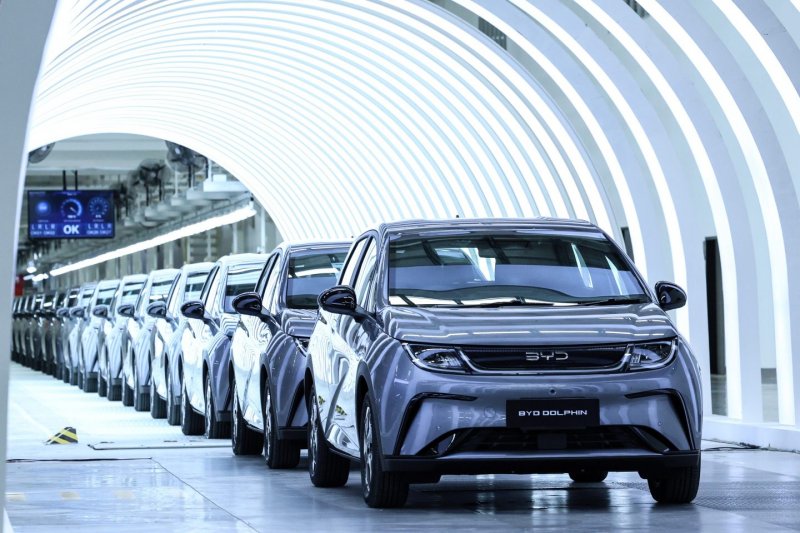
Chinese carmakers are rapidly expanding their presence in Europe’s lucrative auto market, supported by technological advances that competitors are increasingly trying to replicate.
Analysts say the next stage of their strategy will be local production, News.Az reports, citing AFP.
Brands such as BYD, Chery, Geely, and XPeng were largely unknown in Europe just three years ago, but have quickly gained ground. According to Dataforce, they reached a 9 percent share of European car sales in March, including 14 percent of electric vehicle sales.
Their market share has doubled over the past year, with some models now ranking among the top sellers in countries including Italy, Spain, and the United Kingdom.
This rapid rise is putting pressure on European manufacturers, which have been weakened by a domestic market that has contracted by about a quarter since 2019. It also comes as the European Union pushes ahead with plans for 90 percent of all new cars sold to be electric by 2035.
RECOMMENDED STORIES
Analysts say the policy has aligned well with Chinese manufacturers, who already lead in the electric vehicle sector at home, supported by strong state backing.
“Europe, one of the only major global markets, is a natural outlet for Chinese carmakers,” said Jamel Taganza, head of consulting firm Inovev. He added that the EU’s electric vehicle roadmap “opened up the European market to them in a very short time.”
For Chinese firms, exports are also a necessity due to significant overcapacity. Their factories are operating at around 50 percent of capacity, compared with roughly 60 percent for European manufacturers, according to AlixPartners analyst Alexandre Marian.
“The Chinese manufacturers’ strengths are not just labour costs; it’s innovation,” said Michael Foundoukidis, an automotive analyst at Oddo. He added that in China, companies are offering vehicles that are “twice as efficient for half the price” of European models.
The next strategic step for Chinese automakers is local production. Industry experts say building cars in Europe would help avoid tariffs and reduce transport costs.
“All manufacturers believe that if you want to gain a foothold in a market, it’s easier to produce locally,” said Lionel French Keogh, sales director of Chery France, which plans to build a small electric city car in Europe. Foundoukidis added that firms aiming to exceed a 10 percent European market share “will have no choice but to assemble in Europe.”
EU tariffs on imported electric vehicles introduced in 2024 are also accelerating this shift.
BYD is constructing a factory in Hungary, while Leapmotor—partnered with Stellantis—plans to produce two models at a Stellantis plant in Zaragoza, Spain. Reports also suggest Stellantis is considering producing Leapmotor vehicles in Spain under the Opel brand. XPeng is assembling knock-down kits in Austria.
European manufacturers are responding by adopting similar partnership strategies, mirroring Chinese practices from the 2000s. Stellantis has partnered with Leapmotor, while Volkswagen is working with XPeng, which is launching a jointly developed electric model for the Chinese market. Renault has also partnered with Geely on internal combustion and hybrid engines.
AlixPartners’ Marian described this as a “reverse joint venture.”
Keogh said European firms are seeking such alliances to gain access to Chinese electric vehicle expertise. “It’s a complete reversal of the situation,” he said, noting that European companies once viewed Chinese manufacturers as imitators.
Renault has also begun developing new models on shorter timelines of around two years and is developing its electric Twingo at its research and development centre in China.
Foundoukidis said the outlook for European automakers is not yet decided, provided they improve competitiveness within the next two to three years. However, he warned that they may need to reduce capacity in Europe or close factories.
This has already begun in some cases, including Stellantis halting production in Poissy near Paris and Volkswagen announcing major job cuts and a reduction in global production capacity by one million units.
Taganza cautioned that European manufacturers still have the ability to respond.
Renault’s upcoming Twingo project and Stellantis’ strategic plan, due to be announced on May 21, are expected to be key indicators of the industry’s direction.
Meanwhile, BYD has applied to join the European Automobile Manufacturers’ Association, though an ACEA spokesperson said no decision has been made, noting that membership requires “an established industrial presence in Europe.”
By Nijat Babayev


Similar news