What opportunities and risks does BYD face in the AI robot market?


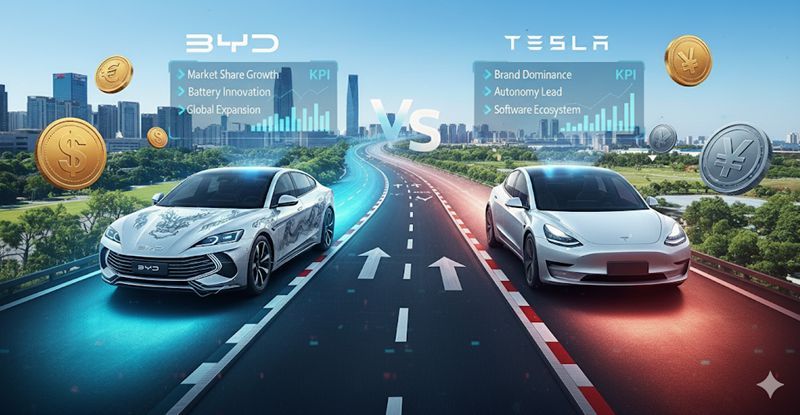
Chinese electric vehicle giant BYD is expanding beyond cars and batteries into artificial intelligence powered robotics, joining companies such as Tesla and XPeng in what is becoming one of the most important technology races of the decade.
The move signals that leading electric vehicle manufacturers increasingly see humanoid robots and intelligent automation systems as the next major growth opportunity after electric vehicles, News.az reports.
As advances in artificial intelligence accelerate, companies are investing billions of dollars into technologies that could transform manufacturing, logistics, healthcare, retail and even household services.
What exactly is BYD doing?
BYD is reportedly increasing investment in robotics, automation and artificial intelligence technologies as part of a broader strategy to expand beyond its traditional automotive business.
The company has already developed extensive expertise in manufacturing automation through its vehicle and battery operations. The new push aims to leverage that experience to develop more advanced robotic systems capable of performing increasingly complex tasks.
Industry observers view the initiative as a sign that BYD wants to compete directly in the emerging market for intelligent robots.
Why are electric vehicle companies interested in robots?
Electric vehicle manufacturers possess several advantages that make robotics a natural extension of their existing businesses.
Modern electric vehicles already rely on advanced software, sensors, cameras, artificial intelligence, battery technology and precision manufacturing.
Many of the technologies needed for autonomous robots are similar to those used in self driving vehicles.
As a result, companies such as BYD, Tesla and XPeng can adapt existing expertise and infrastructure to develop robotic systems more efficiently than many traditional manufacturers.
What kinds of robots are being developed?
The focus is increasingly shifting toward humanoid robots capable of operating in environments designed for humans.
These robots are intended to walk, carry objects, operate tools and perform repetitive tasks.
Developers believe such systems could eventually work in factories, warehouses, offices, hospitals, hotels and homes.
In addition to humanoid robots, companies are also developing industrial robots, logistics robots, inspection robots and autonomous service machines.
Why are humanoid robots attracting so much attention?
Humanoid robots offer the possibility of automating tasks without requiring major changes to existing workplaces.
Most factories, warehouses and offices were designed for human workers. A robot that can move through doors, climb stairs, use tools and interact with equipment designed for people could be deployed more easily than specialized machines.
Supporters argue that humanoid robots could eventually help address labor shortages, improve productivity and reduce operational costs.
How does BYD compare with Tesla?
Tesla is currently one of the most visible players in the humanoid robotics sector through its Optimus robot project.
Tesla's strategy is based on using artificial intelligence systems originally developed for autonomous driving to create robots capable of performing useful tasks.
BYD, meanwhile, brings significant strengths in battery technology, manufacturing scale and supply chain management.
Although Tesla may have gained more public attention in robotics, BYD's industrial capabilities could make it a formidable competitor.
What is XPeng doing in robotics?
XPeng has also become increasingly active in the robotics sector.
The company has invested heavily in artificial intelligence, autonomous systems and robotic technologies as part of its broader innovation strategy.
Like Tesla and BYD, XPeng believes future growth opportunities extend far beyond electric vehicles.
Its robotics projects reflect a broader trend among technology driven automakers seeking to diversify into emerging industries.
Why is China investing heavily in robotics?
China views robotics as a strategic industry with long term economic importance.
The country faces demographic challenges, including an aging population and a slowing growth rate of the workforce.
Robots are increasingly seen as a way to improve productivity, maintain industrial competitiveness and support economic growth.
Chinese policymakers have also identified artificial intelligence and advanced manufacturing as key priorities for future development.
How important is artificial intelligence to modern robots?
Artificial intelligence is at the core of next generation robotics.
Traditional industrial robots typically perform repetitive tasks based on pre programmed instructions.
Modern AI powered robots can learn from data, adapt to changing environments, recognize objects, understand commands and make decisions.
Advances in machine learning, computer vision and large language models are significantly expanding the capabilities of robotic systems.
What role do batteries play in robotics?
Battery technology is one of the most critical components of mobile robots.
Robots require compact, efficient and long lasting energy sources to operate effectively.
BYD is one of the world's largest battery manufacturers, giving it an important advantage in robotics development.
Improved batteries can extend operating times, reduce charging requirements and enhance the practical usefulness of robots in real world environments.
Could robots become as important as electric vehicles?
Many technology analysts believe the robotics industry could eventually rival or even exceed the electric vehicle market in economic significance.
Robots have potential applications across virtually every sector of the economy.
Manufacturing, healthcare, logistics, agriculture, construction, retail and domestic services could all be transformed by advanced robotics.
If widespread adoption occurs, the market opportunity could be enormous.
What tasks could humanoid robots perform?
Future humanoid robots could perform a wide range of activities.
Potential applications include assembling products, transporting materials, stocking shelves, cleaning facilities, inspecting equipment, assisting elderly individuals and providing customer service.
Some developers envision robots eventually handling dangerous, repetitive or physically demanding work that humans may prefer to avoid.
However, achieving these capabilities reliably remains a major technological challenge.
What are the biggest obstacles facing robotics companies?
Despite rapid progress, significant challenges remain.
Robots must operate safely around humans.
They need to navigate unpredictable environments and handle a wide variety of objects and situations.
Artificial intelligence systems must become more reliable and adaptable.
Cost is another major factor. Advanced humanoid robots remain expensive to develop and manufacture.
Companies must prove that robotic systems can deliver economic value sufficient to justify investment.
Will robots replace human workers?
This remains one of the most debated questions in technology.
Supporters argue that robots will primarily take over repetitive, dangerous and labor intensive tasks while creating new opportunities in engineering, maintenance, programming and supervision.
Critics worry that widespread automation could disrupt employment in certain industries.
Most experts expect a gradual transition in which humans and robots work together rather than an immediate replacement of human labor.
Why are investors excited about robotics?
Investors see robotics as a potentially transformative industry similar to the early days of the internet, smartphones or electric vehicles.
Advances in artificial intelligence have significantly improved the capabilities of robots, making commercial adoption more realistic than ever before.
Companies that successfully develop practical robotic systems could gain access to vast new markets and revenue streams.
This potential explains the growing investment flowing into the sector.
How could robotics transform manufacturing?
Manufacturing is expected to be one of the first sectors to benefit from advanced robots.
Factories already use industrial automation extensively, but next generation robots could provide greater flexibility and adaptability.
Humanoid robots may eventually move between tasks, operate different types of equipment and assist human workers in ways that traditional machines cannot.
This could increase efficiency while reducing operational costs.
What does BYD hope to achieve?
BYD appears to be positioning itself for a future in which artificial intelligence, robotics and automation become major drivers of economic growth.
By entering the robotics race early, the company hopes to build expertise, secure market share and create new business opportunities beyond electric vehicles.
The strategy reflects a broader vision in which transportation, artificial intelligence and robotics become increasingly interconnected.
How intense is competition in the robotics industry?
Competition is becoming increasingly fierce.
In addition to BYD, Tesla and XPeng, numerous technology companies, startups and research institutions are investing heavily in robotics.
Major players from the United States, China, Japan, South Korea and Europe are all competing to develop the next generation of intelligent machines.
This competition is accelerating innovation and pushing technological progress forward at a rapid pace.
What does this mean for the future?
The growing involvement of companies such as BYD, Tesla and XPeng suggests that robotics is moving from a niche technology sector toward mainstream commercial adoption.
As artificial intelligence continues to improve, robots are expected to become more capable, more affordable and more useful across a wide range of industries.
While significant challenges remain, the direction of travel is clear. Robotics is increasingly becoming one of the most important technology frontiers of the twenty first century.
Bottom line
BYD's decision to join Tesla and XPeng in a major push into AI powered robotics reflects a broader transformation taking place across the technology industry. As advances in artificial intelligence, batteries and automation converge, companies are racing to develop robots capable of performing real world tasks at scale. Although widespread deployment may still be years away, the competition now underway could shape the future of manufacturing, services and everyday life for decades to come.
By Faig Mahmudov


Similar news