Could material from comet 3I/ATLAS reach Earth?


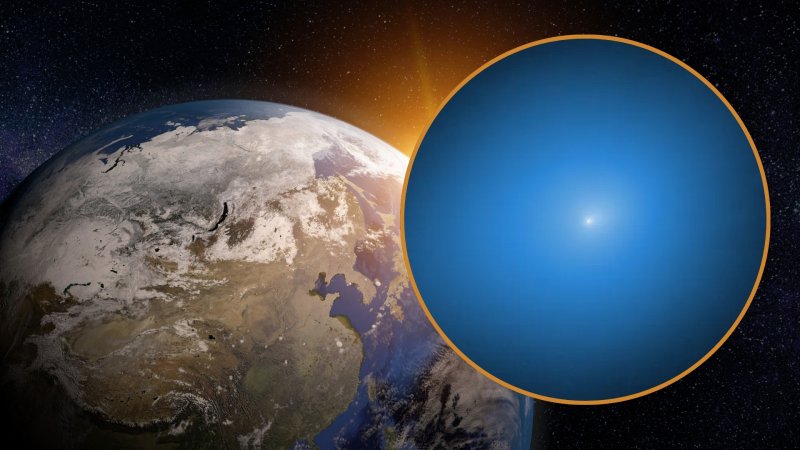
Avi Loeb, Baird Professor of Science at Harvard University and bestselling author of Extraterrestrial and Interstellar, has addressed the possibility of material from the interstellar comet 3I/ATLAS reaching Earth.
Loeb recalled that on December 19, 2025, 3I/ATLAS made its closest approach to Earth at a distance of 269 million kilometers, News.Az reports, citing Medium.
While some have whimsically speculated about an “interstellar gift” arriving during the holiday season, there are scientific concerns over the comet’s gas plume, which contains cyanide and hydrogen cyanide — a toxic gas historically used as a chemical weapon in World War I.
However, Loeb explained that this risk is effectively mitigated by the solar wind. Based on mass loss measurements from the Webb Space Telescope, the comet’s gases would be swept away at a distance of just a few million kilometers from 3I/ATLAS, far shorter than the 55 million kilometers separating the comet from Earth’s orbit. This ensures that no harmful material from 3I/ATLAS is expected to reach our planet.
Dust particles which are smaller than a micrometer would be swept away even faster by the solar radiation pressure. However, solid particles or objects that are bigger than a millimeter have a sufficiently small cross-section per unit mass to continue along their path, largely unaffected by the solar radiation or wind. However, such tiny particles will burn up in the Earth’s atmosphere before reaching the ground, as long as they are much smaller than a meter.
Objects larger than a meter that might have been released from 3I/ATLAS would be sufficiently sparse for making the probability of any of them to hit Earth negligible. Given the mass loss rate of 3I/ATLAS, there are less than a million of these large objects released in recent months. Their origin at a distance larger than about twice the Earth-Sun separation implies that the closest among them will never get closer than ten times the Earth’s radius.
This, of course, is under the assumption that the released objects cannot maneuver by technological propulsion.


Similar news