Europe aims to boost LNG regasification capacity


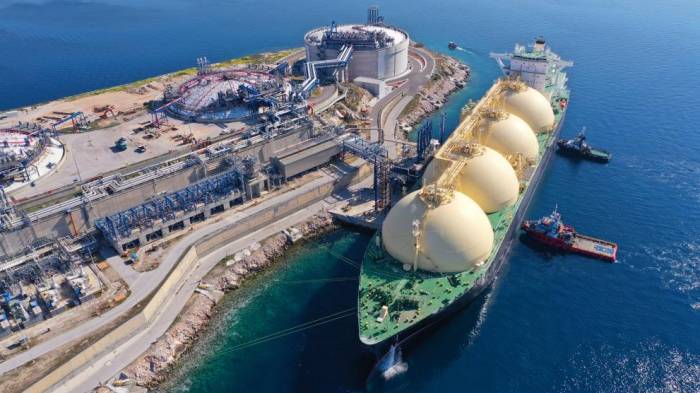
European countries aim to boost their liquefied natural gas (LNG) regasification capacity to 324.2 billion cubic meters (bcm) by the end of this year, a 26% increase from pre-Russia-Ukraine War levels. Despite this increase, current utilization stands at only about half of the existing capacity.
Data from the Institute for Energy Economics and Financial Analysis (IEEFA) projects that the combined regasification capacity of 27 EU countries, Türkiye, and the UK will reach 413.6 bcm by 2030, News.Az reports, citing foreign media.European countries, which focused on LNG investments after the Russia-Ukraine War started in 2022, upped their regasification capacity to 277.8 bcm in 2022 and 312.9 bcm in 2023.
Meanwhile, Europe's gas demand continues to decline due to growing renewable energy sources and energy efficiency measures.
Europe's gas consumption, which fell to its lowest level in 10 years last year, decreased by 5.4% annually to 232.1 bcm in the first half of 2024. EU gas consumption declined by 3.2% during the same period.
In the first half of this year, gas consumption in Norway and the UK fell by 36% and 13%, respectively.
Within the EU, the biggest decrease in gas consumption occurred in Portugal, Malta and Croatia with 18%, 15% and 14%, respectively. Natural gas consumption in Türkiye fell by 4% during the first six months of this year compared to last year.
While some countries experienced a surge in gas consumption. Finland raised its consumption level by 37%, Greece by 30%, Lithuania by 27%, Estonia by 25% and Sweden by 24%, during the same period.
IEEFA forecasted that European demand for natural gas will drop 11.2% this year to 148 bcm, 'meaning the continent has likely already passed peak LNG consumption.'
By 2030, LNG demand is expected to fall to 93 bcm.


Similar news