Gippsland backyard astronomer Chris Stockdale wins national medal for 100-exoplanet milestone


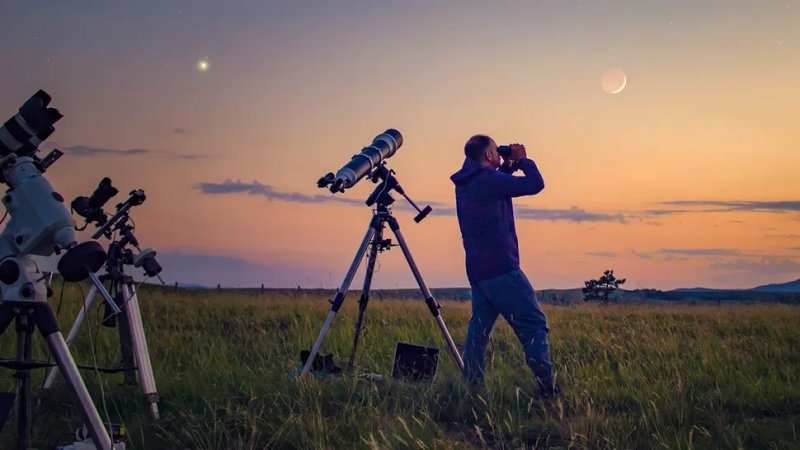
From a small observatory in Victoria's east, Chris Stockdale spends his nights watching for something most people would never notice, the faintest flicker of light from stars hundreds of light years away.
It's the kind of work that sounds like science fiction, but for this Gippsland astronomer, it has become routine — a careful hunt for planets orbiting other suns, News.Az reports, citing ABC.
It's a side hustle for Mr Stockdale that began in the 1960s.
"I got into astronomy because of the Apollo program at the time and the Moon landings," he said.
"And also there were a couple of bright comets and I remember my father getting me up at 4am to have a look at these comets that were in the sky and it was really good.
RECOMMENDED STORIES
Mr Stockdale now operates a fully automated telescope system from a observatory in his Churchill backyard, capturing data from distant star fields.
The set-up includes a 320-millimetre telescope mounted on a precision tracking system, designed to stay locked onto a single patch of sky for hours at a time.
From that data, Mr Stockdale is looking for something extremely specific — a tiny dip in a star's brightness as a planet passes in front of it.
"It was a case of which star caused the actual dip in the light that was associated with a planet crossing in front of the star, as we would see it," he said.
"Just a small dip, which was typically half a per cent or 1 per cent, so not very much."
Those faint changes in light are the key to finding exoplanets — worlds orbiting stars far beyond our solar system.
It is work that has propelled him into global collaborations, including NASA-linked projects, helping confirm potential planets identified by space-based surveys.
The astronomical analysis
Mr Stockdale has contributed to more than 100 scientific papers and helped confirm up to 100 exoplanets.
Yet he is quick to emphasise the collaborative nature of the work.
"There's many people involved in actually doing the discovery and I'm sort of one of the cogs in the wheel," he said.
Mr Stockdale verifies predicted targets from the ground, working through long lists of candidates that require precise timing.
"There's actually this large list of the candidates and when they'll be observable at my location," he said.
When conditions are right, he captures light curves and graphs that reveal subtle changes in brightness.
"I do analysis to tease out the dip or assign it so I know it's another star over there which could be an eclipsing binary as an example," he said.
Some nights the signal is clear. Other times the process becomes a long puzzle.
"I could spend another eight or 10 hours actually looking for what's going on," he said.
Page medal recipient
Mr Stockdale's work has now been formally recognised by the Astronomical Society of Australia (ASA), which recently awarded him the 2026 Berenice and Arthur Page Medal.
"It makes me incredibly proud and honoured to have received it," he said.
"I was sort of over the moon, literally."
ASA representative and resident astronomer at Melbourne's Scienceworks Tanya Hill said the recognition reflected just how critical Mr Stockdale's work had become to modern space science.
"It's a way for professional astronomers to really celebrate and highlight the incredible work that's being done by amateur astronomers," Dr Hill said.
"And in particular with Chris, not only has he been able to confirm so many planets, he's co-author of a nature paper which is a pinnacle for research astronomers themselves.
"And I know when the committee realised that and saw the fantastic endorsements that he had from the collaborations with the professional astronomers, it was clear that Chris was definitely a great recipient for the medal."
By Leyla Şirinova


Similar news