Hong Kong fire: lesser-known details emerge as Tai Po high-rise blaze investigation widens


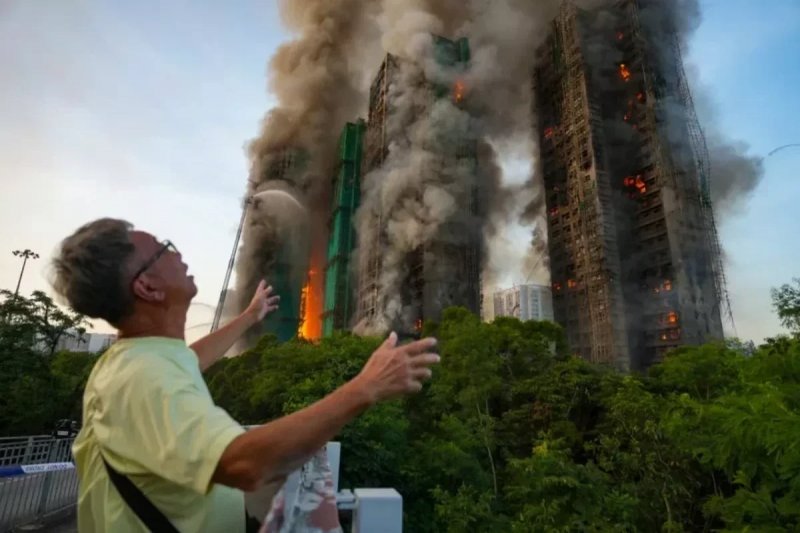
New details are emerging about the deadly Hong Kong fire that engulfed a major residential building complex in Tai Po, with investigators examining lesser-known structural and logistical factors that may have accelerated the disaster, , News.az reports
The Hong Kong Fire Services Department confirmed that the blaze—now fully extinguished—claimed 94 lives and affected residents across eight interconnected high-rise blocks containing almost 2,000 flats. While the initial cause is still under review, several less-publicized elements have begun shaping the narrative surrounding one of Hong Kong’s worst residential fires in years.
Bamboo scaffolding and mesh coverings intensified the blaze
Investigators revealed that the fire likely spread faster due to the triple-layer nylon mesh wrapped around the bamboo scaffolding on the building’s exterior.
This mesh—used to prevent debris from falling during renovation—can trap heat, causing flames to rise vertically like a chimney.
Residents reported hearing “continuous crackling” as the mesh ignited, showering burning debris onto balconies.
Blocked escape routes slowed evacuation
Several survivors stated that some emergency stairwells had been partially obstructed with renovation materials, including sealed paint buckets and lightweight wooden planks.
Although this has not been officially confirmed, authorities acknowledged they are reviewing building-by-building compliance logs related to renovation storage rules inside common areas.
Fire alarms reportedly malfunctioned in two towers
Lesser-known but widely discussed among residents is the allegation that internal fire alarms in at least two towers did not activate simultaneously.
Some tenants said they only realized the severity of the fire when smoke entered their corridors.
Officials confirmed they are “checking timestamps” from alarm control panels to verify sequence failures.
Narrow balcony design trapped heat and smoke
Architectural experts pointed out that the complex’s original 1980s balcony design—deep-set and boxed in by concrete walls—might have intensified heat buildup, causing glass panes to burst inward.
This design is now rare in modern Hong Kong high-rises but remains common in older districts like Tai Po.
Search operations extended due to unusual floor layout
Rescuers noted that the complex’s labyrinth-like internal layout, with U-shaped floor plans, long connecting corridors, and split elevator lobbies, complicated search and rescue.
Firefighters used thermal imaging cameras and rope rescue teams to access units with jammed doors—another detail not widely reported.
Residents trapped by metal security gates
Many households had installed double-layer metal security gates, popular in older Hong Kong neighborhoods for burglary prevention.
These gates—often padlocked separately—became obstacles during smoke-heavy conditions. Firefighters had to cut through dozens of them using hydraulic equipment, slowing down entry to flats.
Old air-conditioning mounts acted as fuel points
Fire engineers noted that rusty metal A/C brackets lined with accumulated dust and flammable insulation material helped fire spread upward along the exterior. Such mounts, used widely in older buildings, often contain dried debris that ignites quickly in high temperatures.
Drone footage revealed “heat pockets” hours after main fire was out
Officials used aerial drones equipped with thermal sensors to detect trapped heat inside upper floors. Some units showed dangerous heat pockets even after visible flames had died, leading firefighters to continue spraying targeted streams of water deep into wall cavities.
Evacuees reported mobile network outages
Another lesser-known detail: residents said they faced temporary mobile signal loss during the crucial first 20 minutes, likely due to heat damage to local network boxes. This disrupted emergency calls and family communication.
Mental health response teams deployed
Hong Kong authorities discreetly deployed psychological first aid teams, including counselors and social workers, to assist traumatized elderly residents—many of whom lived alone in small units and were unfamiliar with evacuation procedures.
Investigation expands to contractors and safety documents
The government is now reviewing:
-
renovation permit applications
-
scaffolding safety checks
-
materials stored in common areas
-
alarm maintenance contracts
-
emergency lighting logs
Officials say the probe includes “hundreds of pages” of compliance documents from building management and subcontractors.


Similar news