How AI is changing media, politics, and war


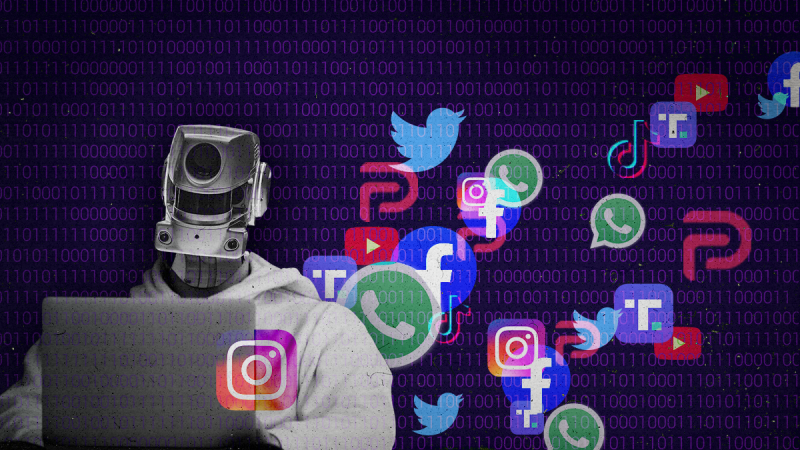
Artificial intelligence is no longer a background technology shaping productivity and efficiency, News.Az reports.
It is now actively reshaping three of the most powerful domains of modern society: media, politics, and war. In each of these fields, AI is not merely an upgrade to existing tools. It is altering power dynamics, accelerating decision-making, and redefining how influence and force are exercised.
What makes this transformation particularly consequential is that these changes are happening faster than public understanding, legal frameworks, and democratic oversight can adapt.
AI and the transformation of media
Media has become one of the earliest and most visible arenas of AI disruption. Newsrooms increasingly rely on AI for content generation, translation, headline optimization, audience analytics, and even automated reporting of routine events such as financial results or sports scores.
At the same time, generative AI has lowered the barrier to content production across the board. Anyone can now produce articles, images, audio, and video at scale. While this democratizes publishing, it also floods the information space with low-cost, high-volume material, making attention the scarcest resource.
The most profound change, however, is credibility. AI-generated text and visuals can closely imitate human journalism. Deepfake videos and synthetic audio blur the line between real and fabricated statements. As a result, audiences are increasingly unsure what to trust, and bad actors can exploit this uncertainty to discredit legitimate reporting by claiming authentic material is “AI-made.”
Media power is also shifting toward platforms. Algorithms decide which stories are amplified, buried, or monetized. Editorial judgment is increasingly shaped by engagement metrics optimized by AI, pushing news outlets toward speed, emotion, and virality over depth and verification.
Politics in the age of algorithmic influence
In politics, AI is transforming how campaigns are run, how voters are targeted, and how narratives spread. Data-driven profiling allows political actors to segment populations with extraordinary precision. Messages can be tailored to specific fears, identities, and preferences, often without public visibility or accountability.
Generative AI makes political persuasion cheaper and more scalable. Personalized campaign messages, automated social media posts, and synthetic personas can be deployed at minimal cost. This gives well-resourced actors, including foreign influence operations, unprecedented reach.
The rise of deepfakes introduces a new threat to democratic processes. Fabricated videos or audio recordings of political leaders can circulate rapidly, forcing governments and institutions to respond to events that never occurred. Even when debunked, the damage may already be done.
AI also reshapes governance after elections. Predictive analytics are used to assess public sentiment, anticipate protests, and model policy outcomes. While this can support informed decision-making, it also encourages a shift from democratic deliberation to technocratic management, where political choices are justified as “what the data shows.”
International bodies such as the United Nations have repeatedly warned that unchecked AI-driven disinformation and surveillance threaten democratic norms, particularly in fragile political systems.
AI as a force multiplier in modern warfare
War is undergoing perhaps the most dramatic AI-driven transformation. Military applications of AI span intelligence analysis, logistics, cyber operations, autonomous systems, and decision support. AI enables faster target identification, real-time battlefield awareness, and predictive modeling of enemy behavior.
Autonomous and semi-autonomous drones have become emblematic of this shift. Equipped with AI vision systems, they can navigate, track targets, and strike with limited human input. This lowers the cost of precision attacks and reduces risk to operators, but it also lowers the threshold for using force.
AI accelerates the tempo of warfare. Decisions that once took hours or days can now occur in seconds. While speed can be a tactical advantage, it increases the risk of escalation based on faulty data, misinterpretation, or system errors. Human judgment may be sidelined at critical moments.
Cyber warfare is another domain where AI plays a central role. Automated vulnerability discovery, adaptive malware, and AI-driven defense systems create a constant, largely invisible conflict. Attacks on infrastructure, communications, and financial systems can now be launched and adjusted at machine speed.
Perhaps most concerning is the erosion of accountability. When AI systems recommend or execute actions, responsibility becomes diffuse. Determining who is accountable for mistakes, civilian harm, or escalation becomes legally and morally complex.
The convergence of media, politics, and war
AI’s most destabilizing effect may lie in how it links these three domains. Information warfare sits at the intersection of media and conflict. Political manipulation often relies on media amplification. Military operations increasingly depend on data flows shaped by information environments.
A deepfake released during a crisis can influence public opinion, constrain political leaders, and alter military calculations simultaneously. AI-driven narratives can soften societies before kinetic conflict begins, blurring the line between war and peace.
This convergence favors actors who can operate across domains – shaping perception, influencing politics, and projecting force in coordinated ways.
Power concentration and asymmetry
AI does not distribute power evenly. States with advanced data access, computing infrastructure, and technological ecosystems gain strategic advantages. At the same time, AI enables smaller actors to punch above their weight through cyber operations, disinformation, and low-cost autonomous weapons.
This dual effect destabilizes traditional deterrence. Established powers struggle to maintain control, while non-state actors gain tools once reserved for governments.
The bottom line
AI is changing media, politics, and war not as separate phenomena, but as a unified transformation of power. It accelerates influence, compresses decision time, and shifts control toward systems that are opaque and difficult to regulate.
The challenge is not simply technological. It is political and ethical. Without transparency, accountability, and international norms, AI risks undermining trust in media, distorting democratic processes, and making conflict more frequent and less controllable.
How societies respond to this shift will determine whether AI becomes a stabilizing force – or a catalyst for deeper global instability.


Similar news