How to start a successful online business?


Starting an online business is no longer a niche ambition reserved for technology experts or venture capital backed founders, News.Az reports.
It has become a mainstream economic activity that allows individuals, small teams, and established companies to reach global markets with relatively low upfront investment. Yet while barriers to entry are lower than ever, the rate of failure remains high. The difference between success and disappointment usually lies not in luck, but in preparation, strategy, execution discipline, and the ability to adapt.
This FAQ explainer provides a structured, end to end guide on how to start a successful online business. It is designed as a practical reference, addressing the most common questions asked by first time founders as well as those transitioning from offline to digital operations.
What is considered an online business

Source: sweetprocess
An online business is any commercial activity in which the core value creation, customer acquisition, transaction, or delivery is conducted primarily through digital channels. This includes, but is not limited to, ecommerce stores, subscription platforms, software as a service products, online media businesses, digital agencies, marketplaces, and education platforms.
The defining feature is not the product type, but the operating model. An online business relies on the internet for marketing, sales, communication, and often fulfillment, even if some physical components are involved.
Why start an online business instead of a traditional one
Online businesses offer several structural advantages compared to traditional brick and mortar operations.
First, startup costs are generally lower. There is no need for physical retail space, large inventories, or extensive staff at the early stage. Second, scalability is significantly higher. A well designed online system can serve hundreds or millions of customers with marginal cost increases. Third, geographic reach is global by default, enabling access to customers far beyond local markets.
However, these advantages come with increased competition and greater transparency. Success depends on differentiation, credibility, and operational excellence rather than mere presence.
How do you choose the right online business idea

Source: contiguglia
Choosing the right idea is one of the most critical decisions in the entire process. A strong online business idea typically sits at the intersection of three factors.
The first factor is market demand. There must be a clear, identifiable group of people actively searching for a solution or product. Demand can be validated through search trends, competitor analysis, online forums, and customer interviews.
The second factor is value differentiation. The idea must offer something meaningfully different or better than existing alternatives. This could be price efficiency, convenience, specialization, personalization, speed, or expertise.
The third factor is founder alignment. The business should align with your skills, interests, and long term motivation. Online businesses often require sustained effort before profitability, so personal engagement matters.
How do you validate an online business idea before investing heavily
Validation is the process of testing assumptions with minimal resources. The goal is to confirm that real customers are willing to pay for the proposed solution.
Common validation methods include creating a simple landing page with a clear value proposition, offering pre orders or early access, running small scale advertising campaigns, or selling a minimum viable version of the product or service.
Customer feedback at this stage is more valuable than theoretical analysis. If people are not willing to commit time, email addresses, or money, the idea likely needs refinement.
What legal and structural steps are required to start an online business
Before operating publicly, several foundational steps should be addressed.
You must decide on a legal structure appropriate to your jurisdiction, such as sole proprietorship, limited liability company, or corporation. This affects taxation, liability, and credibility.
Business registration, tax identification, and compliance with consumer protection and data privacy regulations are essential. For online businesses, compliance with digital regulations such as data protection, cookie policies, and payment security standards is particularly important.
It is advisable to consult legal and accounting professionals early, as mistakes in this area can create long term risks.
How important is branding for an online business
Branding is often misunderstood as visual design alone. In reality, a brand is the sum of perceptions customers have about your business.
A strong online brand communicates clarity, trust, and relevance. This includes a clear brand promise, consistent tone of voice, professional visual identity, and transparent communication.
In digital environments where customers cannot physically interact with products or people, brand credibility becomes a critical trust signal. Poor branding can undermine even high quality offerings.
How do you build a professional online presence
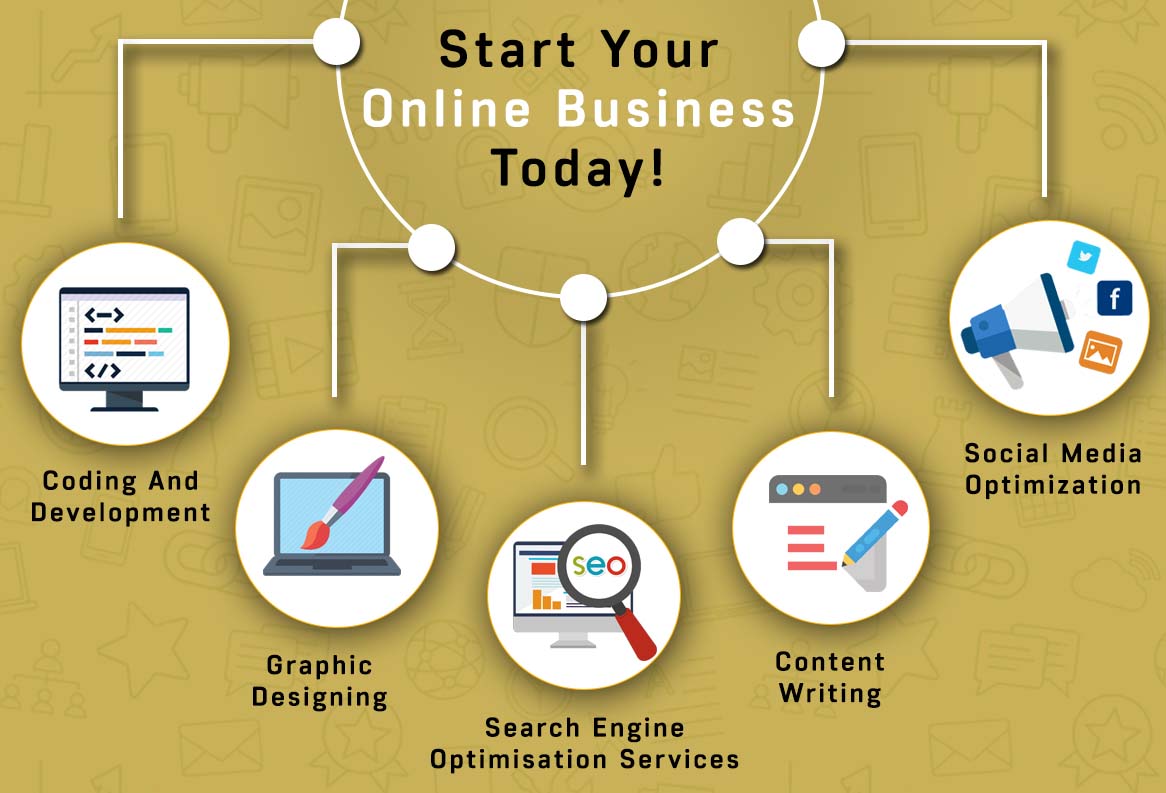
Source: webindiamaster
A professional online presence usually begins with a website or platform that serves as the central hub of operations.
The website should clearly explain what the business offers, who it is for, why it is valuable, and how to take action. Navigation should be intuitive, loading speed optimized, and mobile responsiveness ensured.
Beyond the website, presence on relevant digital channels such as social media, search engines, and industry platforms strengthens visibility and credibility. Each channel should serve a defined purpose rather than being used indiscriminately.
How do online businesses acquire customers
Customer acquisition is one of the most challenging aspects of online business. It generally relies on a combination of organic and paid strategies.
Organic acquisition includes search engine optimization, content marketing, social media engagement, and partnerships. These methods require time and consistency but build long term assets.
Paid acquisition includes digital advertising, influencer collaborations, and sponsored placements. These methods offer speed and scalability but require careful cost control and performance tracking.
Successful businesses balance both approaches and continuously optimize based on data.
What role does content play in online business success
Content is a foundational element of many successful online businesses. It educates, builds trust, attracts traffic, and supports conversions.
Effective content addresses real customer questions, pain points, and decision criteria. It should be informative rather than promotional, positioning the business as a reliable authority.
Content formats may include articles, videos, guides, newsletters, and interactive tools. The key is consistency and relevance, not volume alone.
How do you price products or services online
Pricing strategy must balance perceived value, market expectations, and cost structure.
Online customers can easily compare alternatives, so pricing must be justified through differentiation. Undervaluing offerings can harm brand perception, while overpricing without clear value limits adoption.
Many online businesses experiment with tiered pricing, subscriptions, freemium models, or bundles to capture different customer segments. Continuous testing and feedback are essential.
How do payment systems and transactions work
Online businesses rely on secure digital payment systems to process transactions.
Key considerations include payment method diversity, transaction fees, currency support, refund policies, and fraud prevention. The checkout process should be simple, transparent, and trustworthy.
Any friction at the payment stage directly reduces conversion rates. Reliability and security are non negotiable.
How do you deliver products or services efficiently
Delivery depends on the business model.
For digital products and services, automation enables instant or scheduled delivery with minimal marginal cost. For physical products, logistics partnerships, inventory management, and clear shipping communication are critical.
Customer expectations regarding speed and transparency are high. Clear delivery timelines and proactive communication significantly improve satisfaction.
How do online businesses manage customer support
Customer support is a strategic function, not merely an operational one.
Efficient support systems include clear documentation, frequently asked questions, self service tools, and responsive communication channels. Feedback from support interactions often reveals product improvement opportunities.
Positive support experiences increase retention and word of mouth, while poor support quickly damages reputation in public online spaces.
How important is data and analytics
Data driven decision making is one of the strongest advantages of online business models.
Analytics tools allow founders to track traffic, conversion rates, customer behavior, acquisition costs, and lifetime value. These insights guide marketing, product development, and resource allocation.
However, data must be interpreted thoughtfully. Metrics should inform strategy, not replace critical thinking or customer understanding.
How do you build trust in an online environment
Trust is built through consistency, transparency, and social proof.
Clear policies, visible contact information, professional communication, customer testimonials, and third party validations all contribute to trust.
Trust is cumulative and fragile. One misleading claim or unresolved issue can outweigh months of positive activity.
How long does it take for an online business to become profitable
There is no universal timeline. Profitability depends on the business model, market conditions, execution quality, and investment level.
Some service based businesses generate revenue quickly, while product or platform based ventures may require longer development and marketing cycles.
Founders should plan for a runway that allows learning, iteration, and adjustment rather than expecting immediate returns.
What are the most common reasons online businesses fail
Failure often results from a combination of factors rather than a single mistake.
Common causes include insufficient market demand, unclear value proposition, poor financial management, ineffective marketing, lack of focus, and burnout.
Many failures could be avoided through early validation, realistic planning, and willingness to adapt based on evidence.
How can an online business scale sustainably
Scaling requires systems, not just growth.
This includes documented processes, automation, delegation, and strategic hiring. Growth without structure leads to inefficiency and quality erosion.
Sustainable scaling balances expansion with customer experience, financial health, and team capacity.
How important is mindset and discipline for founders
:max_bytes(150000):strip_icc()/start-online-business-with-no-money-4128823-final-5b87fecd46e0fb00251bb95a.png)
Source: thebalancemoney
Founding an online business is as much a psychological challenge as a technical one.
Consistency, resilience, and learning orientation are essential traits. Progress often comes in uneven cycles, requiring patience and adaptability.
Successful founders treat the business as a long term project, continuously improving rather than seeking shortcuts.
What is the single most important principle for online business success
The most important principle is customer centricity.
Businesses that deeply understand their customers, continuously deliver value, and evolve with changing needs are far more likely to succeed than those focused solely on products or technology.
Everything else strategy, marketing, branding, and operations ultimately serves this principle.
Final takeaway
Starting a successful online business is not about following a rigid formula. It is about making informed decisions, testing assumptions, building trust, and executing with discipline over time.
The digital economy rewards those who combine strategic thinking with operational excellence and genuine customer focus. With the right preparation and mindset, an online business can become not only a source of income, but a scalable, resilient, and meaningful enterprise.
By Faig Mahmudov


Similar news