NASA confirms that 3I/ATLAS is visible in the pre-dawn sky, but only through telescopes or high-end binocular systems.
NASA described the new images as “a breakthrough in our understanding of interstellar comet chemistry and structure.”
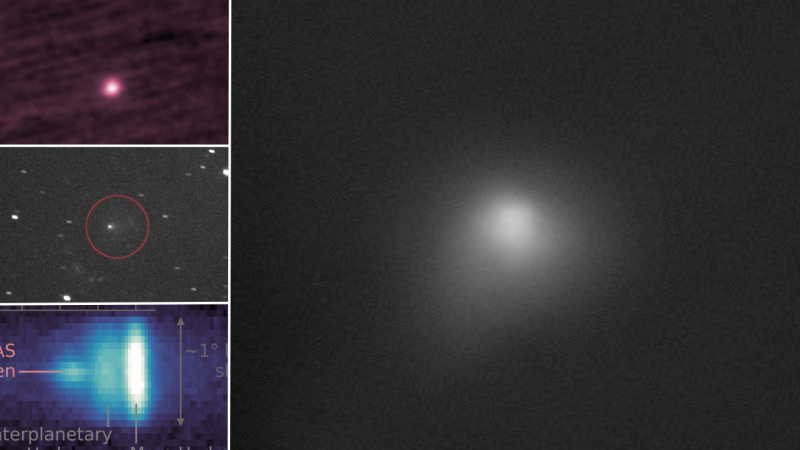
Astronomy enthusiasts are eagerly awaiting the December approach of the interstellar comet 3I/ATLAS, which will pass closest to Earth this month.
Experts say the event offers a rare opportunity for both scientists and skywatchers to observe the mysterious visitor from beyond our solar system, News.Az reports, citing foreign media.
The comet, only the third confirmed interstellar object in history, is expected to reach its nearest point to Earth in December 2025, providing the best viewing opportunity for millions of years.
Although 3I/ATLAS is not bright enough to be seen with the naked eye, NASA notes that it can be observed with a small telescope through spring 2026. NASA’s real-time simulator, Eyes on the Solar System, allows users to track the comet’s exact position and trajectory.
“This is an extraordinary chance to observe an object formed around another star,” one NASA researcher noted. “These encounters are exceedingly rare in human history.”
The interstellar comet known as 3I/ATLAS made global headlines in July when astronomers confirmed that it originated outside our solar system. When first detected, it was racing through the void at an incredible 137,000 mph, according to NASA.
Its speed, hyperbolic trajectory, and approach path from the direction of the constellation Sagittarius offered definitive proof that it formed around another star before being ejected into deep interstellar space.
By December 19, 2025, it will pass within 170 million miles of Earth— roughly twice the distance between Earth and the Sun — and well above any threat threshold.
The comet also made a close pass of the Sun on October 30, coming within 130 million miles, just inside the orbit of Mars.
Although its exact size remains uncertain, the European Space Agency estimates the object could span hundreds of feet to several miles across.
According to Hubble Space Telescope observations, the comet’s icy nucleus may be anywhere from 1,400 feet to 3.5 miles wide — still small compared to typical solar system comets but enormous as a wandering interstellar object.
NASA confirms that 3I/ATLAS is visible in the pre-dawn sky, but only through telescopes or high-end binocular systems.
NASA described the new images as “a breakthrough in our understanding of interstellar comet chemistry and structure.”