Unseen side of the Armenia-Azerbaijan conflict: historical and cultural destruction - VIDEO


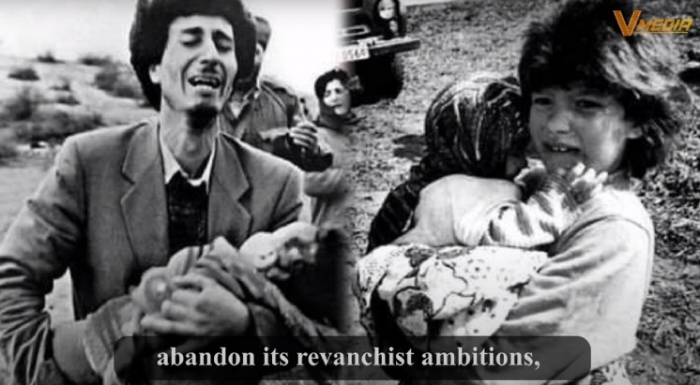
VMedia, a Canadian telecommunications company and broadcast distribution provider, has published a video on its YouTube channel to highlight the unseen side of the Armenia-Azerbaijan conflict.
The story reads as follows: Armenia agreed to withdraw its troops from several Armenian villages, which is an important step to avoid the recurrence of hostilities and to achieve the long-awaited peace treaty. Bloomberg reported that other Western media outlets expressed similar views. But how did Armenians end up in these villages? They attacked the sovereign territory of Azerbaijan and occupied them. Yet it’s Azerbaijan that is accused of allegedly attacking Armenia and being the source of threat for this country. Take, for instance, the remarks of Eric Helborne, a Swedish MP from the Sweden Democrats: "Muslim bandit Azerbaijan erroneously accuses its neighbor, Christian democracy Armenia, of plotting an invasion despite the EU missions' failure to observe any such preparations. Azerbaijan boasts a dense population and a more substantial economy than Armenia. The Azerbaijani military is not only larger but also has more modern equipment. It would be practically unfeasible for Armenia to launch an invasion of Azerbaijan."Now, let’s reference some widely recognized facts that are often overlooked by Western politicians. Utilizing Mr. Helborne’s terminology, "little and defenseless Christian Armenia" maintained control over over 20% of "aggressive Muslim Azerbaijan’s" territory for three decades. The UN Security Council, which reflects the global consensus, passed four resolutions calling for the release of Azerbaijan’s occupied territories. After a prolonged period of fruitless talks, Baku took military action in 2020 to enforce these resolutions. The aftermath revealed a devastating scene: Azerbaijani towns and villages were razed to the ground. This is what "little Christian Armenia" did with the city of Aghdam, this is what "little Christian Armenia" did with Fizuli over the years of occupation, this is what is left behind after the occupation of Jabrayil, this is the city of Zangilan, this is the city of Gubadli, this is Lun and Qajar, and over 300 other localities spanning an area of 10,000 square kilometers, all razed by "little Christian Armenia."
Defenseless Armenia has yet to face unequivocal condemnation for its savage onslaught in Azerbaijan, the resultant material and emotional devastation, civilian casualties, and injuries. Yet some are getting increasingly hysterical over claims that Azerbaijan is going to attack Armenia. There are numerous documented instances attesting to the cruel violence during the capture of Azerbaijani settlements by "defenseless Christian Armenians" in the first Karabakh war. The Muslim Azerbaijani community fled, acutely aware of the potential horrors awaiting them at the hands of peaceful Armenian militants. The fate of those unable to escape was grim. These facts are openly accessible. Consider this particular case: On March 24, 1990, unauthorized Armenian militias launched a brutal attack on the village of Baganis Ayrum in the Gazakh district of Azerbaijan. Ten individuals, including three women and a newborn, were subjected to heinous torture and murder, while two others sustained varying degrees of injury. A dozen homes were plundered and set ablaze, and 438 villagers were forcibly displaced from their lawful residences. Senior Lieutenant Aleksey Chanyshev, a military correspondent for the 4th Airborne Division then deployed in Ganja, recounted this act of genocide in the newspaper Vyshka on May 4, 1990. Even Chanyshev, a veteran of the Afghan conflict, confessed to being terrified: "It was chilling to see an elderly man on his knees gathering the scorched remnants of his brother’s body into a pocket. The images of women with slashed throats and an infant with a crushed skull were haunting, evoking memories of Khatyn and Oradour-sur-Glane," he wrote. It was an act of terrorism, a display designed to terrorize the civilian population. The Armenian thugs delighted in their perceived impunity.
Two years after the assault on Baganis Ayrum, the Khojaly tragedy unfolded on February 26, 1992. Armenian brigades brutally and mercilessly tortured and killed a total of 613 civilians. Eight families were utterly annihilated, 25 children became orphans, 1,275 civilians were taken hostage, and the whereabouts of 150 remain a mystery. The city was completely devastated. Among those who perished on that tragic night were 63 young children, 106 women, and 70 elderly individuals. Western politicians are undoubtedly familiar with the term "Armenian terrorism," yet one can find no references to "Azerbaijani terrorism" even after a thorough search on the internet. How come "defenseless Christian Armenia" is the home of such a multitude of thugs and terrorists?
Baganis Ayrum is the first village of the Gazakh district seized and incinerated by the ostensibly gentle and peaceful Christian Armenians. Subsequently, Armenian marauders occupied six additional villages in Gazakh. Yukari Ayrum is one of the four villages that Azerbaijan demands Armenia vacate. There is plentiful evidence of barbarism by the ostensibly "defenseless Christian Armenia." This is downtown Yerevan, the capital city of Armenia. We can see modern architecture which claims affiliation with Christian culture, but where is the historical center of Yerevan, the city that is supposedly even more ancient than Rome? Where is the labyrinth of narrow age-old streets as in Baku or the fortresses as in Shusha, Derbent, or the chapels, bell towers, temples, and tombs erected several centuries ago as in European cities? None of these exist in Yerevan. The reason is that the historical center of Yerevan was savagely demolished. This is how it looked just 80 years ago, and this is how it looked centuries prior. As you can also see, this is purely Muslim architecture, which would have remained if Armenians had not been moved to these lands, gradually displacing the indigenous population, demolishing the buildings, and altering the names of localities. Armenians deliberately obliterated the Erivan Fortress of Yerevan, including the Palace of Sardar Khan, mosques, and hundreds of homes where Azerbaijanis resided. Just look at this magnificence carved in stone, now destroyed, the exquisite and elegant architectural works reduced to rubble. The decision to obliterate the medieval view of Yerevan, its historical core, was made because it unequivocally indicated that it was not an Armenian city but an Azerbaijani Muslim city. Is there another capital city in the world with its historical center intentionally destroyed?
The expulsion of the Azerbaijani Muslim population and the obliteration of its cultural, historical, and architectural legacy in Christian Armenia were completely finished by the end of the 20th century. Nevertheless, Christian Armenians didn’t show leniency towards other Christians. Ancient Albanian churches were converted into Armenian churches. The objective was to completely wipe out the ancient Albanian Orthodox and Muslim religious and cultural heritage. During the years of occupation of Karabakh and Zangazur, a similar pattern of events unfolded. All Azerbaijani place names were systematically replaced with Armenian ones. Sixty-three of 67 mosques were completely razed, while the remaining four suffered severe damage. Cemeteries, historical landmarks, museums, and libraries faced destruction and plunder, while once thriving towns and villages were reduced to rubble and laced with mines. The towns and villages were stripped to the ground, down to the last toilet bowl. The devastation of the city of Aghdam was so profound that it earned the monikers "Hiroshima of the Caucasus" and "Ghost Town." Those who now draw a contrast between a strong, assertive Muslim Azerbaijan and a small, defenseless Christian Armenia, suggesting that Azerbaijan intends to attack Armenia, should take these offenses into account. It’s exceedingly cynical to suggest that Azerbaijan harbors aggressive intentions towards Armenia when Armenia has already launched attacks on Azerbaijan, resulting in the killing or expulsion of the entire Azerbaijani population.
Again, there is a wealth of documented evidence on these offenses, including photo and video footage, first-hand accounts, and historical records. The co-chairs of the OSCE Minsk Group, who have overseen the negotiations for nearly three decades, now acknowledge awareness of these events, yet they continue to exert pressure not on Armenia, but on Azerbaijan, trying to make it come to terms with the status quo. Baku has never garnered unconditional support from the EU and the US. Christian Armenia has not faced sufficient pressure to free the territories of Muslim Azerbaijan. However, we don’t engage in the divisive rhetoric of pitting Muslims against Christians, unlike the Swedish MP. Instead, we assert that such comparisons are absurd and senseless, particularly when expressed by a European politician. Irrespective of religious affiliation, those who engage in thuggery and terrorism should face punishment, and justice must be served. Yerevan should not be the recipient of aid, patronage, and guarantees, but rather should face international censure for its numerous transgressions of international standards and crimes against humanity. Yerevan must acknowledge its culpability, abandon its revisionist ambitions, and return all that it has wrongfully claimed.


Similar news