US researchers identify likely base for Russia's new nuclear missile


Two US researchers have pinpointed what they believe to be the deployment site for Russia's 9M730 Burevestnik, a new nuclear-powered cruise missile that Russian President Vladimir Putin has claimed to be "invincible."
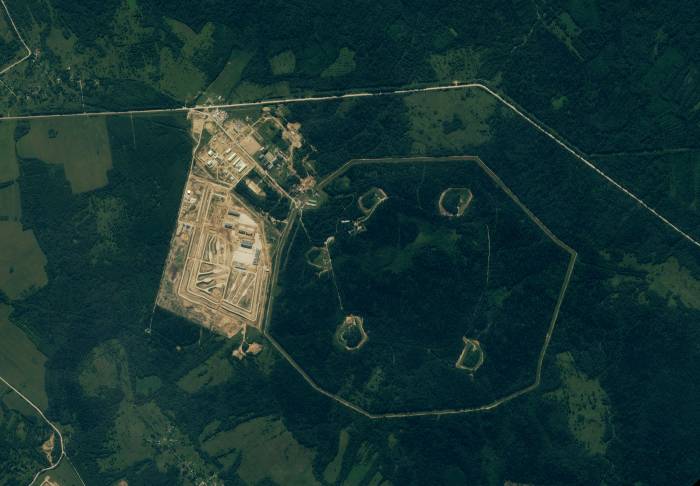
Putin has said the weapon - dubbed the SSC-X-9 Skyfall by NATO - has an almost unlimited range and can evade US missile defenses. But some Western experts dispute his claims and the Burevestnik's strategic value, saying it will not add capabilities that Moscow does not already have and risks a radiation-spewing mishap, News.Az reports citing Reuters.Using images taken on July 26 by Planet Labs, a commercial satellite firm, the two researchers identified a construction project abutting a nuclear warhead storage facility known by two names - Vologda-20 and Chebsara - as the new missile's potential deployment site. The facility is 295 miles (475 km) north of Moscow.
Reuters is the first to report this development.
Decker Eveleth, an analyst with the CNA research and analysis organization, found the satellite imagery and identified what he assessed are nine horizontal launch pads under construction. They are located in three groups inside high berms to shield them from attack or to prevent an accidental blast in one from detonating missiles in the others, he said.
The berms are linked by roads to what Eveleth concluded are likely buildings where the missiles and their components would be serviced, and to the existing complex of five nuclear warhead storage bunkers.
The site is "for a large, fixed missile system and the only large, fixed missile system that they're (Russia) currently developing is the Skyfall," said Eveleth.
Russia's defense ministry and Washington embassy did not respond to a request to comment on his assessment, Burevestnik's strategic value, its test record and the risks it poses.
A Kremlin spokesman said these were questions for the defence ministry and declined further comment.
The US State Department, the CIA, the Office of the Director of National Intelligence and the US Air Force National Air and Space Intelligence Center declined to comment.
The identification of the missile's probable launch site suggests that Russia is proceeding with its deployment after a series of tests in recent years marred by problems, said Eveleth and the second researcher, Jeffery Lewis, of the Middlebury Institute of International Studies at Monterey.
Lewis agreed with Eveleth's assessment after reviewing the imagery at his request. The imagery "suggests something very unique, very different. And obviously, we know that Russia is developing this nuclear-powered missile," he said.
Hans Kristensen of the Federation of American Scientists, who also studied the Vologda imagery at Eveleth's request, said that it appears to show launch pads and other features "possibly" related to Burevestnik. But he said he could not make a definitive assessment because Moscow does not typically place missile launchers next to nuclear warhead storage.
Eveleth, Lewis, Kristensen and three other experts said Moscow's normal practice has been stockpiling nuclear payloads for land-based missiles far from launch sites - except for those on its deployed Intercontinental Ballistic Missile (ICBM) force.


Similar news