World enters a week of elections: From Malta and Colombia to Ethiopia and Armenia


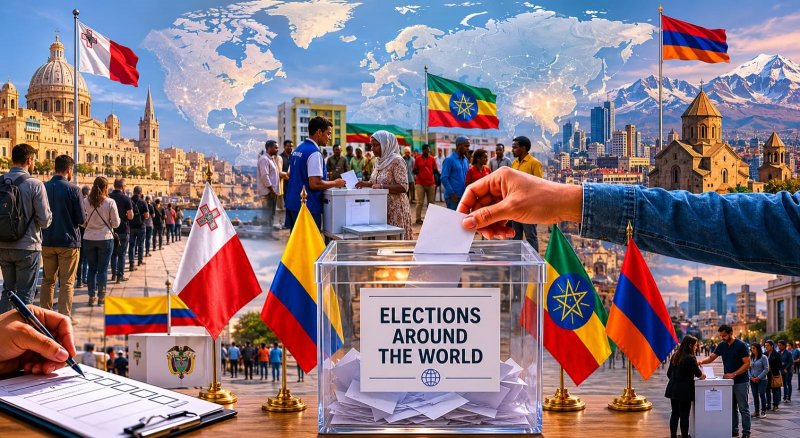
May 29, 2026, is not marked by major national elections, but it opens a dense political week during which several countries will go through important votes. According to international electoral calendars, the coming days include parliamentary elections in Malta, votes in Somaliland and Guinea, the first round of Colombia’s presidential election, elections in Ethiopia, local elections in South Korea, and parliamentary elections in Armenia.
At first glance, these events are not connected. Europe, Africa, Latin America, Asia, and the South Caucasus all have different political systems, different domestic crises, and different electoral dynamics. Yet in each case, elections are not merely a technical procedure. They are a test of political stability, public trust in institutions, and the ability of states to pass through competition without serious upheaval, News.Az reports.
The first important vote will be Malta’s parliamentary elections on May 30. This small European Union country rarely stands at the center of global politics, but its elections matter for understanding political moods inside the EU. Malta remains a parliamentary democracy with strong competition between the Labour Party and the Nationalist Party. For the current political leadership, the vote will be a test of public trust amid broader European debates over the cost of living, migration, the economy, government transparency, and the role of small states within the EU.
Malta’s election is also interesting because political shifts in small countries can happen quickly. Ideological lines matter, but so do the quality of governance, the reputation of leaders, trust in parties, and the ability of authorities to respond to everyday economic concerns. For this reason, the result on May 30 will be seen not only as a contest for parliamentary seats, but also as a judgment on the country’s political course.
On May 31, attention will move in several directions at once. One of the most significant events will be the first round of Colombia’s presidential election. This vote matters well beyond Latin America. Incumbent President Gustavo Petro cannot run for a second term, and the country is heading into the election amid debates over security, the economy, the fight against armed groups, drug trafficking, and the future of the left-wing political project.
Colombia’s campaign has already become a contest between several strong political currents. The left is trying to preserve influence after Petro’s presidency. Right-wing candidates are focusing on tough security policies and criticism of negotiations with armed groups. Centrist and center-right politicians are trying to offer voters an alternative between continuity and a sharp turn to the right. If no candidate wins a majority in the first round, the country will move to a second round, and the political intrigue will only intensify.
Elections in Somaliland and Guinea are also scheduled around the same period. For the international agenda, these votes are important primarily as indicators of political stability in regions where elections often take place against the backdrop of institutional weakness, internal tension, and complicated relations between the authorities, the opposition, and security structures. In such countries, elections are rarely just a procedure for transferring power. They become a test of state manageability, public trust, and the ability of political elites to avoid a new round of crisis.
On June 1, the key event will be Ethiopia’s parliamentary and regional elections. This is one of the most important votes of the coming week. Ethiopia is the second most populous country in Africa and one of the key players in the Horn of Africa. Prime Minister Abiy Ahmed’s ruling Prosperity Party is considered the favorite, but the vote is taking place amid serious instability in several regions, including Amhara and Oromia. Moreover, elections will not be held fully in all parts of the country.
For Abiy Ahmed, these elections are important as an attempt to confirm political control after several years of severe internal crises. His path from reformer and Nobel Peace Prize laureate to the leader of a country that has endured civil war and regional conflicts has become one of Africa’s most dramatic political stories in recent years. A victory for the ruling party will likely strengthen the prime minister’s formal power, but it will not automatically solve the country’s main problems: security, regional tensions, trust in the state, and relations between the center and the regions.
On June 3, South Korea will hold local elections. At first glance, this is a vote below the national level, but it carries major significance for South Korean politics. Local elections often become a referendum on confidence in the central government and a signal ahead of future parliamentary or presidential campaigns. In South Korea, where political competition is extremely intense, local-level results can change the balance of power between the ruling party and the opposition, while also shaping the strategies of the main political players.
Special attention will be focused on major cities and provinces, where local authorities have significant resources and influence. South Korean politics is traditionally marked by high voter mobilization, strong party discipline, and rapid shifts in public opinion. That is why even local elections can become an important signal of how society evaluates economic policy, social issues, relations with North Korea, the alliance with the United States, and the overall effectiveness of the government.
This electoral chain will conclude with Armenia’s parliamentary vote on June 7. For the South Caucasus, this may be the most sensitive political event of the coming days. The elections will take place amid a deep transformation of Yerevan’s foreign-policy course, deteriorating relations with Moscow, closer engagement with the EU and the United States, and a difficult internal debate over the country’s future.
For Prime Minister Nikol Pashinyan, these elections will be a test of his political course after the loss of Karabakh, tensions with Russia, and attempts to reorient Armenia toward closer cooperation with the West. Moscow has already increased pressure on Yerevan, and Russian-Armenian relations are going through one of their most difficult periods in decades. That is why Armenia’s elections will matter not only for domestic politics, but also for the entire security architecture of the South Caucasus.
The central question of Armenia’s vote is not only whether Pashinyan will retain power. More importantly, the election will show whether his course of distancing Armenia from Russian-led structures and deepening the Western track has sufficient public support. This is why the June 7 vote will be closely watched not only in Yerevan, but also in Moscow, Brussels, Washington, Ankara, Tehran, and Baku.
Thus, although May 29 itself is not a day of major national elections, it opens one of the most eventful electoral weeks of early summer 2026. In different regions of the world, voters will be deciding different questions: who should govern, what course the state should follow, how strong the ruling party remains, whether the opposition has a chance for a comeback, and whether the political system can pass through competition without crisis.
From Malta to Armenia, from Colombia to Ethiopia, these elections show that global politics is shaped not only by wars, summits, and diplomatic crises, but also by domestic votes. These are often the moments when hidden tensions come to the surface and countries receive either a new political mandate — or a new risk of instability.
By Nijat Babayev


Similar news