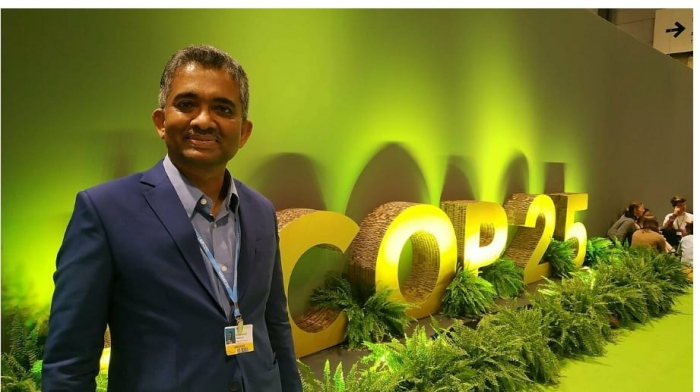
Nithi Nesadurai: COP29 in Baku to discuss increasing climate project funding


The analytical-information portal News.Az continues its series of articles, interviews and videos entitled "COP29 Baku".
As part of this series, we will be posting interviews with and videos of prominent climate and environmental experts. In an interview with News.Az, Nithi Nesadurai, Director & Regional Coordinator, Climate Action Network Southeast Asia, said that the main goal of COP29 will be to increase the quantum of climate finance available for developing countries to address the climate crisis. A decision will be made in Azerbaijan on a new finance goal known as the New Collective Quantified Goal (NCQG)."An ambitious NCQG will set the course for the transformational change required to mobilise and deliver finance by developed countries in a way that addresses the needs and priorities of developing countries. They priorities include adapting to the devastating climate impacts in the wake of record temperature rise, and paying for losses and damages from these impacts," he said.
"My expectation is that the developed countries commit to allocating at least $1 trillion a year to the NCQG. And that this amount is derived from public finance and provided in the form of grants to recipient countries," he added.
He also pointed out that an increase in finance will facilitate ambitious decisions and outcomes on the other priority issues at COP29 especially mitigation, adaptation, loss and damage, and just transition.
"The COP conferences contribute significantly to global efforts to combat climate change. By bringing governments in the world together, the COP conferences provide a platform for them to negotiate and seriously address all issues relating to climate change. They range from mitigation, adaptation and loss and damage to climate finance and market mechanisms," the expert noted.
He said that the COP is also egalitarian in nature where all countries – small or big, rich or least developed – have equal status. "It is one of the few forums where lesser resourced countries can speak truth to power," he added.
"While it is the government representatives who negotiate the outcomes, the COP allows nine constituencies – ranging from civil society and indigenous peoples’ organisations to trade unions and research institutions – to participate as observers. This makes the COP process transparent and accountable, and provides these constituencies with the opportunity to advocate for the most ambitious outcomes," the expert noted.
He went on to say that specific results achieved from recent COPs include COP28 signalling the beginning of the end of the fossil fuel era by agreeing to reduce consumption of fossil fuels and transition away from them in energy systems, in a just, orderly and equitable manner. "At COP27 and COP28 respectively, agreement was reached to set up a Loss & Damage Fund and operationalise it," the expert added.
"Decisions made at the COPs constitute an international environmental treaty. Governments are obliged to create the institutional framework to mainstream these decisions at the national level. COP decisions also provide a hook for civil society organisations to raise these issues with their governments, and advocate for their implementation at the national level," he said in conclusion.
Related articles:
- Baruch Fischhoff: Attendees of COP29 Baku to be motivated by different goals
- COP29 Baku to outline more ambitious climate action strategies – Malaysian expert
- COP29 will bring several opportunities for Azerbaijan - US expert


Similar news