Why is the US moving closer to Armenia? What is behind Rubio’s Yerevan visit


.png)
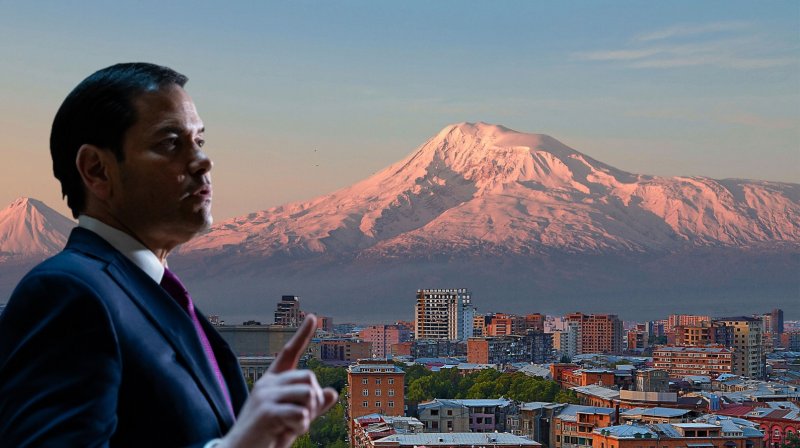
US Secretary of State Marco Rubio’s visit to Armenia is being viewed as a significant development in the changing geopolitical balance of the South Caucasus. Washington’s efforts to strengthen political ties with Yerevan indicate that Armenia is choosing a new direction in its foreign policy. According to experts, this process is not only about the development of diplomatic relations but is also part of a broader strategy aimed at weakening Russian influence in the region.
In recent years, the pro-European integration trends observed in Ukraine, Georgia, and Moldova have now become clearly visible in Armenia as well. The Nikol Pashinyan government argues that Russia’s security umbrella has failed to fully guarantee Armenia’s interests and presents closer cooperation with the West as a strategic priority.
Rubio’s visit is also being interpreted as a political support from the US administration for Pashinyan’s government. Analysts believe that the upcoming elections will determine Armenia’s future geopolitical course and directly affect stability in the South Caucasus.
Zaur Mammadov, an associate professor at the Academy of Public Administration under the President of Azerbaijan and chairman of the Baku Politologists Club, told News.Az that the gradual shift of former Soviet states towards European integration has been an ongoing process for many years.
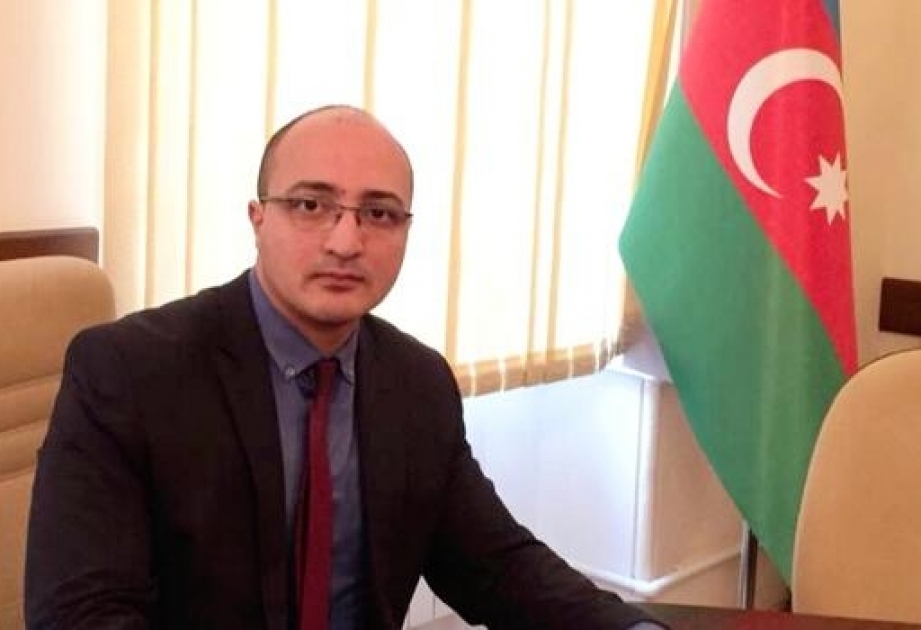
Photo: Zaur Mammadov, an associate professor at the Academy of Public Administration under the President of Azerbaijan and chairman of the Baku Politologists Club
The political analyst noted that the developments in Ukraine, Georgia, and Moldova were not accidental. “The revolutions that took place in those countries were not accidental, and if certain steps had been taken by Russia in time, perhaps we could have seen those revolutions quickly turn into counter-revolutions. However, various mistakes, together with the stronger and more attractive appeal of Western ideology and the Western idea, eventually led to changes in political power. Later, those governments actively promoted pro-Western narratives within their societies, which further strengthened pro-Western tendencies,” he said.
According to Mammadov, similar developments are now being observed in Armenia. “This time, the elections in Armenia are essentially following the same scenario we witnessed in Moldova several months ago, when society was faced with a dilemma between Russia and Europe. Today, in Georgia, Ukraine, Moldova and Armenia, people are no longer voting only for individuals or political parties,” he said. “They are also voting either for European integration or for closer relations with Russia.”
The expert said Armenia is currently undergoing a serious period of transformation. “Today, Armenia is experiencing a profound transformation process, and Nikol Pashinyan states that being under Russia’s umbrella until now has not brought Armenia true independence,” he said, adding that Pashinyan argues Armenia should now turn toward Europe and believes that strengthening independence and sovereignty will be possible under the umbrella of Europe and the United States.
The political analyst also commented on Marco Rubio’s visit to Armenia, saying that even though it lasted only a few hours, it still served as a signal that the US administration supports Pashinyan in the Armenian elections. “Previously, we also witnessed propaganda campaigns by various European Union politicians in support of Armenia’s prime minister and ruling party,” he said.
Mammadov stated that Russia is also sending direct messages regarding developments in Armenia. “Against this backdrop, officials from the Russian Foreign Ministry, representatives responsible for the economic bloc, and figures overseeing military security have openly declared over the past week that Armenia’s economy would not survive without Russia,” he said. The expert further stressed that this would affect the social situation of the population, noting that Armenia as a state would face serious difficulties.
He emphasised that major powers are openly trying to influence the elections. “As we can see, the European Union, the United States, and Russia are openly attempting to influence voters and make public statements to ensure the victory of their preferred candidates,” Mammadov said.
According to the political analyst, the key issue is how the elections will affect Armenia-Azerbaijan relations. “The main question for us is how the results of the 7 June elections will affect Armenia-Azerbaijan relations and regional stability,” he said.
“If Armenian society faces a dilemma, then first of all it must clearly understand what it is voting for, whom it is voting for, and what kind of Armenia it is choosing,” the expert noted.
Mammadov stressed that the main issue for Azerbaijan is Armenia’s complete abandonment of territorial claims regarding Karabakh, while the problems between Russia and Armenia are an internal matter for those two countries.
“What matters to us is the permanent abandonment of claims regarding Karabakh, the adoption of a new constitution, and the complete elimination of anti-Azerbaijani claims. Time will show whether Armenian society is truly ready for this,” he said.
The expert noted that the current Armenian government does not openly claim Azerbaijani territories. “Today, Nikol Pashinyan’s government does not claim Karabakh or Azerbaijani territories and states that it is ready for constitutional changes. However, time will show what direction it may move toward in the future once it becomes stronger,” the expert added.
The political analyst believes Azerbaijan must continue its current course of development under all circumstances, strengthening its economy, army, and development across various sectors.
“We understand that our neighbour is Armenia, and regardless of which geopolitical umbrella it chooses, it will continue acting as an instrument of outside powers,” he said.
Mammadov added that geopolitical competition in the region has existed throughout history, and battles for Zangezur, struggles over oil and gas resources, and the fight for Baku oil have historically demonstrated how different countries aligned themselves with competing sides.
He also said that historical processes continue in different forms even today. “Today we celebrate our Independence Day. In 1918, there were also European forces that did everything possible to prevent Baku oil from belonging to the Azerbaijani state and people. Various Western countries participated in those processes as well,” he said.
The political analyst stated that there are still many forces opposed to peace in the region. “Thirty years ago, we witnessed similar scenarios in different forms. We also observed how regional countries approached developments in the region,” he said.
“Many regional and international actors do not want peace between Azerbaijan and Armenia because each side has its own interests,” the expert noted.
Mammadov called on Armenian society to approach the upcoming elections “seriously” and “responsibly”. “More importantly, if they fail to come to their senses, Azerbaijan may have no choice but to take certain steps,” he said.
In conclusion, the expert stressed that the upcoming elections carry strategic importance for the entire region.
“Even without looking too far into the future, we can confidently say that these elections will directly affect stability in the region,” he noted.


Similar news