Failed martial law attempt in South Korea: Causes and consequences


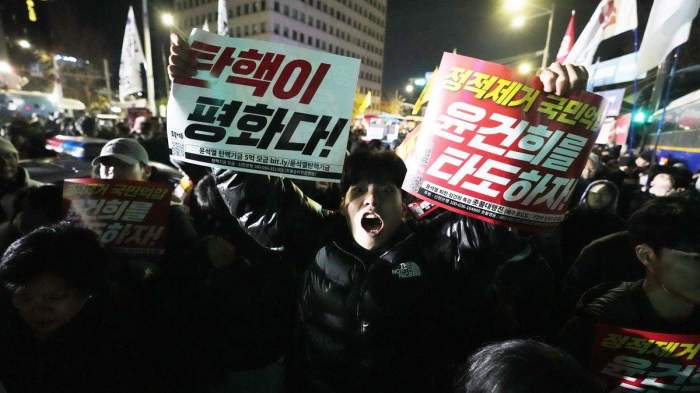
A man shouts to demand South Korean President Yoon Suk Yeol to step down in front of the National Assembly in Seoul, South Korea on Wednesday (December 4, 2024). | Photo Credit: AP
An unexpected attempt by South Korean President Yoon Suk Yeol to impose martial law ended in failure just six hours later.
The country's parliament voted to repeal the declaration, forcing the president to back down under pressure from lawmakers and the public. This event has become yet another episode in a prolonged political crisis that has gripped the nation in recent months.The martial law declaration , announced by Yoon Suk Yeol late Tuesday evening, was ostensibly aimed at protecting the constitutional order from threats posed by North Korea and "anti-state elements" within the country. In a televised address, the president cited North Korea as a direct danger and accused internal political forces of undermining legitimate institutions of power.
The decree, signed by General Park Ahn-soo, outlined measures such as full control over the media, a ban on political activity and protests, and authorization for warrantless arrests. However, this sparked fierce opposition from both the ruling party and the opposition.
By Wednesday morning, the situation had escalated: protesters gathered outside the National Assembly building, military forces attempted to enter the premises, and lawmakers erected barricades to block them. The Democratic Party, which holds a parliamentary majority, swiftly convened a session to vote on overturning the martial law declaration. Ultimately, 190 out of 300 legislators voted in favor of its repeal. The military withdrew from the parliament’s grounds, and the president conceded to the National Assembly's decision.
South Korea is experiencing one of its most severe political crises in decades. In the spring, the Democratic Party achieved a sweeping victory in parliamentary elections, securing 192 out of 300 seats. This gave them the ability to block the president’s initiatives, forcing Yoon Suk Yeol to frequently veto legislation.
The president's party, People Power Party (PPP), has lost public trust, leading to the resignations of its leader Han Dong-hoon and Prime Minister Han Duck-soo. The situation is exacerbated by scandals surrounding the presidential administration. For instance, First Lady Kim Keon-hee has come under scrutiny for her lavish gifts, tarnishing the president’s reputation further.
In his speeches, President Yoon Suk Yeol has repeatedly accused parliament of undermining the constitutional order. He claims the opposition is paralyzing the state's operations by initiating impeachment proceedings against high-ranking officials, including the defense and interior ministers. Since his administration took office, 22 impeachment processes have been initiated.
Meanwhile, the opposition accuses the president of incompetence and failure to address economic and social challenges. Democratic Party leader Lee Jae-myung called the imposition of martial law an unconstitutional move, while even the head of the president’s party condemned the measure as unlawful.
The public response to the martial law declaration was immediate and intense. Protests outside the National Assembly united both supporters and opponents of the president. Chants such as "No to martial law" and "Down with dictatorship" reflected widespread concern over the potential return of authoritarian practices.
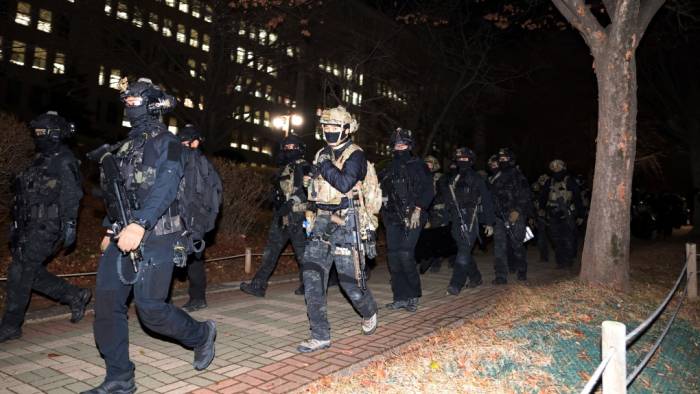
South Korean martial law soldiers leave the National Assembly in Seoul, South Korea, Wednesday, Dec. 4, 2024. (The Canadian Press/AP-Yonhap, Kim Ju-sung)
According to South Korea’s Constitution, martial law can be overturned if a parliamentary majority demands it. This mechanism worked as intended but revealed the fragility of the nation’s political system, where tensions between branches of government have reached a breaking point.
The imposition of martial law in South Korea brings to mind the events of 1979, when martial law became a tool for political control following the assassination of dictator Park Chung-hee. Today’s events underscore that such measures face strong resistance in a society that has become deeply committed to democratic principles over the past decades.
The failed attempt to impose martial law has dealt a significant political blow to President Yoon Suk Yeol. The opposition, sensing his vulnerability, has already announced plans to initiate impeachment proceedings if he does not resign voluntarily. Amid growing public discontent and intensifying protests, the prospects for political stability in South Korea appear bleak.
The nation faces not only the challenge of overcoming the current crisis but also the urgent need to reevaluate mechanisms of governance to prevent similar situations in the future. Without such reforms, the conflict between the executive and legislative branches is likely to escalate further.
(If you possess specialized knowledge and wish to contribute, please reach out to us at opinions@news.az).


Similar news